

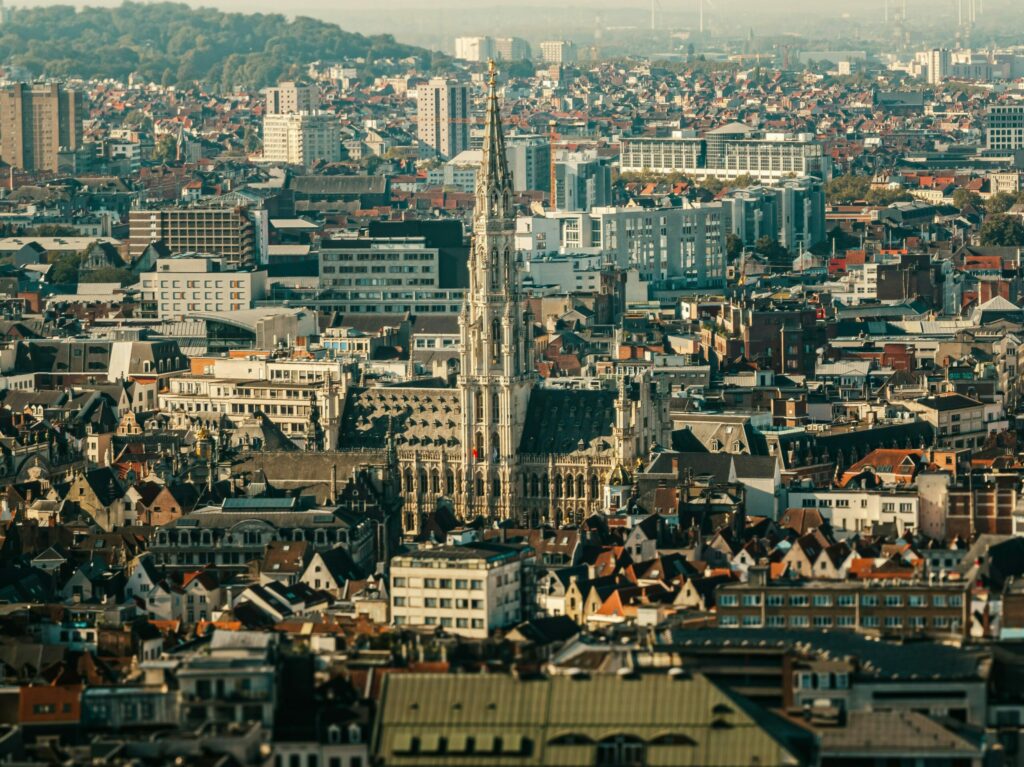
While some celebrate Brussels’ growth, others see a city buckling under poor governance and misplaced priorities.
A few weeks ago, Philippe Van Parijs published an opinion piece with the provocative title "The price Brussels pays for its success." I strongly disagree with most of his arguments and proposals and found that piece painfully disconnected from the harsh reality of political incompetence and irresponsibility that we are witnessing today, ruining the Brussels Capital Region dangerously close to collapse.
Van Parijs bases his definition of "success" on the population growth of the Brussels-Capital Region, a thesis defended by Harvard economist Edward Glaeser. Van Parijs notes that Brussels has grown faster than Flanders and Wallonia since 2000, but this comparison is misleading.
The Van Parijs Brussels
Firstly, Philippe is comparing the population growth of a large metropolis with two vast and partly rural areas, certainly in the case of Wallonia. Moreover, the choice of starting point is misleading because, as he himself points out, the population of Brussels declined sharply between 1970 and 2000.
If we were to make the comparison from 1970 to the present, we would see a very different picture. Brussels grew by 17% during that period, while Flanders grew by 27% and Wallonia by 17%.
The truth is that from 2000 onwards, Brussels simply caught up to its previous level, mainly thanks to international migration.
This trend was not unique to Brussels, but could be observed across all major cities in North-Western Europe, which proved to be a kind of "natural" magnet for migrants, who tend to arrive in big cities first and often move to the periphery or even rural areas later on.
It's exactly this fast growth of international migration in big cities that fuelled far-right movements in many European countries.
Van Parijs then claims that since 2000, many people have left Brussels with more skills and higher incomes, but that Brussels has not been able to reap the benefits of this. He also points out that housing in the city is more expensive, which is why many people are leaving the city. But this is not a phenomenon unique to Brussels either, and can be observed in any large city.
Housing in the city is simply more expensive because the commute to many jobs is much shorter and it is possible to live without a car, which is often a hidden cost for those who leave the city.
When it comes to education, it is a fact that more and more parents want their children in Brussels to become bilingual in French and Dutch, and even functionally trilingual, because who does not want their children to master English as well?
Dutch-language education seems to be doing reasonably well in this respect, while French-language education still mainly produces monolingual French-speaking pupils who do not speak Dutch at all and have little command of English.
It is true that Dutch-language education in particular is struggling to find enough teachers. This is partly due to its growth, but also to the fact that Brussels falls short in many areas when it comes to convincing these teachers to come and live in Brussels.
A city that pushes people away
Brussels faces deeper issues that go beyond education. Expensive housing is not the main cause of the problem, but rather the lack of safety, cleanliness, and bilingual services in both the public and private sectors. Today, Brussels is still doing far too little to make Dutch speakers feel comfortable and at home in the city.
His next proposal, to allow veiled policewomen as a way of promoting safety, comes as a big surprise. Does he really believe that in some neighborhoods the police are seen as a "Foreign Legion" simply because there are no veiled policewomen? If that is really the view of the police, which I doubt, then is the problem really with the police or rather with the mentality of the population in those neighborhoods?
As far as the electoral system is concerned, the proposal by Van Parijs and seven other professors to work with a single joint electoral college certainly has some merit. However, the proposal remains completely blind to the political balance of power in this country. After all, a change to the Brussels electoral system can only be approved by a two-thirds majority in the national parliament.
Brussels is, after all, the capital of Belgium, and a compromise between the two major language communities will always be necessary for any substantial reform of Brussels, whether Brusseleers like it or not. In the federal parliament, N-VA and VB combined hold almost one-third of the seats and could block any reform.
In Van Parijs' proposal, both parties risk simply disappearing from the Brussels parliament. Why on earth would they ever approve such a proposal? And does Van Parijs really think that other Flemish parties such as Open VLD and CD&V would approve such reform against N-VA?
In addition, he also wants to extend voting rights to the 40% (actually, 37% is the correct figure) of non-Belgians. But he himself states that 15% of the population of Brussels speaks neither French nor Dutch. Isn't it perhaps a basic requirement for being a citizen in a democracy that one has at least some connection with the local society?
Let's not forget that a large part of the European population of Brussels is here on a temporary basis. Sometimes for three years, sometimes five or ten, but rarely for life. On what basis should temporary visitors be given the democratic right to determine the long-term future of this region?
This is not the case elsewhere in Europe either. Foreigners can vote for the local council, but even that is only done by a small minority of Europeans (17% to be exact).
Is civic will enough?
Finally, Van Parijs ends with a call to "ordinary Brussels residents" to take action every day to improve the city. That all sounds very nice, but it completely ignores the total political incompetence and irresponsibility that has plagued this city for the last 10 years with bloated administrations and failed projects, such as the long-delayed Metro 3.
Just to give a recent example, last year the Brussels Capital Region only invested €3.2 million in road maintenance, but plans to spend €35 million of subsidies each year for Kanal, a new modern art museum.
How much longer must Brusseleers endure such irresponsible political choices? How long must they watch a government overspend by 25% of its public income, while politicians block each other through petty power games?
The solution to the current deadlock is not for ordinary Brussels residents to try harder, but for the political class to finally find a way to govern this region properly, with respect for the existing rules on the representation of the two major communities in this country. If that really cannot be achieved after more than 555 days, a temporary federal takeover is the last resort to save this city from total ruin.
