

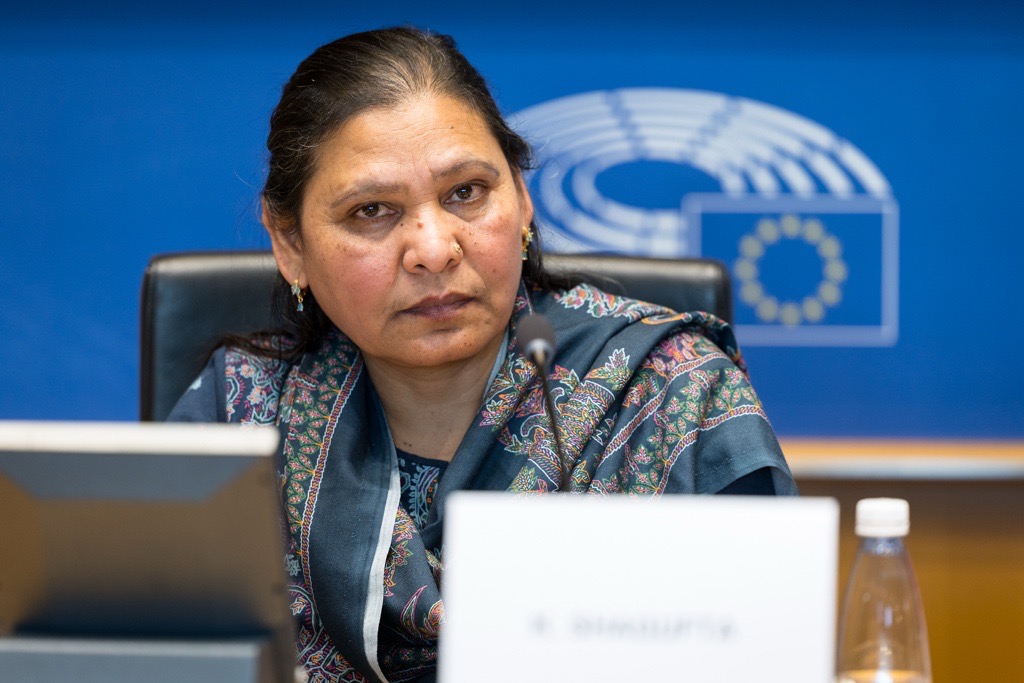
When I hosted an event in the European Parliament earlier this month, together with my colleague MEP Bert-Jan Ruissen, the room fell silent.
Standing before us was Shagufta Kausar, a Pakistani mother whose voice trembled as she said: “Without the resolution, my children would have grown up as orphans.”
Shagufta and her husband, Shafqat Emmanuel, spent years on death row for a “blasphemy” offence they never committed. Their appeal had been delayed again and again.
Everything changed in April 2021, when the European Parliament adopted a resolution explicitly naming them and warning Pakistan that ongoing abuses against religious minorities could jeopardise its preferential trade status with the EU. Within weeks, the Lahore High Court finally heard their case and acquitted them on 3 June 2021.
This was not diplomacy in theory, it was diplomacy that saved lives. And today the European Union once again holds real leverage. This time, the stakes are the futures of hundreds of Pakistani girls who fall victim to abduction, forced conversion, and coerced marriage every year.
Pakistan’s child victims of forced marriage and conversion
In Pakistan, children – some as young as nine – are snatched from their families, pressured into signing statements they cannot read, and forced into “marriages” with men twice their age.
Many of these cases involve girls from religious minorities, especially Christians. Rights groups estimate that around 1,000 minority girls face forced marriage and conversion annually.
Pakistan’s courts are able to intervene, as the 2025 case of 14-year-old Catholic girl Elishba proved. A magistrate in Punjab refused to return her to the man who kidnapped, converted, and “married” her, ruling that a minor’s supposed consent has no legal validity and that the marriage was unlawful.
This is what justice looks like when the law is applied with integrity. But it is the exception, not the rule. Far too often, police ignore evidence, courts decline to verify age documents, and judges return girls to their abductors over the desperate objections of their families.
Pakistan’s patchwork of laws – some setting 18 as the minimum marriage age, others allowing exceptions under religious rules – creates fertile ground for abuse.
A uniform national minimum marriage age of 18 would not solve every problem, but it would close one of the most dangerous loopholes enabling forced marriage and forced conversion.
Trade privileges give the EU unmatched influence – if we choose to use it
The European Union is not an observer in this story. It is Pakistan’s most important trading partner. Since 2014, Pakistan has enjoyed the benefits of the EU’s GSP+ programme, which provides duty-free access to a large portion of the EU market in exchange for adhering to 27 international conventions on human rights, labour standards, and good governance.
These trade benefits have reshaped Pakistan’s economy. In 2023, EU imports from Pakistan reached €8 billion – €6.2 billion of which entered under GSP+ preferences. Pakistan is the single largest beneficiary of the scheme.
But GSP+ is not unconditional. Earlier this year, EU officials visiting Islamabad explicitly warned that Pakistan’s continued access to these benefits depends on concrete reforms, particularly in areas related to blasphemy laws, forced conversions, and women’s rights.
Europe has leverage. The question is whether we will use it.
Turning the Parliament’s moral voice into binding reform benchmarks
The 2021 European Parliament resolution that helped free Shagufta and Shafqat demonstrated the impact of linking human rights to trade. But we cannot stop at isolated success stories. We must translate moral appeals into enforceable conditions.
As the EU reviews Pakistan’s GSP+ performance for 2024–2025, it should require specific, measurable reforms that directly address the plight of vulnerable girls.
Some positive steps are underway, including proposals to raise the marriage age to 18 nationwide. But in Punjab – the most populous province and the epicentre of forced marriage cases – the reform bill remains stalled.
A strong Punjab law establishing a minimum marriage age of 18, with no religious exceptions, must be a core requirement for continued GSP+ privileges. Additional benchmarks should include:
- mandatory age verification in all marriages,
- full legal recognition that minors cannot consent to sex or marriage,
- enforceable protocols for police, prosecutors, and judges handling abduction and forced conversion cases.
These are not foreign demands. They reflect Pakistan’s own laws, constitutional commitments, and international obligations.
If we call ourselves human rights champions, now is the moment to prove it
The European Union prides itself on defending freedom of religion or belief worldwide. But that claim carries weight only if it is backed by decisive action when it matters most.
Today, this responsibility lies before us. We can stand with the Pakistani lawyers, activists, judges, families, and – above all – the girls who are fighting for their basic human dignity.
Shagufta’s story reminds us what is possible when Europe chooses to act. The consequences are real for people far beyond our borders – people with names, families, and futures that depend on our resolve.
We now have the chance not only to protect one family, but to prevent a generation of girls from being trapped in what amounts to a lifelong sentence disguised as marriage.
We must take that opportunity – not later, not in the next review cycle, but now.
