

Adolf Hitler was on his way to victory. France had fallen. The RAF had just barely fended off the Luftwaffe in the Battle of Britan, but British cities were now suffering the Blitz.
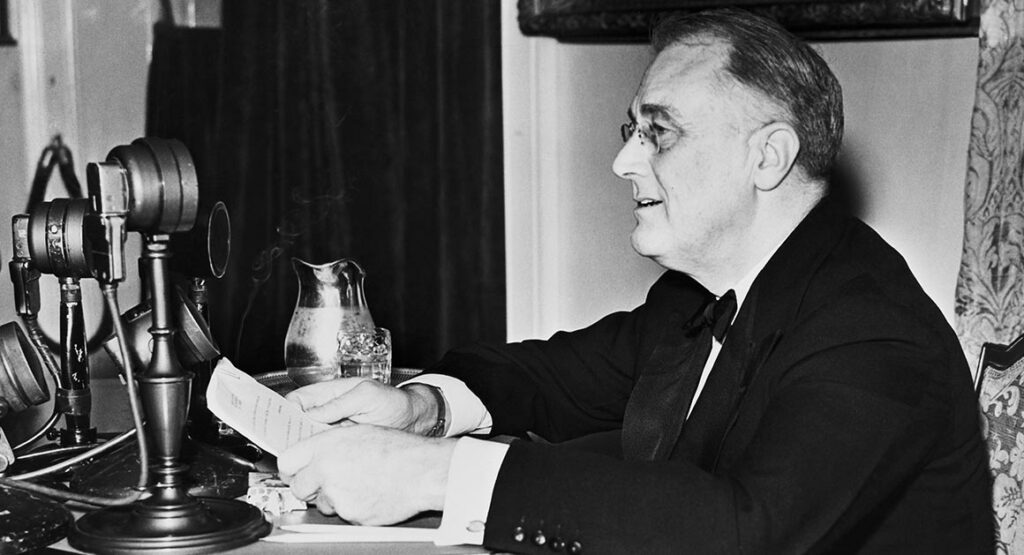
It was 85 years ago on December 29th, 1940, when defeat looked certain that President Franklin D. Roosevelt made his famous ‘Arsenal of Democracy’ speech. In it, he called upon US industry to massively accelerate its arms production, so America could come to the defence of democracy in Europe.
He addressed the nation by radio: “The people of Europe who are defending themselves do not ask us to do their fighting. They ask us for the implements of war, the planes, the tanks, the guns, the freighters which will enable them to fight for their liberty and for our security.”
FDR argued that this was directly in America’s interest given the imperial aggression of the Axis powers of Germany, Italy and Japan and the implications for the Western Hemisphere.
He proclaimed: “We must be the great arsenal of democracy.”. This speech did stir America’s industrial might into action, with the Lend-Lease Act passed a few months later. The US role of course then proved decisive in winning WWII.
The geopolitical parallels with today are clear, as Ukraine fights for its life against a Russian-Chinese axis. If Russian aggression succeeds, it will have serious implications for democracy and prosperity on both sides of the Atlantic.
Unfortunately, instead of confronting Putin in Europe, President Trump today seems to appease him at every step. But as FDR said: “There can be no appeasement with ruthlessness.”
President Trump’s recent 20-point plan for Ukraine was seen by many as Russian inspired. The US National Security Strategy published earlier this month was a shock to all of us in Europe who believe in the transatlantic relationship. It reads like America’s resignation letter from global leadership.
How could this be happening? America was for so long a beacon of democracy for the world. One reason might be that, as in 1940, we are swamped in disinformation and foreign election interference. In recent days, the US even placed sanctions on a former EU Commissioner for doing his job tackling disinformation. Europe is wondering how much of the world has turned so pro-Russian so quickly.
In his speech, FDR said of people working for the Axis powers: “Their secret emissaries are active in our own and in neighboring countries. They seek to stir up suspicion and dissension, to cause internal strife. They try to turn capital against labor, and vice versa. They try to reawaken long slumbering racial and religious enmities which should have no place in this country. They are active in every group that promotes intolerance.”
That echoes still today, with well documented Russian interference in American and European politics, just using new online tools.
Many Americans will legitimately ask why should they pay their tax dollars to help fight Putin in Europe? In 1940, FDR’s argument was that if the Axis powers dominated Europe and Asia, then the US would be economically, politically and eventually even militarily threatened in its home continent. This logic still applies today.
If Russia and Russia-friendly parties dominate Europe (and some are leading in national polling), and if China dominates Asia - then similar pressure will bear down on the Western Hemisphere.
Does America want to continue to lead, standing as a democratic beacon as it did during the 20th century? Under President Trump, it seems not. Those who drafted the National Security Strategy, or people like Elon Musk, could have been considered appeasers in 1940. FDR said of appeasers:
“They say that we can and should become the friends and even the partners of the Axis powers. Some of them even suggest that we should imitate the methods of the dictatorships. Americans never can and never will do that.”
Normally, now a call to action from the White House would be required, for the President to rediscover the bold global leadership of FDR. But President Trump is no FDR.
President Trump clearly hates the European Union. After working on both sides of the Atlantic to support the Allies during WWII, Jean Monnet became the main architect of European political integration, which is now the EU. He coined the phrase ‘arsenal of democracy’ used by FDR. Speaking in 1952, Monnet identified that strong institutions must carry wisdom through the generations:
“The tragic events we have experienced and those we are experiencing now may have made us wiser. But we will pass away, others will come to replace us; we will not be able to leave them our personal experience because this experience will disappear with us. What we can leave to them are institutions.”
Let us hope, as we move into 2026, that the great institutions of America can rediscover the spirit of FDR and the US can again become an arsenal of democracy.
The future of the Western world depends on it.
