

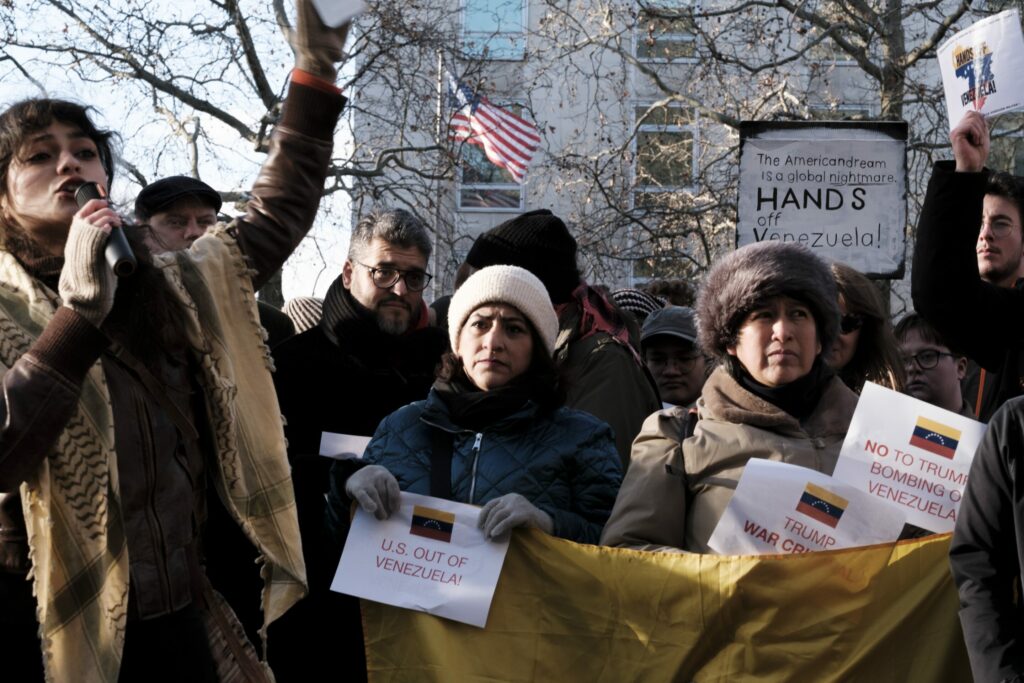
No, it’s not Iraq in 2003… Yes, the U.S. is dreaming up weapons of mass destruction.
The capture and extradition of Nicolás Maduro in Caracas, Venezuela at the behest of Donald Trump and his acolytes evoke mixed feelings. On the one hand, the ouster of Maduro, who has grossly mismanaged his country since inheriting it from Hugo Chávez, is a reason to celebrate for Venezuelans and all lovers of democracy. On the other hand, the show of force by the U.S., was absolute, ruthless, and without regard for international law, sets a dangerous precedent.
The U.S., with its immense military power on full show in Caracas on January 3, is no stranger to laughing in the face of international law in pursuit of regime change and oil. Trump’s speech following the capture showed plainly that he plans to act with impunity at home and abroad.
While the allusion to the Iraq War is relevant, two aspects of Maduro’s capture are strikingly different. First, the operation was surgical, not a drawn-out conflict; It displayed the kind of military superiority “strongman” leaders would envy. Second, the U.S. administration’s mentality in Venezuela is different. Trump and his administration don’t have to “sell” the U.S. public or the world a story of WMDs as they did in 2003.
The might of the U.S. military and the brashness of the person at its helm are enough, in Trump’s opinion, to justify any action anywhere.
Europe must prepare for shifts
What should we make of this in Europe? First and foremost, and echoing the sentiments of many, the time for condemnation and “strongly urging restraint” is over. Trump has shown that he has no reservations when it comes to exerting the full force of the U.S. military to carry out his expansionist and interventionist goals. This should strike fear into the hearts of those who support liberty and democracy.
Take, for example, Greenland. The rhetoric from the Trump Administration towards the Danish Kingdom is inflammatory and not all that different from those made about Venezuela. His references to the Monroe Doctrine and his designation of Greenland as necessary for U.S. defense are rightfully concerning in Copenhagen and Brussels.
While the issue remains, for now, in diplomatic channels, this is still a direct attack on the U.S.’s oldest continuous European ally. It is a sick irony that military leaders in Copenhagen may be secretly relieved to see U.S. aircraft carriers tied up in the Caribbean rather than steaming north towards icier waters. But what seemed not so long ago as a wholly imaginary scenario is now a real possibility. If the U.S. were to take action to seize Greenland against a longstanding and loyal ally, it would not simply upend the world order; it would attack its very heart.
There have been many strong and well-reasoned statements made by European leaders on Venezuela and Greenland. But what will come of these statements in the face of someone who is seemingly deaf to reason? Despite their numerous shortcomings, Europe need not abandon its altruistic objectives. But policy in Brussels must now be grounded in strategic realism.
Trump has shown that diplomacy must be backed by deterrence. He may balk at Teddy Roosevelt’s famous quote, “speak softly and carry a big stick”, but this is exactly what Europe must do to counter his “yell loudly and carry a big stick” tactic. It is, and always will be, a time for diplomacy, but we should be wary, from Bogotá to Brussels, that Copenhagen could be the next Caracas.
When strategy becomes force
The Trump Administration will continue its charge across the globe to consolidate power and wealth through force, social media, and means not yet visible. While the thin red line metaphor is perhaps overused, it remains appropriate in an era where a leader commanding the most advanced military in history laughs in the face of cooperation. When that leader frames Greenland as a prize, he frames Europe as an adversary. Europe can ill afford to bend the knee.
The capture of Maduro may slip to the middle pages amid the pace of the news cycle. The proliferation of wars and the persistence of vast global tragedies and suffering mean this may be little more than a footnote in Trump’s second term. But this comprehensive rejection of the global order and international law signals a shift in U.S. foreign policy unlike anything seen in the 21st century.
The world order since World War II has failed billions, but it has also brought extraordinary progress. I will neither defend its evils nor sanctify its successes, but its wholesale destruction at the behest of the U.S. government will benefit few and harm many. The accumulation of wealth and power and the rejection of norms by the Trump Administration therefore present a collective threat to Europe and the world.
We live in an age where there are no certainties. It is frightening, confusing, and ripe with contradictions. In this chaos, Europe cannot lose faith in the fundamentals of international cooperation. It must continue a collective effort to build a more just and inclusive world. But cooperation without resolve is hollow: Europe must speak softly and carry a big stick.
