

I once believed that what I saw would endure simply because I had witnessed it. As a child in Tangier, I thought memory itself could hold the world still. It could not.
The moment the black Fiat 124 struck me on the Route de Tetuán, time fractured. One instant, the sky was flawless Moroccan blue and Mikki, my best friend, ran beside me chasing his horses. The next, the asphalt rose with terrifying speed. Shock crackled through me like electricity. Then came a silence so vast it seemed to divide one life from the next. Many thought I had died.
For weeks at Tangier’s small Al Kortobi Hospital, drifting in and out of consciousness, I wondered if I had. The world reached me only in fragments: light filtered through a low, arch-like window, the echo of footsteps in a corridor, a voice, perhaps my uncle Hadou, calling my name from very far away. Everything else was suspended.
The accident never receded into memory. It became a fixed point, a narrow passage through which everything else would later pass. Even now, in my troisième âge, that silence remains recognizable, a threshold crossed without ceremony. Only much later did I understand that surviving teaches a particular attentiveness to fragility, to chance, to others moving through the world unprotected. After it, time, place, and belonging no longer behaved as they once had.
A passage into fragility
Tangier in those years shimmered under Mediterranean light. Villages yielded slowly to the city’s appetite. Dust rose lazily in the countryside while birds circled high above the hills. Time moved with patience. Years later, Brussels would impose geometry. Canals ran straight as rulers, streets aligned with purpose. Order left its mark before I knew what it was teaching me.
I did not plan the mosaic that formed between these places. It assembled itself all the same.
Childhood summers in Tangier moved between two tempos. There was the countryside near the rare female Sufi shrine of Lalla Joumaa, where life followed agrarian rhythms shaped by season and light. And there was the city, pulsing and impatient, where roads appeared overnight and houses rose fast and haphazard.
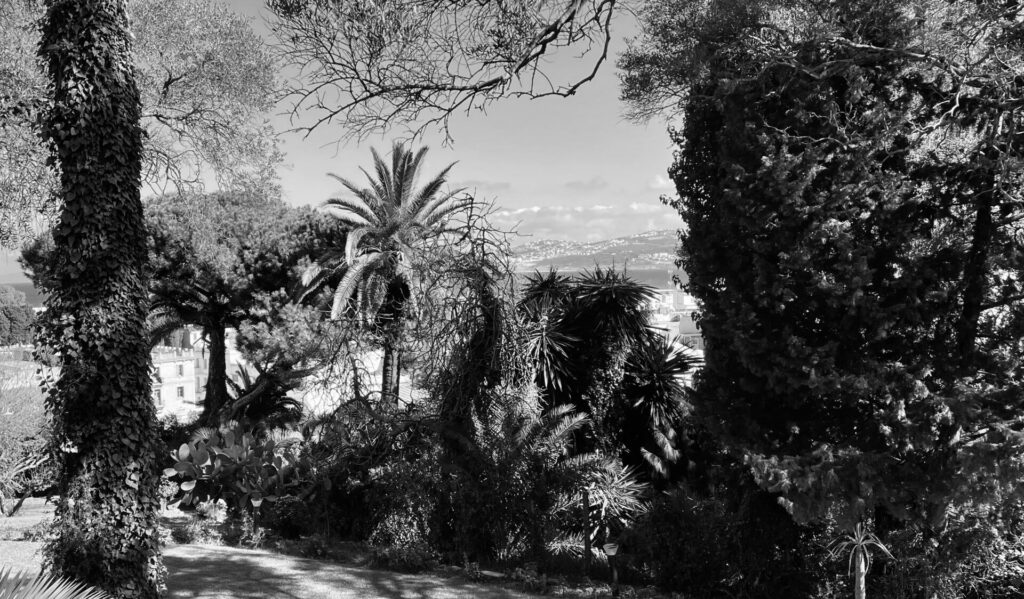
On certain nights, a narrow dirt road carried us up the mountain past rows of cypress trees toward a modest café perched at the peak. The Cypress Café was hardly a café at all, just a small bungalow where the qahwaji, seated cross-legged on the ground, prepared scalding mint tea with ceremonial care. He poured from high above, the stream landing perfectly in the narrow circle of the glass below, forming a rizza, a trembling crown of foam.
From there, surrounded by cypress, one could look down at the Plaza de Toros, the old bullring left from Spanish rule. From above it resembled a faded stone bowl, nothing like the imposing structure it became at street level. I never imagined the café could vanish. I only knew it as a place where thought loosened its grip. In a life that would later be shaped by movement, it offered a brief suspension, a quiet, inadvertent apprenticeship in stillness.
Below, workers paused at Hamadi’s cantina, where the village’s only telephone rang and the mail arrived. Olives, wheat bread, and bisara, a thick pea soup favored by laborers, were served to men whose mornings began while Tangier still slept. The cantina was a provisional home where hunger, news, and companionship gathered before dispersing again.
From the sea, Titan, the pale blue harbor crane, was the first and last thing we saw. It rose like the skeleton of a giant against the sky, measuring departures and arrivals with mute authority. I believed it permanent. I rested something essential on that belief.
Years later, returning from Belgium, we approached Tangier under familiar light. The sea had not changed. The hills remained where they had always been. But Titan was gone. Its absence did not announce itself. It simply failed to appear. What vanished with it was not just steel but the illusion that anything I witnessed would remain intact if I looked away. Tangier had continued without me. That quiet indifference unsettled me more than loss itself.
Crossing into elsewhere
Immigration came when I was ten. Titan was there when we departed in the spring of 1968, watching us embark toward expectation and uncertainty. Brussels received us without hostility but without warmth. To my eyes, it was dazzling. Trams ran on time. Canals held their lines. Rain hissed against stone streets. French and Flemish murmured everywhere, animated and incomprehensible.
There were challenges: forms that never fit our names, silences that stretched across classrooms, the quiet ache of being unrooted in the middle of childhood. Our saving grace was that we learned to carry these moments in the background, shaping the spaces between events rather than the events themselves. We came from a proud ancestral people and never allowed others to define us. We were survivors of the times, never victims. That distinction mattered. It gave us strength.
Winter arrived. Snow fell thick and deliberate, pressing the city into stillness. One school-free Wednesday, I followed other children to Parc Marie-José with a battered wooden sled. Sliding down the hill, snowflakes competing for space on my face, something loosened. Walking home with the sled over my shoulder, watching the snow melt into my sleeves, I understood, without words, that silence could be generous.
One evening, deep in winter, a tram lost power in a storm. A frail elderly conductor stepped out into the snow to reconnect the trolley pole to the wire above. Wind pushed against him. The pole slipped. He tried again. Inside the tram, passengers watched without speaking. At last, the lights flickered back on. A shy applause rose. Dank u. Merci. The conductor nodded slightly and returned to his seat, steering the tram back into the storm.
It was an unremarkable event, the kind that happened often in those winters. Yet it stayed with me. I see now why. Inside that stalled tram, dignity required no explanation. Belonging began before comprehension. I did not yet know the language, but I understood the obligation, how attention itself could be a form of respect, and restraint a quiet kind of ethics.
At school, Madame Hontoit noticed my confusion and guided me gently. Un pas à la fois. One step at a time. At home, my mother rebuilt Morocco with turmeric, tagines, saffron, mint, and olive oil. Her kitchen became a narrow bridge between continents. During Ramadan, bowls of harira traveled to neighbors’ doors. She believed generosity could outlast geography, though it demanded effort each time it crossed a threshold.
The geography of becoming
Later, Boston became another landscape of adaptation. The rhythm of streets and the breath of the Charles River filtered through memories of Tangier and Brussels alike. Wet leaves near Fresh Pond, the rattle of the Red Line, the Salt and Pepper Bridge, all entered my consciousness through older places. I could be many things at once but never singular. Singularity, I came to see, is a luxury reserved for those who remain.
Each summer, I returned to Morocco. Each year, Tangier grew larger and less intimate, reshaped by progress. I admired families like the Mikkis, rooted for centuries, who resisted change not with protest but persistence. Persistence, I learned, is not always chosen. Sometimes it is simply the shape necessity takes. Distance made admiration easier. Endurance belonged to those who stayed, and it carried its own constraints.
Nearly sixty years have passed since the accident, since the Tangier of my childhood. Brussels and America built bridges between my many selves, yet Tangier remains the ground beneath them all. To speak of it now is to speak of memory altered by movement, of love that survives precisely because it cannot be recovered intact.
Today, I return more often, sometimes with Mikki, still here, still steady, a reminder that friendship can be more reliable than time. I do not return to reclaim what was lost but to understand what still holds.
The city is louder now, taller, more impatient. Yet in late afternoon, when the wind shifts and the light softens, something familiar returns: the rustle of cypresses, the distant echo of hoofbeats, the call to prayer drifting across the valleys.
Standing there, I understand that what I once called home was never fixed. It lived in repetition and gesture, in the pouring of tea, in a tram stalled in snow, in a kitchen scented with ginger and mint. Movement did not erase it. Movement taught it how to travel.
With each journey, belonging learned to endure, never permanent, never guaranteed, but momentarily real. In memory, Titan rises again, not as steel but as witness. Between departure and return, between love and loss, the Cypress Café remains a place where time once paused long enough for a life to take shape, and where belonging still feels, briefly, possible.
