

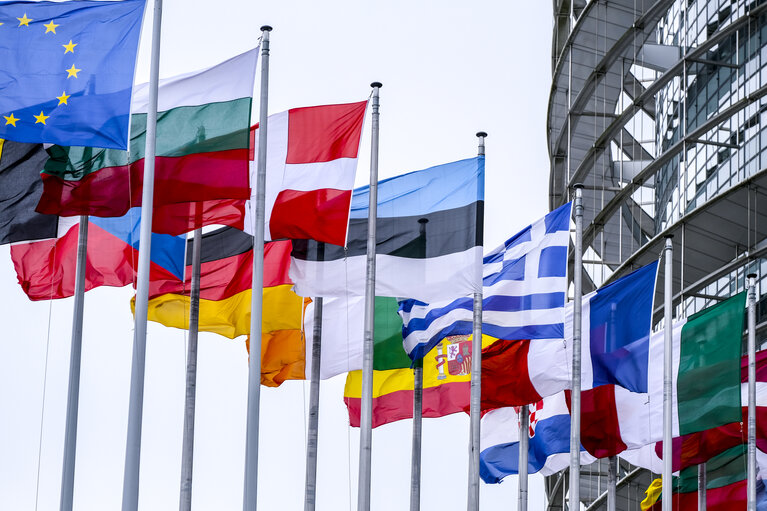
The European Union’s linguistic diversity, long celebrated as a cornerstone of its identity, has also become a weakness.
In an era defined by geopolitical instability, economic rivalry, and the urgent need for a cohesive defence strategy, the EU’s lack of a common working language is more than an administrative nuisance. It is a hindrance to the integration of its economies, it slows the growth of companies that can become world leaders, and it adds friction to the free movement of labor. Moreover, it will be a significant weakness when the EU finally concludes it needs to create its own armed forces.
The latest EF English Proficiency Index paints a mixed picture. While countries like Germany, the Netherlands, and Austria maintain strong English skills, others with large populations like France, Italy, and Spain remain behind. COVID made matters worse. Younger adults—those who should be the most globally connected—have yet to regain the proficiency levels they held before the pandemic.
In a world where the US and China operate with the agility of a single language, there is no EU-wide mandate to ensure English proficiency. European leaders should be thinking in 10-20 and 50-year horizons, as the Chinese have done so successfully. It is striking that there is still no time frame for all public elementary schools in Europe to be fully bilingual, so children acquire a strong foundation when they are most receptive.
Imagine a European economy where every citizen, business, and worker could operate seamlessly across borders, unencumbered by language barriers. The single market’s potential—its promise of free movement, innovation, and shared prosperity—would be more easily realised. Instead, we have a system where businesses struggle to grow beyond their national borders, researchers face hurdles collaborating with peers, and labor is locked out of opportunities because they can’t communicate effectively in a common language.
Nowhere is the need for English more pressing today than in defence. The war in Ukraine has exposed Europe’s fragmented military capabilities. As the EU finally begins to invest in joint defence projects, from missile systems to armoured vehicles, seamless communication is imperative. Soldiers, logistics teams, and commanders must understand each other instantly, without the delays and distortions of translation. English is the only viable solution.
India’s experience with English offers an interesting example. Despite its colonial origins, English has become the backbone of India’s economic and social mobility. It is the language of the courts, higher education, and the booming tech sector. Arguably, without its labor force’s strong English skills, India’s economy might not have climbed from 13th to 5th largest in the world since 2000.
The EU’s reluctance to embrace English is more than a bureaucratic oversight—it is a strategic failure. In a world where the U.S. alliance is increasingly uncertain and authoritarian regimes exploit division, Europe cannot afford self-inflicted inefficiency. The EU must make English its lingua franca—not to erase its linguistic heritage, but to ensure it can function as a cohesive, competitive, and secure entity. The alternative is a Europe that speaks many languages but struggles to be heard. In today’s world, silence is subordination.
