

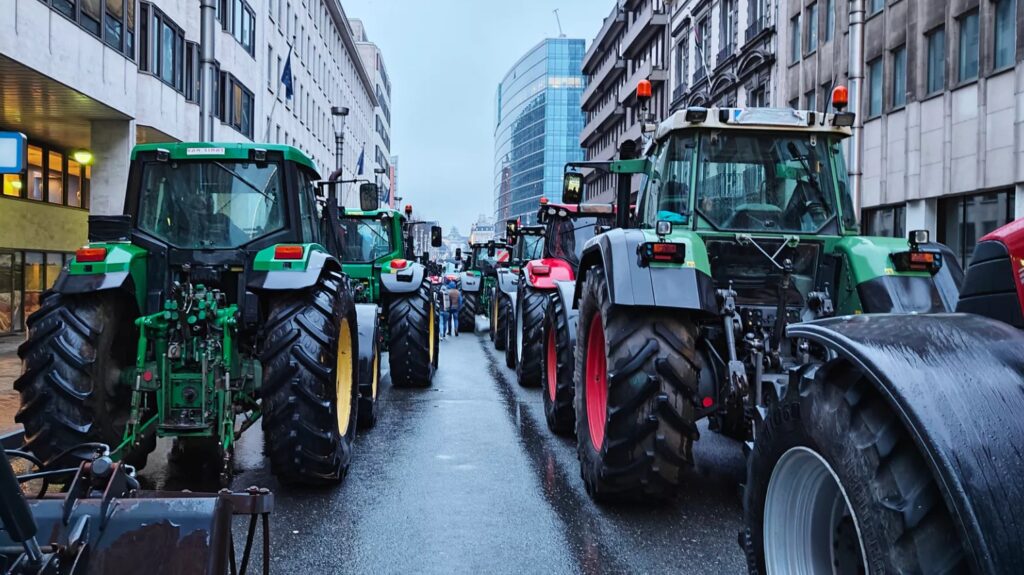
Brussels is undertaking an ambitious overhaul. It is simultaneously reshaping Europe’s trade partnerships, climate rules and food supply chains, even as the global economy splinters and geopolitical tensions boil over.
Each policy may sound good in a conference room. Taken together, however, they risk imposing a significant shock on Europe’s farming sector, without a clear roadmap for how it is expected to absorb the impact on competitiveness, food security, and strategic autonomy.
Central to the ongoing discontent with farmers is a widening gap between high-level policymaking and the realities of agricultural operations on the ground.
The recently inked EU-Mercosur trade agreement has become a lightning rod. Farmers across Europe fear that cheaper imports of beef, poultry, sugar, and grains from South America, produced under looser environmental and labour standards, will undercut domestic producers already operating on razor-thin margins.
Although the deal promises tariff reductions on 91% of EU exports over time, it appears more as a vulnerability to asymmetric global competition than a balanced diversification strategy, especially with ratification stalled by the European Parliament's referral to the Court of Justice, which may potentially delay implementation by a year.
At the same time, the EU is moving forward with its Carbon Border Adjustment Mechanism, or CBAM, a cornerstone of the bloc’s climate strategy. Intended to curb carbon leakage via tariffs on emissions-intensive imports, CBAM's rollout is already inflating costs across farmers' input chains, notably for fertilizers and other energy-dependent materials.
Despite pleas for exemptions, including from 12 member states and France's bid for a retroactive pause, the policy persists, fueling volatility.
And that pressure is already being felt. Fertiliser prices have surged over the past year, driven in large part by new EU duties on imports from Russia and Belarus imposed since mid 2025. While the political rationale is clear, the economic consequences are landing squarely on European agriculture.
At present, fertiliser prices have reached levels not seen since December 2022, during the gas shock after Russia’s invasion of Ukraine. Key products such as nitrogen, NPK and potassium chloride are now 60–100% more expensive than pre-war levels and almost 20% higher than a year ago. On top of that, the combined effect of CBAM implementation and rising duties on Russian fertilisers - from €40–45 per tonne to €65–70 planned for 1 July 2026 - could push fertiliser prices up by a further 20–25%, according to industry estimates.
Brussels’ latest proposal to cap Russian ammonia imports could worsen the situation. It threatens the supply chains of European fertiliser plants, including the one in Antwerp, that heavily rely on ammonia, and could further push fertiliser prices up. Replacing domestic production with expensive imports during a period of fragile food security risks a systemic collapse for the EU economy, while non-EU producers will keep utilising Russian ammonia.
This is not simply a question of farm incomes. Agriculture sustains rural livelihoods, regional cohesion and the EU's food sovereignty. Powerhouses like France, Italy, Germany, the Netherlands and Poland are among the bloc’s agricultural heavyweights. Large-scale disruption in these markets would ripple quickly through the wider European economy.
The stakes are rising. With spring sowing underway in February 2026, industry data indicates that elevated 2025 prices left many farmers with only about 60% of required fertilizer inventories by year-end.
Compounding the strain, the stalled EU–US trade agreement could see Washington impose additional tariffs on European agricultural exports to the United States, the second-largest market for EU farmers, worth around €25 billion annually. This could potentially cost the sector several billion euros in lost competitiveness and revenue.
A sensible move for the EU would be to adopt a more rational, self-interested approach: to formalize a temporary CBAM exemption for fertilizers, allowing time for alternative sourcing and market adaptation, and to put on hold additional pressure on Russian fertilizer imports, which are already declining under existing duties, however politically uncomfortable that may be. A managed transition is the only realistic way to prevent further price spikes without sacrificing longer-term strategic objectives.
Trade policy, climate ambition and geopolitical considerations all matter. But they must be sequenced and calibrated with economic reality. Farmers can't bear all burdens simultaneously.
For resilient food systems, producer viability is key. Neglect this, and noble policies could spark instability from fields to cities and the Union.
