

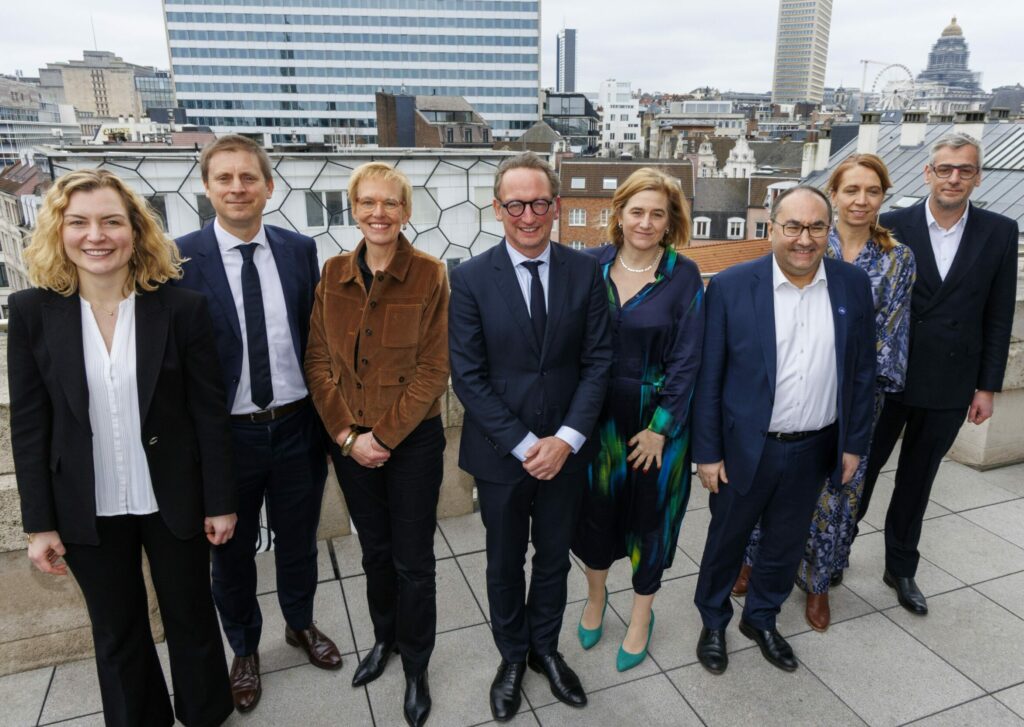
What no one thought possible happened last week. After 615 days, exactly one third of the legislative term, the Brussels Region got a new government. Some praise for the perseverance and initiative of George-Louis Bouchez (MR) is certainly in order.
For the first time, during the short, three-day conclave, but especially during the preparations, he showed that he is capable of keeping his often counterproductive temper in check. This is an important development in view of his burning ambition to one day become prime minister of this country.
How and why the Brussels negotiations suddenly rose from the palliative stage is not entirely clear. Behind-the-scenes talks between the MR, PS, and Anders, with CD&V in a supporting role, reportedly paved the way. The MR finally wanted to capitalize on its election victory, and the PS needed money for its struggling municipalities, social housing, and its pet project Kanal.
A preliminary agreement on budget tables was reached behind the scenes. It was very striking that Budget Minister Dirk De Smedt (Anders) suddenly announced at the end of January that the deficit for 2025 would be “only” one billion, 200 million less than previously assumed. This was a crucial difference that suddenly made it possible to reconcile the different positions. The MR and PS had already agreed on an effort of 1 billion, but for Anders, a balanced budget in 2029 was crucial in order to finally be able to sever ties with N-VA.
And so it came to pass, and in many ways the Brussels formation resembled the vaudeville that preceded the formation of the Vivaldi government. Then, too, there were almost 500 days of struggle between ‘purple-green’ (a coalition without N-VA) and ‘purple-yellow’ (a coalition with N-VA).
Then, too, time did its work, allowing Open VLD (now Anders) and CD&V to finally take ‘their responsibility’ and the PS to get what it wanted: a government without N-VA. The price for the Vivaldi debacle was sky-high, especially for Open VLD, which was battered during the elections. Similarly, the failure of the Brussels project could be fatal for the party. Not only in Brussels itself, but especially in Flanders.
The clever thing for Frédéric De Gucht (Anders) is that there is quite a bit of juggling with budget figures in Brussels. The promised budget balance in 2029 will only be certified by the Court of Auditors in November 2030, well after the regional and local elections. Based on what is currently known about the coalition agreement, there seems to be a lot of hot air in the budget again.
Anyone who remembers how the previous budget minister, Sven Gatz, insisted for years that there would be a balance in 2024 cannot help but be extremely skeptical about this optimistic liberal ambition. The deficit in 2024 ultimately amounted to 1.6 billion, more than 25% of revenue. Moreover, a balanced budget in 2029 was and is not a priority for any other coalition partner.
Budget promises under scrutiny
The intention to make significant savings in the Brussels administrations can only be welcomed. These had grown so much in recent years that the situation had become completely untenable. The only question is how this can be achieved without outright redundancies. The moratorium on new recruitment, which was introduced by Sven Gatz in 2023, has so far yielded little results. By the end of 2025, the workforce had been reduced by barely 121 FTE, a mere 0.5%.
No savings will be made on the STIB/MIVB (public transport), even though it is one of the biggest budget lines. Its budget has increased by almost 50% in recent years, while the number of passengers is still lower than before the coronavirus pandemic in 2019. Nothing will change in terms of the double layer between the region and the municipalities. On the contrary, the municipalities in financial distress will once again receive more money.
In short, the Brussels dice may have been cast, but the questions remain. Each party appears satisfied with the agreement, but the contradictory statements are so blatant that one wonders whether there is actually an agreement. Negotiations will have to be held every three months because hardly any specific agreements have been made, understandably so in just 3 days of actual negotiations.
It also remains a mystery how a balanced budget can be achieved by combining the PS's “no austerity measures” claim with the MR and Anders' “tax cuts for the middle class.” Even with a government, Brussels remains the epitome of Belgian surrealism.
A remarkable precedent is that, for the first time in the history of the Brussels Region, a French-speaking party (the PS) has succeeded in imposing the Dutch-speaking coalition. This also creates the very bizarre situation that the Dutch-speaking coalition of Groen-Open VLD-Vooruit has remained exactly the same as before the elections. Even the three ministers remain the same. Moreover, this means that the three governing parties represent only a minority of Dutch-speaking Brussels residents.
Only the parliamentary support of Benjamin Dalle (CD&V) makes this construction legally possible. Did this ensure that the voice of Dutch-speaking Brussels residents was sufficiently heard? Wasn't the lack of a full Flemish majority also Vivaldi's Achilles heel?
Time will tell how credible the figures in the coalition agreement are. For now, only the additional expenditure and tax cuts are concrete and clear. It would not be the first time that both revenues and potential savings are greatly overestimated in Brussels. The Region is governed by a political class for whom optimism is not just a moral duty but actually a way of life. Their trademark is political irresponsibility that borders on blatant negligence.
By 2029, the debt is likely to reach 20 billion, more than three times revenues. This illustrates above all the structural weakening of the Brussels Region, which has no answer to the endemic impoverishment of a large proportion of its population. As the smallest region, Brussels is federally no match for the interests of Flanders and Wallonia in a slowly disintegrating Belgium.
The categorical refusal to even sit down at the table with N-VA means that there will be no manna from the federal heaven for Brussels in the coming years. Whether this attitude was in the interests of the people of Brussels is therefore highly questionable.
