

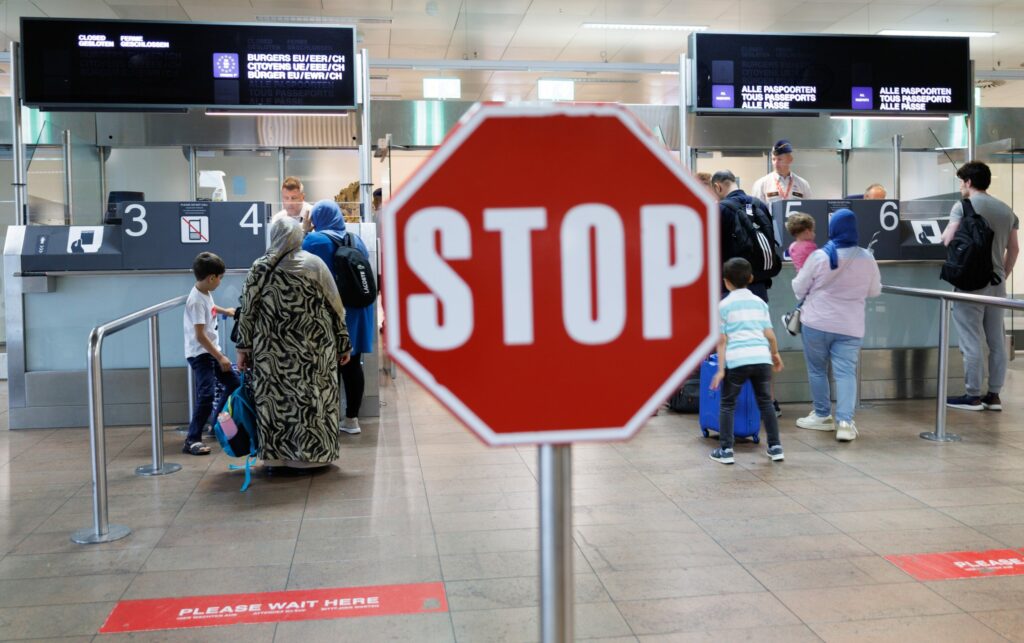
Belgium’s court ruling is a reminder that migration governance must respect EU law and that Europe cannot curb asylum pressures without addressing the external drivers it helped create.
When the Constitutional Court of Belgium suspended Belgium’s stricter family-reunification rules pending clarification from the Court of Justice of the European Union, reactions were predictable. Some saw judicial overreach. Others celebrated a human-rights victory.
Both interpretations miss the deeper point.
This is not a clash between “open borders” and “firm control.” It is a test of whether Belgium and by extension the European Union can pursue migration management without eroding the legal architecture that defines it as a community governed by law.
In a Union built on treaties, directives and the supremacy of EU law, migration policy cannot float free of fundamental rights. Family unity is not an administrative concession. It is anchored in Article 7 of the EU Charter of Fundamental Rights and reflected in long-standing European jurisprudence on the right to family life.
The Court’s intervention is therefore not activism. It is legal realism.
Rule of law is not an obstacle to policy
Belgium’s government has defended its tightening of family-reunification criteria as necessary to reduce pull factors and protect reception capacity. These are legitimate policy concerns. Belgium, like several Member States, has faced sustained pressure on its asylum reception system in recent years.
But legitimacy of concern does not automatically confer legality of response. The Constitutional Court’s referral to the CJEU underscores a basic principle: national discretion operates within European limits. If domestic reforms risk conflicting with EU law, clarification must precede enforcement. That is not obstruction. It is institutional discipline.
In the long run, that discipline strengthens policy. Measures adopted in haste and overturned later do not create credibility. They create uncertainty. Uncertainty for migrants, administrators and citizens alike.
The illusion of solving asylum at the border
Yet the more strategic question lies elsewhere. Across Europe, asylum debates have narrowed to three variables: border control; reception capacity; and return procedures. The implicit assumption is that if internal controls are tightened sufficiently, external pressures will subside. This assumption is increasingly difficult to sustain.
Displacement does not originate at Schengen’s borders. It originates in conflict zones, collapsing economies, fragile governance systems and climate-stressed regions. Many of these contexts intersect; sometimes directly, other times or indirectly; with European foreign, trade and climate policy.
That is not an accusation. It is structural reality.
Europe’s external policies and unintended consequences
Consider conflict dynamics. European states remain significant exporters of defence equipment. Strategic partnerships are often built on stability considerations rather than democratic consolidation. Short-term security cooperation can, over time, entrench governance deficits that later generate instability and outward migration.
Consider trade architecture. Agricultural subsidies under the Common Agricultural Policy distort markets in parts of Africa. Raw materials are exported from the Global South with minimal value addition, while high-value processing and intellectual property remain concentrated in Europe. Unequal value chains constrain job creation in countries whose demographic growth far outpaces employment absorption.
Consider climate justice. The EU is a historical contributor to global emissions. Climate-induced displacement is accelerating from the Sahel to South Asia. Yet adaptation financing remains slow, fragmented and insufficient relative to projected needs.
Consider governance partnerships. In fragile states, European policy sometimes prioritises migration containment over institutional reform. Stability is pursued, but accountability lags. The result can be political repression that eventually drives more people outward.
None of these policies were designed to create asylum flows. But policy ecosystems interact. When Europe debates asylum exclusively as a domestic management issue, it risks ignoring the external feedback loops embedded in its own strategic choices.
Family unity as strategic policy, not sentiment
Within this broader context, family reunification deserves to be seen for what it is: a stabilising mechanism.
Research across OECD countries shows that refugees who are reunited with their immediate families integrate faster, achieve better employment outcomes and rely less on long-term social support. Separation, by contrast, prolongs vulnerability and uncertainty.
If Europe’s goal is sustainable integration rather than perpetual marginality, family unity is not a luxury. It is part of effective policy design. Restrictive measures may signal toughness, but they do not address displacement drivers. Nor do they reduce the humanitarian obligations that arise once protection is granted.
Legal realism and policy coherence
The pending decision of the CJEU will clarify the legal boundaries. But whatever the outcome, a deeper strategic lesson remains.
Europe cannot meaningfully reduce asylum pressures through internal restriction alone while external policies continue to contribute, even unintentionally, to the conditions that drive migration.
Policy coherence is not a moral slogan. It is strategic necessity. If the EU seeks fewer asylum arrivals, it must:
- Align trade agreements with genuine development outcomes;
- Reform subsidy regimes that distort fragile markets;
- Scale climate adaptation financing to match rhetorical ambition;
- Apply governance conditionality consistently, not selectively.
Migration management cannot be siloed from foreign policy, trade, climate and development cooperation.
Belgium’s opportunity
Belgium sits at the institutional heart of Europe. It hosts EU institutions and shapes European debate. Rather than viewing the Constitutional Court’s intervention as a setback, policymakers could treat it as an opportunity to recalibrate. Defending family unity within the framework of EU law does not preclude firm migration governance. It simply insists that firmness remain anchored in legality and strategic coherence.
The real choice before Europe is not between control and compassion. It is between fragmented policy and integrated policy. Europe cannot tighten the door while ignoring the structural forces that destabilise the neighbourhood. Legal realism demands more than border management. It demands alignment between what Europe does abroad and what it enforces at home.
If that broader coherence is embraced, the asylum debate may finally move beyond reactive restriction and toward sustainable reform. And that would serve not only asylum seekers but Europe itself.
