

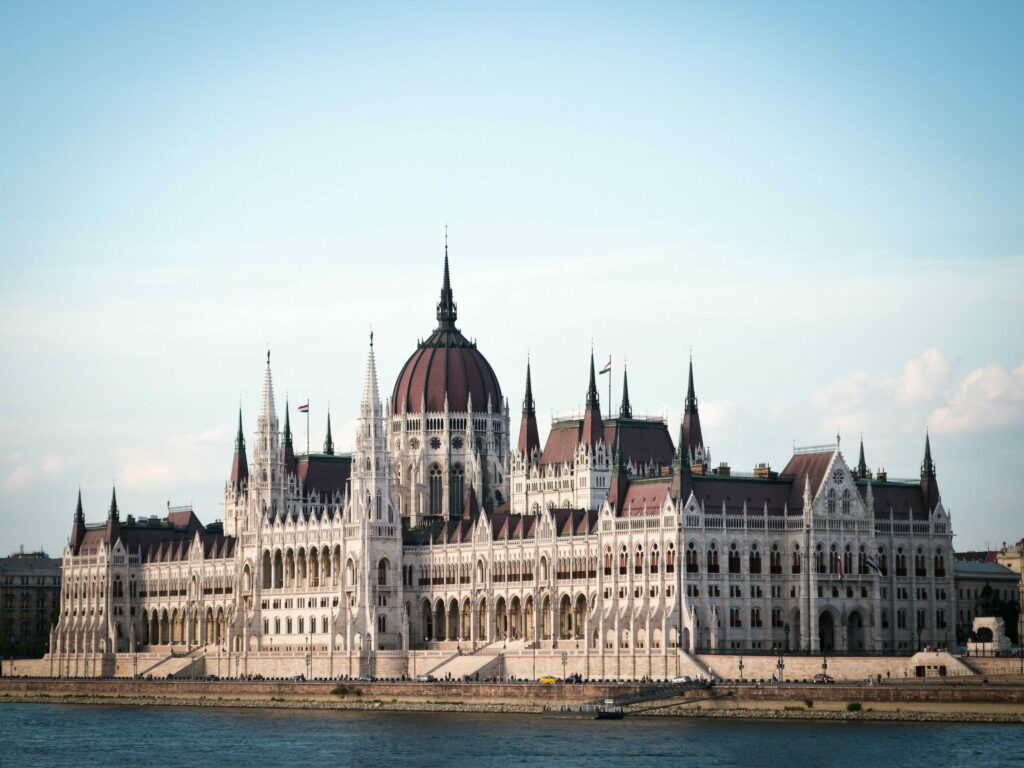
On Sunday, Hungarians head to the polls in a vote that will shape the country’s domestic trajectory and the coherence of European Union foreign policy.
While the opposition TISZA party leads in several polls, a victory for Viktor Orbán and his Fidesz party would likely see Budapest double down on a role that many in Brussels view as obstructive.
Under Orbán, Hungary has become a member state willing to bend democratic norms and use its veto as leverage for national ends. Nowhere is this more visible than in Budapest’s relationship with Moscow.
Since the invasion of Ukraine, Hungary has repeatedly slowed or threatened to block EU sanctions and financial support for Kyiv. These are not merely symbolic gestures. Following an attack on the Druzhba oil pipeline, Orbán held up a €90 billion EU loan package and a new round of sanctions, tying approval to the resumption of oil transit. This reinforced a domestic narrative casting Ukraine as a threat to Hungarian energy security.
Furthermore, Hungary has deepened its energy ties with Russia. Long-term gas contracts remain, Russian oil continues to flow, and the expansion of the Paks Nuclear Power Plant by Rosatom underscores a strategic relationship that has endured despite the war.
Orbán has met Vladimir Putin multiple times since 2022, while Foreign Minister Péter Szijjártó is a frequent visitor to Russia. Reports that Szijjártó shared sensitive EU information with Sergey Lavrov have only heightened concerns in Brussels.
Russia is only one pillar of a strategy to position Hungary between competing global powers. The return of Donald Trump to the White House has accelerated this.
Hungary has emerged as one of Washington’s closest partners within the EU under the current administration. Trump has praised Orbán’s model of governance, while senior US officials, including Marco Rubio and – only a few days before the election – JD Vance, have expressed support for his re-election. This election interference and ideological alignment is rooted in Orbán’s transformation of Hungary into a hybrid regime since 2010.
China forms the third axis. Over the past decade, Budapest has deepened ties with Beijing through the Belt and Road Initiative. Today, Hungary attracts nearly a third of all Chinese investment into Europe, primarily in electric vehicle and battery production. Consequently, Budapest remains reluctant to support EU initiatives that would harden the bloc’s stance toward Beijing.
EU’s rule of law tool box
This convergence raises a fundamental question: what happens to a union built on shared values when a member persistently diverges? If Orbán secures another term, there is a risk that countries such as Slovakia or Czechia might follow his lead, eroding the EU’s credibility as a political community.
Expelling Hungary is occasionally suggested but is not legally feasible under current treaties. It would also be politically unwise. Public support for EU membership in Hungary remains high.
A recent poll by the European Council on Foreign Relations (ECFR) found that three-quarters of Hungarians trust the EU and 77% of citizens support the country’s membership. Forcing an exit would likely strengthen Orbán’s narrative of external victimization.
The ongoing Article 7 procedure, which allows for the suspension of a member state’s voting rights, has been stuck in the Council since 2018. In practice, this path is blocked by the requirement for unanimity. Any such decision would require the agreement of all other member states, a threshold that remains out of reach. Governments in Bratislava and Prague, wary of setting a precedent, are hesitant to support such a move.
This leaves institutional reform as the more plausible long-term solution. The EU’s reliance on unanimity in foreign and security policy has come under strain. Moving toward qualified majority voting (QMV) would make it harder for a single government to block sanctions or aid. This idea is gaining traction, with figures such as German politician Johann Wadephul and European People's Party President Manfred Weber arguing for its expansion.
However, as smaller states fear losing sovereignty, a modified mechanism may be preferable, where a veto can only be exercised collectively by at least four member states.
In the meantime, the EU has resorted to workarounds. Informal coalitions and selective opt-outs have allowed progress in some areas, but these are imperfect. Hungary has shown that even when it opts out of Ukraine-related financial schemes, it can still obstruct their implementation.
The most effective tool remains financial conditionality. Tens of billions of euros in EU funds for Hungary have been frozen over rule-of-law concerns. The impact is tangible. Budget shortfalls have strained public services, allowing opposition leader Péter Magyar to make corruption a central issue.
ECFR polling indicates that corruption and poor public services are now top concerns for Hungarian voters. For the EU, this serves as a reminder that leverage exists if applied consistently.
Whatever the outcome on Sunday, the broader challenge remains. Europe is operating in a fragmented world where external pressures are mounting. A union that cannot act collectively risks diminishing its influence.
Hungary’s trajectory has brought this dilemma into focus. The question is whether the EU can adapt to confront a difficult member while preserving its ability to act as a unified force.
