

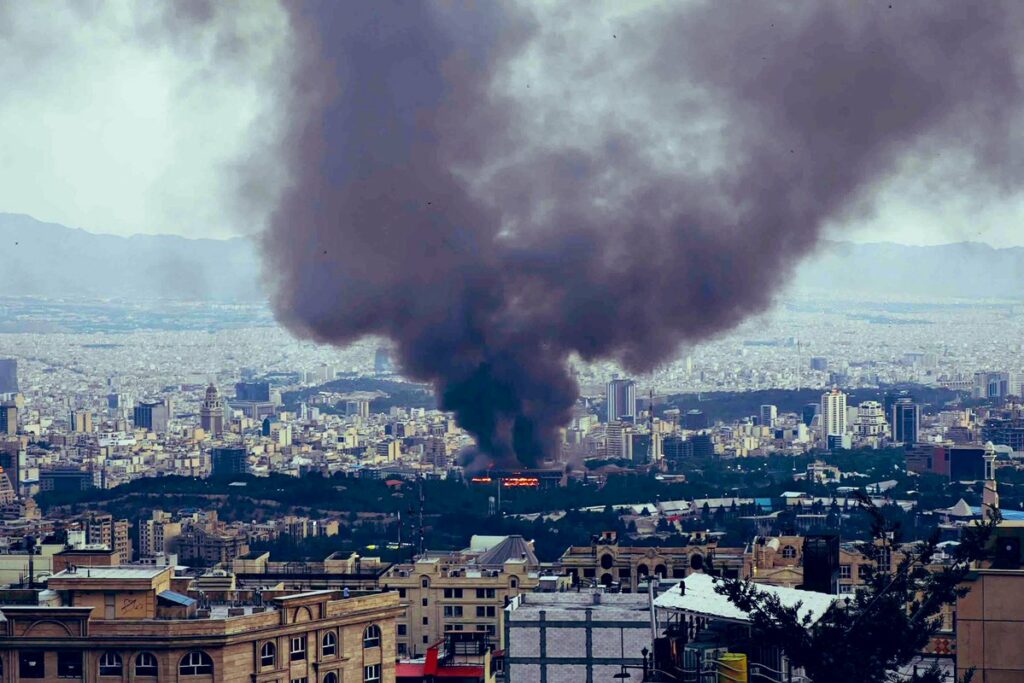
US president Donald Trump’s announcement early Wednesday morning (8 April) of a two-week ceasefire in the war with Iran was overall greeted with relief but all the issues that triggered the US-Israeli strikes against Iran remain unresolved.
Trump had painted himself into a corner after the war continued longer than expected and did not topple the Iranian regime as expected. Instead, it resulted in the closure of the Strait of Hormuz causing a global energy crisis. In the days before the ceasefire, he doubled down on his threats against Iran, warning that the US would destroy its civilian infrastructure and that a whole civilization would die.
Since the war erupted on 28 March, it kept escalating without any clear exit strategy. It could easily have spiraled out of control if the US and Israel would had started bombing Iran’s civilian infrastructure. Hardliners on both sides might have wanted to continue the war but every war must end with a sustainable political agreement, the sooner the better.
In this case, the hostilities ended without any agreement but the temporary ceasefire offers a window of opportunity to negotiate a political agreement. In the Ukraine war, which continues for its fifth year, Russia has never agreed to a ceasefire to enable serious peace talks.
There are no victors in this war which caused devastation in all countries affected, Iran, Lebanon, the Gulf countries and Israel. For Iran, the survival of the regime was in itself a victory. For the US and Israel, the ceasefire was immediately followed by a battle on narratives about their achievements in the war.
When welcoming the ceasefire, EU’s High Representative for foreign affairs, Kaja Kallas, described it as an opportunity for diplomacy and a ‘step back from the brink after weeks of escalation’. The two-week ceasefire aims to defuse threats, halt missile exchanges, restore maritime traffic, and create a diplomatic pathway for a long-term resolution, she wrote on X.
However, the EU continues to be sidelined in mediating a political-diplomatic solution of the conflict. On the two first days after the ceasefire, Kallas was travelling to Saudia Arabia and the United Arab Emirates, where she met the foreign ministers and the Secretary-General of the Gulf Cooperation Council.
Visits to Iran or Israel were not on her itinerary. According to a Commission spokesperson, the High Representative, as EU’s chief diplomat, travelling to the region was in itself an activation of the best tool the EU has in its ‘toolbox’ for contributing to solving conflicts.
In a statement on Wednesday evening, EU leaders and other leaders stated that “the goal must now be to negotiate a swift and lasting end to the war within the coming days. This can only be achieved through diplomatic means”. They called upon all sides to implement the ceasefire, including in Lebanon.
The Commission spokesperson went further and said on Thursday (9 April) that the EU condemned the Israeli strikes against Lebanon after the ceasefire with Iran had entered into force. He expressed EU’s solidarity with the people of Lebanon. That said, he repeated EU’s demand that Hezbollah must be disarmed and that the EU will support the Lebanese government’s and army's efforts to disarm it.
Two conflicting plans
The EU continues to stick to its priorities: to prevent Iran from acquiring nuclear weapons, to put an end to its destabilizing activities in the region (i.e. support of proxies), and to limit its ballistic missile programme. These are the very issues that remain unsolved after the 40-days war with Iran. Ending the Iranian regime’s suppression of its own population has been forgotten or is not achievable for now.
A previous 15-point plan proposed by the US was rejected by the Iranian regime. Instead, it presented its own 10-points plan last week. During his rambling press conference on Monday, Trump said that the plan is “not good enough, but it’s a very significant step.” Neither plan has been published but according to media reports they include points which are unacceptable to either party.
For the time being, the fragile ceasefire with Iran still holds and talks between the US and Iran on a political agreement are scheduled to take place on Saturday in Islamabad, Pakistan. It was also Pakistan, in a trio with Egypt and Turkey, who managed in the last minute to convince Trump to a ceasefire in exchange for an Iranian promise to open up the Strait of Hormuz for freedom of passage.
While the points in the two plans express maximalist demands in the negotiations to follow, Trump expected that the Strait of Hormuz would be reopened from the very start of the ceasefire. This has not happened yet. Iran has announced that it has delineated safe navigation routes but so far only a few ships have dared to make the passage through the Strait.
The Iranian plan stated that transit will be coordinated with its armed forces in a way that guarantees Iran’s supremacy. Trump repeated on Wednesday night his threat to use force again against Iran if it did not comply with the terms of the ceasefire. The American forces will remain in place until the ‘REAL AGREEMENT’ reached is fully complied with. He did not mention what agreement he referred to.
The Strait is considered as international waters and was open for transit passage until the war started. Now Iran wants to charge toll fees. Trump has floated the same idea. A Commission spokesperson commented on Thursday that freedom of navigation in the Strait must be ensured with no payment or toll whatsoever. It is a global public good and should be open according to international law.
Ceasefire in Lebanon key
Another unclear point is if the ceasefire includes Lebanon. According to Iran and Pakistan, it does. The Iranian plan does not mention Lebanon but includes a point on the ‘cessation of the war against Iran and its affiliates’. Israel claims that the ceasefire does not include Lebanon and launched intensified air strikes against Hezbollah targets on Wednesday. The cross-border strikes continued on Thursday.
Iran threatens not to respect the ceasefire or not conduct talks with the US if Israel continues its strikes against Hezbollah, its most important proxy. Hezbollah could have decided to stay outside the war but joined Iran in indiscriminate combined missile, rocket and drone strikes against Israel, dragging Lebanon into the war.
Excluding Hezbollah from the ceasefire without any protests would have send a signal to its other proxies in the region that Iran cannot be trusted.
In a televised speech to the war-torn Israeli public, Prime Minister Benjamin Netanyahu claimed that “Iran is weaker than ever, and Israel is stronger than ever”. According to Netanyahu, Iran has committed to opening the Strait of Hormuz after waiving all of its preconditions. There is still “goals to complete, and we’ll achieve them either by agreement or by the resumption of fighting,” he added.
Ahead of parliamentary elections, the government is under pressure from residents in the north to continue the war against Hezbollah until it has been disarmed and removed from the border region so that they can feel safe. But that could take years to achieve, according to a senior officer in the army. In the meantime, the north of Israel down to Haifa continues to suffer rocket fire by Hezbollah.
But continuing the military campaign against Hezbollah and establishing security zones in southern Lebanon is likely to become counter-productive judging from past wars. It is time to try the alternative, a political process with Lebanon could lead to the full disarmament of Hezbollah.
Different situation now
It has not been high on the agenda of the current Israeli government, which has been preferring military means to political solutions. The situation is different now, with a weakened Iran out of the picture and hopefully focusing on improving the economy for its own people. In Lebanon, contrary to Gaza, there is a peace-oriented government which wants to change course and save the country.
In a surprising turnabout, the Israeli Prime Minister announced on Thursday evening that he had instructed the government to start direct negotiations with Lebanon as soon as possible. The negotiations will focus on the disarmament of Hezbollah and the establishing of peaceful relations between Israel and Lebanon.
The decision follows Lebanon's repeated requests to open direct negotiations with Israel, he added. In fact, he was reportedly asked by Trump to do it. Lebanese President Michel Aoun said earlier that “the only solution to the situation Lebanon is facing is a ceasefire with Israel that would lead to direct negotiations between the two countries.”
Netanyahu hurried to issue another statement shortly afterwards that there is no ceasefire in Lebanon. “We are continuing to strike Hezbollah with full force, and we will not stop until we restore your security”, referring to the residents in the north.
The talks, if they will get started under fire, are scheduled to take place in Washington but Cyprus has also been mentioned. Cyprus chairs the EU Presidency and is close to both Israel and Lebanon.
A ceasefire between Lebanon and Israel entered into force already in November 2024 but was never fully implemented. Israeli troops continued to keep five positions on the Lebanese side of the border. Hezbollah was not fully disarmed despite the affirmation of the Lebanese government of the state’s monopoly on arms.
“The Lebanese army is one of the weakest and most underfinanced armies in the world,” Dr Moran Levanoni, an expert on Lebanon and researcher at the Israeli Institute for National Security Studies (INSS), told The Brussels Times. “Up to 40% of the soldiers, including senior officers, belong to the Shiite community who do not see Hezbollah as their enemy and leak information to them.”
The Lebanese army misled the government when claiming that Hezbollah had been disarmed in southern Lebanon and that it is capable of disarming it in the rest of the country. Israel faces a dilemma: to “finish” the job to disarm Hezbollah now or risk recurrent wars.
To support a ceasefire, both the US and the EU would definitely need to become more involved and strengthen the Lebanese army.
