
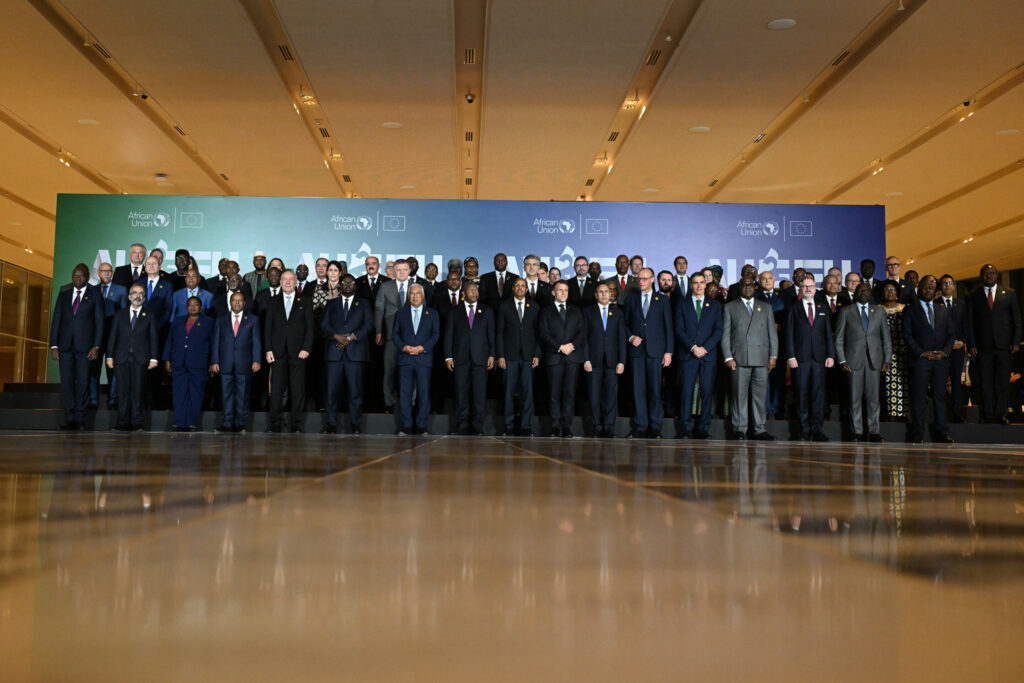
By the time French President Emmanuel Macron arrived in Nairobi this week defending Europe’s role in Africa, the real story was no longer about France alone. It was about an unmistakable shift taking place in Africa–Europe relations: the gradual but irreversible movement from paternalism toward partnership.
The language of “reset” has become fashionable in diplomatic circles. Yet behind the carefully crafted communiqués and summit photography lies something far more profound. Europe is slowly coming to terms with a new African reality. It is a reality in which fairness is no longer aspirational but inevitable.
For too long, Africa–Europe relations operated within a deeply unequal framework. Europe extracted raw materials; Africa imported finished products. Europe prescribed governance lessons; Africa absorbed conditionalities.
Europe controlled capital flows, technology, and financial architecture; Africa supplied commodities and labour. The relationship survived because history, dependency, and institutional imbalance sustained it.
The weakening foundations of institutional imbalance
Africa today is not the Africa of the 1980s or even the early 2000s. Its demographic rise alone changes everything. By 2050, one in four people on earth will be African. Its urban markets are expanding. Its digital economy is accelerating. Its strategic minerals are indispensable to the global green transition. Its geopolitical relevance has become impossible to ignore.
And crucially, Africa now has options.
China finances infrastructure. Türkiye is expanding commercial footprints. Gulf states are investing aggressively. India is deepening strategic engagement. Russia has pursued security partnerships in parts of the continent. Whatever one thinks of these competing actors, they have collectively altered Africa’s negotiating psychology. Europe understands this.
That understanding explains why the European Union now speaks increasingly in the language of “mutual prosperity,” “equal partnership,” “co-investment,” and “shared growth.” It also explains the EU’s €150 billion Africa-Europe Investment Package under the Global Gateway initiative.
A geopolitical competition
Sceptics may dismiss initiatives such as the Global Gateway as geopolitical competition wrapped in diplomatic niceties. There is certainly some truth to that. Europe is not acting purely out of altruism. If we do not want to be naïve, we must admit that no serious geopolitical actor does.
Europe’s recalibration is also driven by strategic anxieties and economic realities: energy diversification following the Ukraine war, supply-chain resilience, migration pressures, industrial competitiveness, and intensifying competition with China, Türkiye, Gulf states, India, and other actors deepening their footprint across Africa. In many respects, Africa has become central to the strategic future of multiple global powers simultaneously.
But reducing the shift entirely to cynical competition misses an important reality that many Africans themselves are beginning to underestimate: a significant number of European policymakers, diplomats, investors, and business leaders genuinely recognise that the old model is unsustainable. Not morally, not politically, and even not economically.
Over the years, through my engagements across Brussels, Antwerp, Luxembourg, Paris, and other European policy and business circles, I have noticed something increasingly striking.
The conversation analysis on Belgium’s geopolitical recalibration toward Africa; a piece later publicly referenced and commended by Belgium’s Minister of Foreign Affairs; Europe’s evolving posture toward Africa reflects not merely diplomatic optics, but strategic necessity. The shift is increasingly being driven by hard geopolitical and economic realities rather than sentiment alone.
Paternalism on a sick bed
Paternalism is not dead. But it is dying. Slowly but steadily. One hears far fewer defences of paternalistic engagement. Increasingly, European stakeholders speak openly about industrial partnerships rather than resource extraction; about technology transfer rather than dependency; about African value addition rather than perpetual commodity exportation.
This does not mean exploitative tendencies have disappeared. They have not. Elements of the old order remain deeply embedded in parts of Europe’s trade architecture and corporate behaviour.
African exporters still confront tariff escalation, restrictive standards, unfair risk profiling, and financing inequalities. The structure of global finance still penalises Africa disproportionately. African countries continue to pay some of the world’s highest borrowing costs despite often possessing lower default histories than perceived.
The structural imbalance story
Even trade data reveals lingering structural imbalance. EU exports of machinery and transport equipment to Africa rose from roughly $17 billion in 1995 to more than $60 billion in 2024, while manufactured exports exceeded $116 billion in 2024. Meanwhile, African exports to Europe remain dominated by crude petroleum, gas, cocoa, copper, and other primary commodities.
This imbalance is precisely why the current transition matters.
Fairness in Africa–Europe relations will not emerge because Europe suddenly became benevolent. It will emerge because the economics of the twenty-first century increasingly demand reciprocity.
Europe needs Africa and vice versa
The continent’s green transition depends heavily on African lithium, cobalt, copper, manganese, graphite, and rare earths. European supply chain resilience increasingly depends on stable African partnerships. Europe’s long-term demographic and labour market realities make African economic stability strategically important. African consumer markets are becoming too large to ignore.
At the same time, Africa also needs Europe, not as patron, but as partner.
The European Union remains Africa’s largest trading and investment partner. EU–Africa trade has grown significantly over the past decade, while European investment stocks in Africa continue to rise. Forty-four African countries currently enjoy duty-free access to the EU market, with 97% of African exports entering the EU tariff-free.
These figures matter because they reveal an often-overlooked truth: despite the headlines around China and other powers, Europe and Africa remain deeply economically intertwined. The challenge now is not whether the relationship will continue. It is whether it will mature.
A relationship maturation anchored on mutual honesty
Europe must finally abandon the subtle paternalism that still occasionally surfaces in its dealings with Africa. This includes the reflex to lecture rather than listen; prescribe rather than partner. Fair trade cannot coexist with structural condescension.
But Africa, too, must move beyond rhetorical victimhood. Fairness also requires strategy, governance credibility, regional integration, infrastructure, and negotiating discipline from African states themselves. Africa cannot demand industrial respect abroad while tolerating institutional dysfunction at home.
This is why the African Continental Free Trade Area may ultimately prove transformative. A more integrated African market changes bargaining power fundamentally. It strengthens Africa’s capacity to negotiate trade terms from a position of scale rather than fragmentation.
The future therefore belongs neither to dependency nor hostility. It belongs to strategic interdependence, a relationship in which Africa is no longer treated as Europe’s junior partner, but as an indispensable geopolitical and economic actor in its own right.
Adjustment to geopolitical reality
Europe’s emerging recalibration toward Africa is not simply a diplomatic trend. It is an adjustment to geopolitical reality. And from what I increasingly observe in conversations across Europe, many Europeans understand this better than critics often assume. The old extractive model is losing legitimacy even within Europe itself.
A new generation of European business leaders increasingly recognises that sustainable prosperity cannot be built on African underdevelopment. Many understand that long-term stability, market expansion, migration management, energy security, and industrial resilience all require a more prosperous Africa. That is why fairer Africa–Europe relations are not merely desirable. They are inevitable.
The remaining question is whether both continents can accelerate that transition before distrust overtakes opportunity. For Africa and Europe, the future cannot be built on guilt, nostalgia, or dependency. It must be built on mutual interest, mutual respect, and mutual prosperity.
Anything less will simply belong to the past.
