
As India’s Prime Minister Narendra Modi toured Sweden, the Netherlands, Norway and Italy this week, the focus understandably was on trade, supply chains, and geopolitics.
Strengthening economic ties with the world’s fastest-growing major economy makes strategic sense at a time of global uncertainty, with India’s bilateral trade with the EU totalling to $118 billion in 2025.
But if European relations with India are reduced to commerce alone, it risks overlooking a deeper issue with long-term consequences - the steady erosion of democratic checks and balances in the world’s largest democracy.
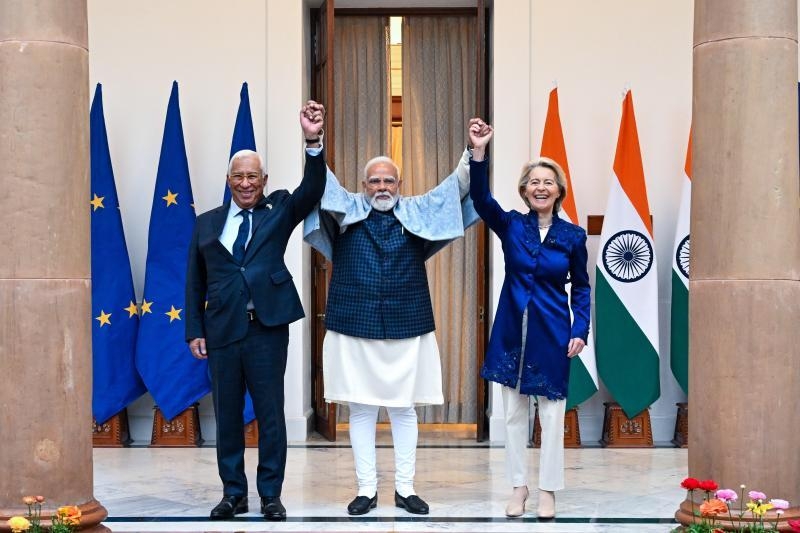
During his visit to Sweden, Modi met his Swedish counterpart, Ulf Kristersson, and European Commission President, Ursula von der Leyen. Von der Leyen reiterated the commitment to the recent EU-India trade agreement, projected to boost bilateral trade by 41% to 65%.
The agreement, called the 'mother of all deals', was signed in New Delhi last January and is expected to be finalised by the end of 2026. Meanwhile, the Swedish Prime Minister reiterated Sweden’s support for India’s permanent membership of a reformed and expanded UN Security Council.
A large and populous country such as India should have a permanent seat at the UN table. But if European relations with India are reduced to commerce alone, this risks overlooking a deeper issue with long-term consequences.
As Modi visits countries that uphold human rights, the rule of law and democracy, at home, the Indian Constitution, which defines India as a sovereign, secular and democratic republic, is being eroded. As the EU seeks closer economic and strategic cooperation with New Delhi, India is confronting a quiet but consequential weakening of its democratic institutions.
Independent assessments underline this trend. CIVICUS has classified India’s civic space as 'repressed' for six consecutive years. The Election Commission of India (ECI), once widely respected at home and abroad, now faces persistent allegations of politicisation and bias.
In a 2026 Democracy Report, Sweden’s V-Dem Institute classified India as an 'electoral autocracy', a country where elections still take place, but democratic checks and balances have significantly weakened. The report noted that 85% of people in South and Central Asia now live under electoral autocracies, including India, Pakistan and Kazakhstan.
Incidents such as the deportation of Italian scholar Francesca Orsini from Delhi airport in October last year, the cancellation of the overseas citizenship of Ashok Swain, a Sweden-based academic over his social media posts, and the denial of a permit to work to French journalist Vanessa Dougnac, have added to concerns among rights advocates about the shrinking space for academic freedom and dissent in India.
Furthermore, journalists face raids, lawsuits and intimidation, while concentrated media ownership and political alignment have reduced space for independent reporting. Reporters Without Borders now describes press freedom in India as being in crisis.
Court under scrutiny
India’s Supreme Court, long regarded as a cornerstone of constitutionalism, has also come under scrutiny.
Early this year, it again denied bail to student leaders who had been detained for more than five years without trial for peacefully protesting against discriminatory citizenship laws. International experts have warned that opaque judicial appointments, executive influence and post-retirement incentives undermine the judiciary’s real and perceived independence.
India’s electoral process has also come under fire for being 'unfair'. A leading civil society election monitoring panel concluded at the end of the Bihar elections (IPMIE) in November 2025: 'The conduct of the Election Commission of India throughout the Bihar election was deeply concerning, and raised troubling questions about its impartiality and institutional integrity'.
Modi’s BJP's return to power in Assam and a big win in West Bengal in the recent concluded provincial elections, was seen as an openly Islamophobic campaign. Allegations on electoral malpractice included centralised voter roll manipulation, targeted deletions disproportionately affecting minorities, and unresolved concerns about transparency, data protection and accountability.
Other accountability institutions have fared no better. Concerns about politicisation have led to the downgrading of India’s National Human Rights Commission in international accreditation. Meanwhile, the UN Special Rapporteur on the Independence of Judges and Lawyers has expressed 'significant concerns' about freedom of expression and assembly, as well as attacks on NGOs and human rights defenders.
Why EU should care
India is not just another trading partner. It is a regional power, a strategic actor and home to nearly one-fifth of the world’s population. Democratic erosion in a country of this scale has global consequences.
An India drifting toward autocracy would weaken democratic norms internationally, embolden illiberal leaders elsewhere and complicate Europe’s efforts to defend a rules-based international order. At the same time, Europe should also pay attention to the ideological direction of India’s ruling party BJP internationally.
BJP representatives have become a regular fixture at far-right events in Europe and the US. Ram Mahdhav, a BJP representative from India appeared alongside German AFD’s Alice Weidel, France’s National Front and senior officials from Orban’s Fidesz at the global far-right event the Conservative Political Action Conference (CPAC) in Budapest in 2024.
BJP in attendance holds political significance, as they are increasingly aligning themselves with broader transnational networks pushing for anti-liberal, exclusionary, nationalistic narratives that stray from the democratic vision European leadership wishes to uphold.
EU leaders often argue that engagement, not isolation, is the most effective way to influence partners. But engagement without principles is unlikely to strengthen democracy. Europe has leverage — through market access, investment, technology cooperation and political legitimacy. Using that leverage would be prudent.
