

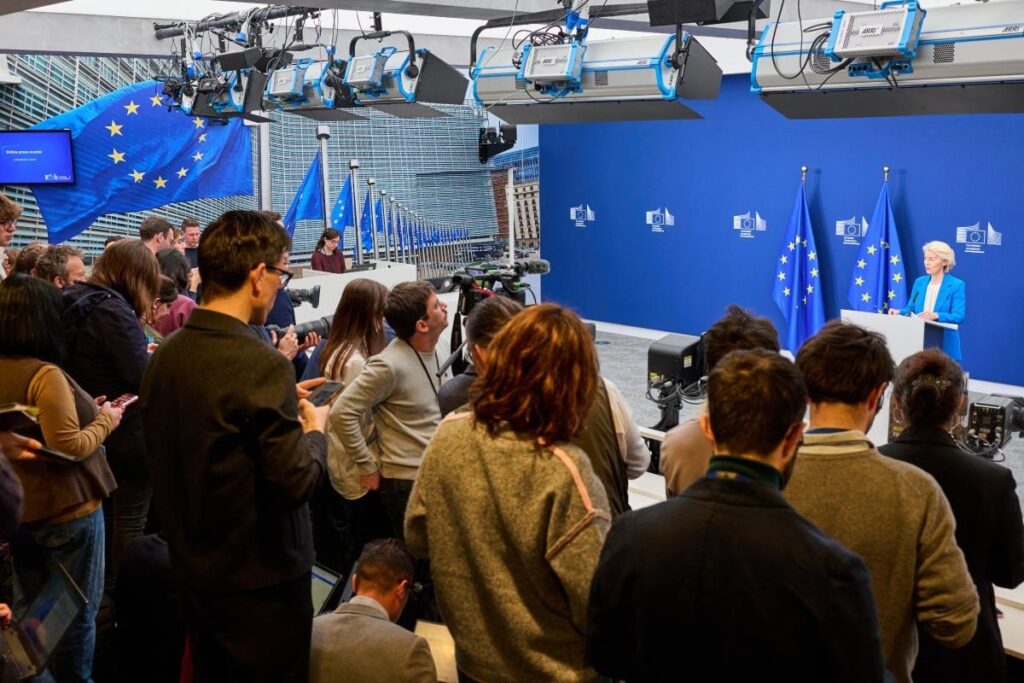
Europe often gets the substance right, but in today’s attention-driven information environment, substance alone is no longer enough.
After more than twenty years with the United Nations as a spokesperson and communications director in humanitarian crises, global health emergencies and peacekeeping operations, one thing struck me almost immediately when I returned to Europe. It was not so much what European institutions say, but how they say it.
In those environments, communication was never simply about image or reputation. It was an operational tool. A message could help reassure a population after an attack, mobilize international funding within days, or force a neglected crisis onto the global agenda. Messages had to be clear, visible and immediately understood. They were not designed to remain inside conference rooms. They were meant to travel quickly and produce tangible results.
When attention becomes a resource
This culture of speed does not exist everywhere within the UN system. In more diplomatic or political settings, communication often remains more cautious, slower and, in many respects, closer to certain European approaches. But in sectors linked to crises — including security crises — humanitarian action or global health, communication tends to move much faster. In emergencies, attention itself becomes a strategic resource.
Back in Brussels, the contrast was striking.
Not because Europe lacks expertise, competence or well-founded positions. Quite the opposite. But because Europe often continues to communicate as if the world still had the time and patience to listen.
In Brussels, messages are sometimes still crafted as though their substance alone will ensure their impact. That is no longer how today's information environment works.
Attention has become something that must be earned. Messages compete constantly for visibility. What is not understood quickly disappears. What is not politically visible often ceases to exist in the media landscape.
Against this backdrop, two distinct approaches to institutional communication have become increasingly visible.
The strengths and limits of simplicity
The first approach — often associated with American government communication — prioritises speed, impact and narrative dominance. Messages are short, direct and intentionally simple. They are designed to circulate immediately, to be picked up by television networks, social media platforms and political actors. Visibility is no longer a by-product of communication. It can become the objective itself.
This approach is remarkably effective. It can impose an issue on the public agenda within hours, shape the media conversation and create a sense of constant momentum. In a crowded information space, that ability to command attention matters enormously.
But it comes at a cost.
When communication is designed primarily to maximize immediate impact, it can produce a succession of powerful announcements that do not always form a coherent long-term narrative. Priorities shift rapidly. Adjustments multiply. Some statements are intended as much to provoke a reaction as to communicate a fully developed policy.
The narrative becomes fluid, adaptable and sometimes blunt in its simplification of reality. That flexibility can be a tactical advantage. But it can also weaken clarity and erode credibility when messages change too quickly or too frequently.
Europe operates almost at the opposite end of the spectrum.
Europe’s culture of caution
Its communication reflects its institutions: cautious, negotiated and complex. Messages emerge from compromise. They seek balance more than impact. They tend to be more stable, more precise and less prone to abrupt shifts.
That restraint is also a form of seriousness. Over time, it often produces communication that is more coherent and more durable.
Yet in many capitals around the world, communication is now regarded as an instrument of power in its own right. In Europe, it is still too often treated as an institutional support function.
As a result, European positions sometimes become almost inaudible. Important decisions disappear behind technocratic language or formulations so carefully balanced that they lose much of their political force.
Some European statements occasionally give the impression of having been drafted primarily to avoid controversy rather than to be genuinely heard.
Europe often accomplishes far more than it is given credit for. Yet it sometimes communicates as though the quality of its actions alone should guarantee recognition.
That is no longer enough.
The risk of speaking too softly
In a media environment dominated by speed, emotion and constant confrontation, visibility is no longer a secondary consideration. It has become part of the balance of power itself.
This does not mean Europe should imitate the most aggressive communication styles or transform its institutions into permanent messaging machines. Europe's political culture is built on restraint, compromise and a degree of stability that remains valuable.
But when Europe possesses the credibility, legitimacy and capacity to act, it should sometimes allow itself to speak with greater clarity, confidence and conviction.
Because in today's global debate, empty spaces rarely remain empty for long.
Ultimately, the way institutions communicate reveals something deeper about how they view power, risk and their own capacity to influence events.
And in an increasingly unforgiving information environment, speaking too softly carries its own risk: no longer being heard.
