

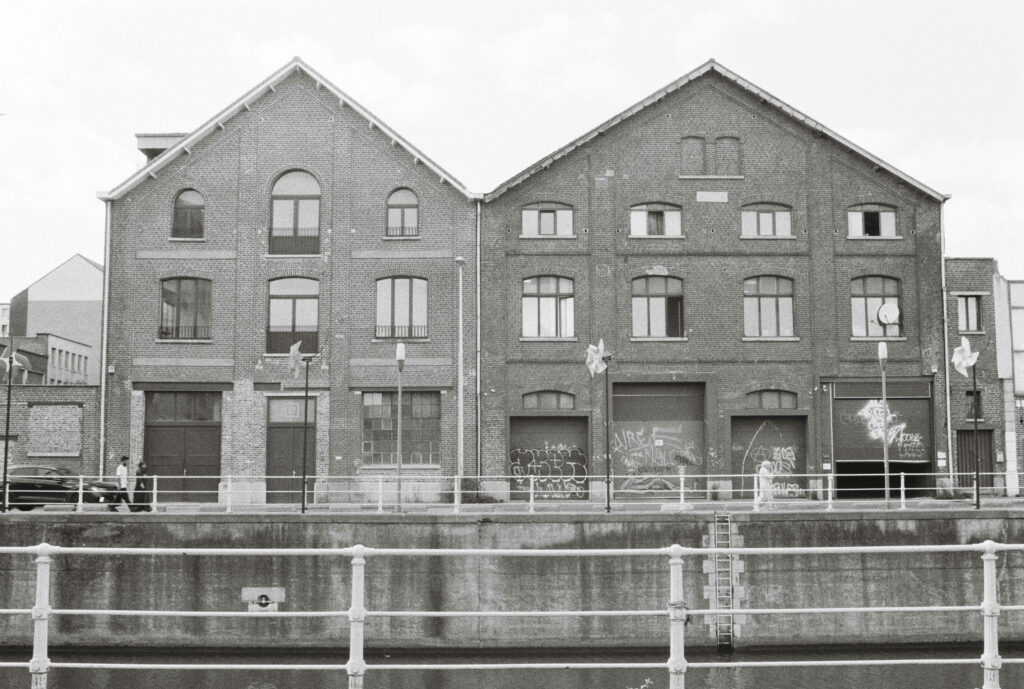
Before dawn, along the canal near the Marché Matinal in the Brussels of the early seventies, the same men gathered each morning in a corner café whose windows fogged almost immediately in winter.
They came from North Africa, the Congo, Turkey, and elsewhere, carrying the smells of turmeric, coffee, kif, and damp wool from crowded immigrant nights.
Inside, the café filled with smoke and the salty steam rising from mugs of Oxo into the morning cold. Chairs crowded around wooden tables worn smooth by years of tired elbows, coffee stains, and cigarette burns.
Beyond the windows, toward Molenbeek proper, the canal lay dark beneath the first light of dawn. Across the water, two soldiers stood motionless on either side of the enormous wooden doors of Le Petit Château.
It was a Brussels of long winter mornings where light arrived slowly and stayed without warmth.
Men learned early to read the smallest disturbances in a room. A pause that arrived too soon. A name spoken without looking up. A chair shifting back before anyone else moved. Some stayed seated while others rose. It seemed that the decision had already passed through the room before words appeared.
We sometimes sat for hours over a single cup, waiting to be chosen for a few hours of unloading fruit and vegetables from trucks arriving before sunrise.
Work was never announced formally. A man entered, looked once around the room, and selected. Sometimes by pointing; sometimes by naming. Those not chosen stayed seated, adjusting their posture, as though stillness could make them less noticeable. Every door opening changed the air. Conversations broke mid-sentence. Heads lifted without intention.
I was sixteen and went whenever I could, especially during school vacations. I did not need the work the way many others did, but it was the quickest money I knew. I wanted cash for Saturday nights, cigarettes—God forgive me—kif, beer, girls, the ordinary ambitions of boys that age.
My father had once waited in those same cafés after arriving in Brussels in 1964. He unloaded salt from péniches along the canal in Molenbeek, in the part of the district people still called Little Manchester, though by then the name already belonged to another century.
He rarely spoke directly about those years. Instead he mentioned fragments: salt entering the lungs, cold rising from the green canal water before dawn, the weight of wet sacks carried against the body on a rainy day.
The belly of the péniche seemed low and endless, he would say.
He shared a room with another Moroccan laborer, Si Mohamed, who became a lifelong brother to him. Both could read and write, and others often came to them for help with letters and counsel at their apartment on Port de Ninove.
Names passed through cafés
In those days a man’s reputation often arrived before he did, carried through cafés, apartments, and loading docks by people who knew someone who knew him.
Employers sometimes addressed me first even when someone else was being hired.
I learned that Si Mohamed was related to a man everyone called Mr. T. The connection seemed inevitable in retrospect. Kinship and reputation moved through the same unseen routes.
The immigrant world around the canal remained small and tightly woven. Men disappeared and returned, lost jobs, found others, shifted rooms, survived on rumor and endurance. New arrivals carried the stunned look of recent arrival. Others had learned how to fade into familiar streets without being noticed.
Most of the men around me were older. Many had wives and children in Morocco, Algeria, Turkey, or the Congo, dependent on wages sent home each month. Some spoke little French or Flemish. Others had lived in Belgium for years without papers, moving carefully between temporary jobs, fear, and furnished rooms.
I occupied a strange position among them. I had arrived as a child and possessed documents they did not. I was in school, spoke French with a near Brussels accent, and employers often addressed me even when someone else was being hired. I translated when needed. Sometimes I softened what had been said.
A man who answered quickly in French carried himself differently afterward. Silence offered protection but also exposed him in other ways.
One morning Mr. T struggled with the pace of the warehouse. A foreman spoke sharply after he hesitated while lifting a crate of oranges. Before emigrating, Mr. T had been a farmer in Morocco and still moved with the caution of agrarian life.
He looked toward me without speaking.
I answered more sharply than I intended. I still remember the foreman’s face, less surprised by the words than by the accent that carried them.
Then the work continued
Crates moved. Trucks emptied. Someone shouted for more pallets.
Decades later Mr. T still spoke about that moment. Something small had shifted its direction there and then.
Many mornings ended without work. We drank coffee slowly and watched daylight gather behind the café windows before dispersing toward tram stops, rented rooms, or other places where waiting resumed under different names.
One Friday morning something happened on the way to the marché matinal.
Rain had fallen through the night. A fine drizzle that did not fall so much as settle into coats and hair. I left home before dawn on the Chaussée de Ninove and walked toward the canal through nearly empty streets. Warehouses lined the water in long rows. Some remained active. Others stood dark and unused.
Small businesses lined the streets then: cafés, fishmongers, groceries, barbershops. One barbershop near the Parvis Saint-Jean-Baptiste remains there today.
Farther along was a butcher shop specializing entirely in horse meat. Behind the counter stood a large red-haired Flemish man in a spotless white apron despite the dark carcasses hanging behind him.
The meat fascinated me as a boy. Darker than beef, almost purple beneath yellow shop lights. In Morocco it was not forbidden, but it carried a sense of taboo. I have never eaten it.
That morning near Place de la Duchesse I saw shapes forming through the rain before I understood what they were.
At first they stood as mass and shadow
Then they became horses arranged across wet straw and sawdust, filling the square in long rows.
They were larger than I expected. Rain darkened their coats until they looked almost polished. Steam rose from their bodies into the cold air. When one shifted its weight the ground seemed to respond.
Farmers from West Flanders moved among them. Men in dark caps circled slowly, sometimes placing a hand on a flank before stepping away. Women stood slightly apart, heads turned, watching before anything was decided.
No one spoke much. Attention moved first, then movement followed. Understanding arrived before language and did not require it afterward.
Two men faced one another and brought their hands together in a single flat clap. The sound broke the rain and then disappeared into it.
The horse moved. The decision had already completed itself.
Money passed between hands without pause. The animal was led away.
Another clap sounded farther across the square.
Then another.
The Anderlecht abattoir was nearby.
I stayed near the large church at the edge of the square watching exchanges continue through steady rain when another memory returned without warning: the annual circus that had once occupied the same ground.
Before the tent appeared trucks crossed the canal carrying poles, cages, canvas, and animals. The air changed before anything was visible: wet sawdust, mud, animal sweat, something metallic underneath it all.
We never had money for tickets. On the final evening after the last performance, workers sometimes let neighborhood kids inside if we helped dismantle the tent.
Inside the square became another place
Acrobats moved overhead in silence that felt heavier than sound. Clowns fell in exaggerated motions that made us laugh without knowing why the laughter came.
And always the horse circled the ring under bright light, a performer standing on its back as it moved at furious speed.
Then the music stopped.
Ropes loosened. Poles lowered. Canvas collapsed into wet ground.
Those who stayed were given a bluish twenty-franc note bearing the face of King Baudouin.
Standing in the rain years later, I thought I should continue toward the canal café before all the places were taken.
I did not move.
Rain continued steadily. Horses shifted. Men crossed between them.
The square accepted each departure without resistance.
Then somewhere behind me came another handclap.
This time I did not turn immediately.
By the time I looked back a horse was already being led away. I watched it disappear into the rain.
