
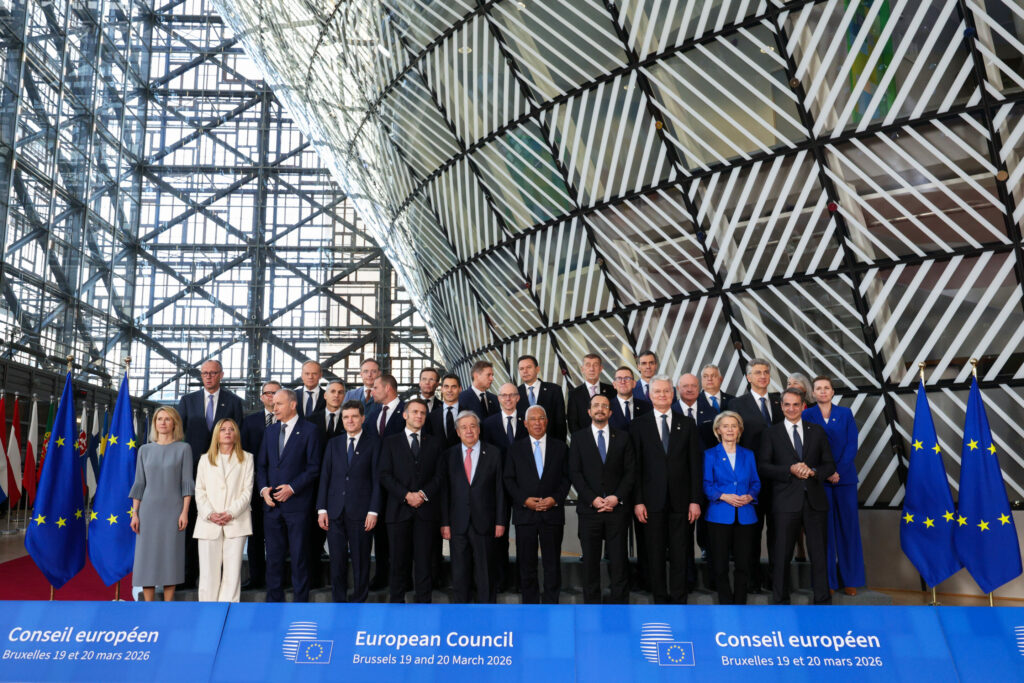
When European leaders gather to debate EU’s future at this week’s European Council, the agenda will invariably be dominated by a familiar catalogue of issues: negotiations over the next Multiannual Financial Framework (MFF), continued support for Ukraine, the ongoing conflict in the Middle East, defense, migration, and competitiveness.
But this framing misses a deeper reality: Europe is not only confronting economic and geopolitical competition; it is operating within an intensifying culture war over narratives, meaning, and belonging. This technocratic and top-down approach frequently overlooks a fundamental historical truth: Europe’s most transformative, paradigm-shifting ideas were born not in the corridors of Brussels but within civil society.
At decisive moments, it has been civic and cultural infrastructures that translate abstract values into lived realities. A good example is the Erasmus programme, which turns 40 next year. Today, Erasmus is recognised as a key pillar of European integration - an institutional framework that allows millions of young people to experience cross-border learning. It is a tangible manifestation of an integrated Europe.
When the Berlin Wall fell, the reconciliation of East and West relied on more than high-level diplomacy. It succeeded because civil society and cultural networks on both sides had spent years fostering grassroots relationships. Similarly, the success of the EU’s ‘Big Bang’ enlargement in 2004 went beyond political rhetoric due to long-standing cultural exchanges.
Yet, despite their historic role in shaping modern Europe, many of these institutions, think tanks, and civic networks are facing increasing administrative harassment, calls to be defunded, and restrictive foreign-funding legislation designed to limit independent public discourse.
The template for restricting civic spaces is rapidly expanding across the EU. Even in the European Parliament, a ‘Scrutiny Working Group’ has been established to examine EU grant agreements with NGOs and other civil society organisations. Many in the sector fear has been specifically designed to target and de-legitimise third-sector financing under the guise of anti-lobbying and transparency.
Even in historically stable democracies, such as Austria, France, Germany and the United Kingdom, independent watchdogs and cultural spaces face increasing pressure as parliamentary inquiries and ‘political neutrality’ audits are weaponized against their operations.
Downgrading of civil society
In its latest monitoring cycle, CIVICUS (the World Alliance for Citizen Participation) downgraded France, Germany, Italy and Switzerland for deteriorating civic freedoms. The ambition is not just to silence domestic dissent, but to isolate communities, halt integration programmes, and fracture the very populations that initiatives like Erasmus spent decades connecting.
These developments should not be seen as isolated or purely bureaucratic trends. Increasingly, attacks on civil society, culture, and independent media are strategic - aimed at eroding the spaces where societies negotiate meaning, build trust, and form shared identities. Weakening these infrastructures is a way to destabilise democratic systems from within - without ever crossing a physical border.
Governments and international bodies are, by their very structures, risk-averse, prone to groupthink, and bound by short-term electoral cycles - making them ill-equipped to innovate out of multidimensional crises in isolation. They rely on independent civic and cultural ecosystems to feed alternative solutions into public debate, bridge trust gaps, and expand the range of possible responses.
Civil society excels in this regard, by taking operational risks at a grassroots level and bridging the trust gap between citizens and institutions. This is something governments cannot replicate.
Europe’s immune system
In this sense, civil society and cultural infrastructures function as Europe’s democratic immune system - sustaining resilience, mediating differences, and reinforcing legitimacy. Defending independent foundations is therefore not a matter of progressive charity or cultural sentimentality; it is a geopolitical necessity and a prerequisite for structural innovation.
Faced with systemic threats, many in this space are turning to historical preservation to anchor their legitimacy. A number of key collections documenting how philanthropic foundations built the intellectual scaffolding for post-war Europe are now open to the public at the Historical Archives of the European Union (HAEU) in Florence.
This historical blueprint is exactly what modern EU policy must safeguard through structural reform. Instead of repeating familiar platitudes about European values, leaders must actively protect the independent networks that generate them - starting with their financial security.
To achieve this, strict funding protections should be introduced to ensure that strategic pillars like Horizon Europe’s - the EU’s flagship research and innovation programme - or the long-standing Creative Europe cultural programme cannot be subject to political interference. Academic freedom, institutional autonomy and independent peer review must remain non-negotiable principles.
Establishing firm and functional legal guardrails to monitor and penalise Member States that use bureaucratic restrictions to weaken independent foundations and NGOs should also be a priority. But defensive measures must also be matched by structural integration and the creation of formal institutional pipelines.
The AgoraEU initiative, for instance, which seeks to bring previously separate culture, citizenship and civic participation programmes under a single umbrella, offers one potential model. Properly designed, it could afford these sectors the same strategic coherence that Europe already gives to research, education and industry.
Almost forty years ago, a unique public philanthropic partnership delivered the Erasmus programme, proving that imagination could triumph over institutional thresholds. Faced with today’s intense international competition, European leaders must realise that they cannot champion democracy and innovation abroad if they allow the very architects of these successes to be silenced at home.
