
The Middle East and the rest of the world breathed a sigh of relief after the US and Iran announced on Monday that they finally had agreed on a Memorandum of Understanding (MoU) about a deal to end the war.
The previous day, the region braced for a resumption of full-scale war after Israel targeted a building in Beirut knowing that it could trigger an Iranian counterattack.
European Commission President von der Leyen said optimistically in a statement on Monday morning that the deal opens the door to broader negotiations on peace and security in the Middle East and should end Iran’s nuclear and ballistic programmes and its destabilising activities in the region.
The MoU was surprisingly signed on Thursday evening separately by President Trump following the G7 meeting in France and by Iran’s President Masoud Pezeshkian. A signature ceremony is still scheduled to take place on Friday in Switzerland. For the G7 leaders' statement on geopolitical issues, click here. The statement goes beyond what was agreed in the MoU.
Both Israel and the EU were sidelined by the Trump administration in the talks with Iran. The details of the MoU were not published or even shared with them. What was rumored or leaked to media about its content raised deep concerns not only in Israel but also in the EU.
The draft 14-point MoU was first published by media on Wednesday. The final text which was later disclosed by an American official confirms their worst concerns.
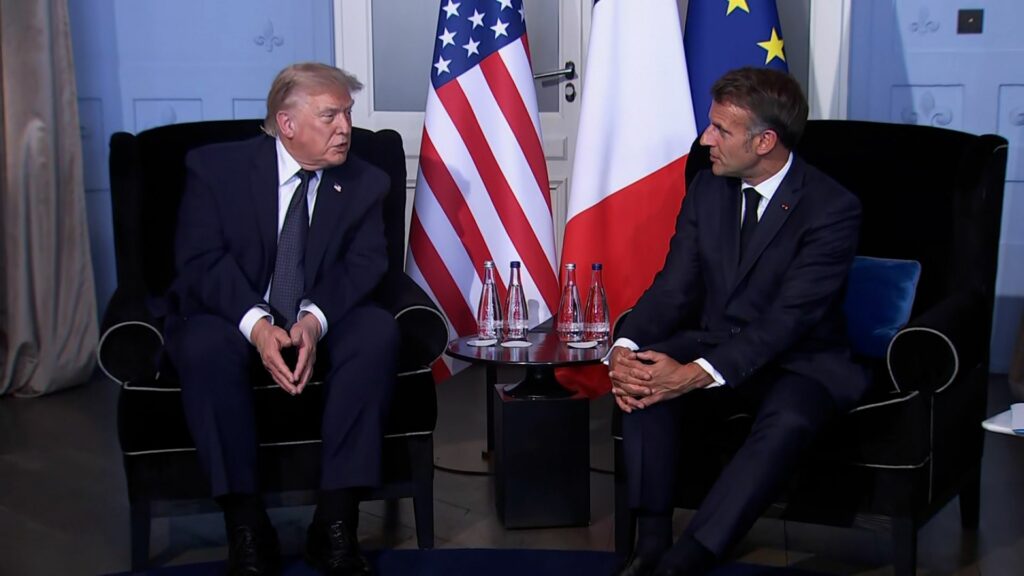
Trump was as usual rambling at the press conference at the G7 meeting. He was unpredictable during the indirect talks with Iran and oscillated between wild threats and unfounded claims that a deal would be signed any day. The new and more radicalized leadership in Iran, which he called ‘regime change’, felt embolden and did not take him seriously.
In his eager to end the war before his birthday and the start of the FIFA World Cup this week, and to open the Strait of Hormuz for fossil fuels tankers, Trump decided to announce ‘victory’ without achieving any of the goals that had motivated the US-Israeli preemptive joint attack against Iran on 28 February.
“The deal with the Islamic Republic of Iran is now complete,” Trump posted on Truth Social on Sunday evening. “Congratulations to all! I hereby fully authorize the toll-free opening of the Strait of Hormuz, and, simultaneously herewith, authorize the immediate removal of the United States Naval blockade. Ships of the world, start your engines. Let the oil flow!”
According to the MoU, Iran and the US commit to negotiate and reach a final agreement within a maximum period of 60 days, which may be extended by mutual consent. What is strikingly missing in the MoU is that any mentioning of any limitation of Iran’s ballistic missile programme and its support to ‘proxies’ and terrorist organisations, such as Hamas in Gaza and Hezbollah in Lebanon.
The nuclear issue unsolved
Trump has assured that the Iran will never be allowed to develop or acquire nuclear weapons. The nuclear issue is included in the MoU but the details are left to be negotiated after the signature of the MoU.
“With an agreement or without an agreement, Iran will not have nuclear weapons – not today and not tomorrow,” Israel’s Prime Minister Netanyahu stated earlier this week, believing that Iran this time is deterred by the risk of war if the MoU is not implemented. The Iranian regime has shown that it does not care about the losses in the war and the economy of the country as long as it survives.
Iran “reaffirms that it shall never produce or develop nuclear weapons” but that it has done also in the past. In the meantime, it continued to build up a stockpile of 440 kilograms of highly enriched nearly weapons-grade uranium, enough for several nuclear bombs. How that stockpile will be “diluted” or extracted from Iran remains to be resolved.
The same can be said whether Iran can be trusted to enrich uranium for civilian use on its soil. Now the US and Iran have “agreed to discuss the issue of enrichment based on a satisfactory framework being agreed upon in the final deal”. Until that is reached, the status quo on Iran’s nuclear program will be maintained and the US will not impose new sanctions or deploy additional forces in the region.
The EU is rightly skeptical to whether the Trump administration has any competence left to negotiate the nitty-gritty of a new nuclear deal which will be better than the 2015 Joint Comprehensive Plan of Action (JCPOA). In 2018, the first Trump administration cancelled it unilaterally at the insistence of Israel’s Prime Minister Netanyahu.
Asked at the EU foreign affairs council meeting on Monday if it is time for the EU to participate in the talks, its foreign policy chief Kaja Kallas responded positively. She mentioned especially that the EU has expertise when it comes to the nuclear negotiations and can offer help to its American counterparts. Whether the US will include the EU in the talks is uncertain.
“The toughest phase of the talks still lies ahead,” Kallas summarized in her press remarks after the meeting. She welcomed the news about the MoU as a potential “potential breakthrough which can give much needed space for deeper negotiations on Iran’s nuclear programme and other critical issues”.
Uncertainty about Lebanon
The US and Iran also declared, once the MoU is signed, that it will end immediately and permanently the war on all fronts, including Lebanon. Hezbollah launched unprovoked attacks from Lebanon against Israel and refuses to disarm.
The terms in the MoU are vague and do not call on Israel to withdraw its troops to the internal border before a political solution is found. Both sides are told to refrain from the threat or use of force against each other and ensure the territorial integrity of Lebanon.
According to the MoU, the final deal will confirm the permanent termination of the war. The MoU does not refer to the separate direct talks between Israel and Lebanon on maintaining the fragile ceasefire between them and achieving a political solution which would result in the disarmament of Hezbollah and the withdrawal of Israeli troops to the internationally agreed border.
On Lebanon, EU leaders did not speak plainly. “Of course, there can be no peace in the Middle East while Lebanon is in flames,” von der Leyen said, stopping short of calling on the disarmament of Hezbollah.
Kallas said that the EU has approved a 100-million-euro assistance package for the Lebanese army to strengthen state authority and support the disarmament of Hezbollah. The EU is also advancing work on a new EU mission in Lebanon but that will hardly be enough. The UN peace keeping force (UNIFIL), whose mandate ends by 2026, failed in preventing Hezbollah’s presence at the Lebanese-Israeli border.
While Iran and the US undertake to respect each-other’s sovereignty and territorial integrity and refrain from interfering in each-other’s internal affairs, Hezbollah continues to be part of Iran’s ‘Ring of Fire’ or Axis of Resistance. Nothing is said about Iran’s interference in Lebanon and its existential threats against Israel. There is no logic in allowing Iran to keep its financial and military links to Hezbollah.
Up-front payment to Iran
In fact, the US has succumbed to Iran’s demands and is prepared to pay them up-front for agreeing to a temporary MoU which might lead to a permanent agreement. The US will begin lifting the naval blockade against Iran in return for Iran ensuring the resumption of commercial vessels through the Strait of Hormuz to pre-war levels “with no charge for 60 days”.
The US also commits to end all sanctions against Iran, to issue waivers for Iran’s export and to release frozen Iranian funds upon the implementation of the MoU. These funds, estimated to over 20 billons dollars, will allow the economic survival of the Iranian regime. In addition, the US and its regional partners (Gulf States) will raise funding of 300 billion dollars for the economic rehabilitation of Iran.
The reopening of the Straight of Hormuz, as an immediate result of the MoU, are good news for the EU and the global economy. But the EU remains cautious and does not take Iran’s commitments for granted. EU leaders von der Leyen and Costa have stated that the EU will only consider lifting sanctions against Iran if the country changes its behaviour.
Among EU Member States, Belgium’s Prime Minister Bart De Wever has cautioned that significant uncertainties remain. "The stability of the Middle East is inconceivable if Iran acquires a nuclear weapon. The question of Iran's nuclear ambitions, therefore, remains highly relevant. That was, moreover, the central issue behind the US military intervention."
“The end of the war under the emerging conditions is probably not good news for any Israeli citizen,” commented Amos Harel, military correspondent in Haaretz, Israel’s leading opposition newspaper, “because at the moment it seems that Iran is emerging from it stronger and more determined”. His book “06:29 – Anatomy of A Failure” has recently been published.
Many question marks still hover around the agreement, he writes. He has been critical against the Netanyahu-government’s continuation of what he describes as a senseless war in Lebanon which cannot bring about the disarmament of Hezbollah. The war has resulted in mass displacement of civilians and the destruction of their homes in southern Lebanon without providing security to north Israel.
This has only played into the hands of Hezbollah which can claim that it defends Lebanon while it actually is taking orders from Iran. The Lebanese army must be reformed and strengthened so that it can confront Hezbollah without risking civil war. Hezbollah must be disarmed of its rockets, drones and heavy weapons and transformed to a normal political party which cannot drag Lebanon into any wars.
In the most optimistic scenario, the MoU will pave the way for talks which will result in lasting and binding solutions of all the issues which triggered the war. The weapons will be silent on all fronts while the US – Iran talks continue until the agreements are achieved. The EU will act where the US has failed and become a player which will use its leverage to contribute constructively to the solutions.
In recent days, the EU has spoken mainly to its Iranian and Gulf counterparts and highlighted is relationships with the Gulf States that were attacked by Iran. It has not shown a similar solidarity with Israel. If the EU stands ready to contribute to a sustainable resolution, as Kallas twitted on X, it needs also to engage with Israel where a new government is likely to win the elections later this year.
