

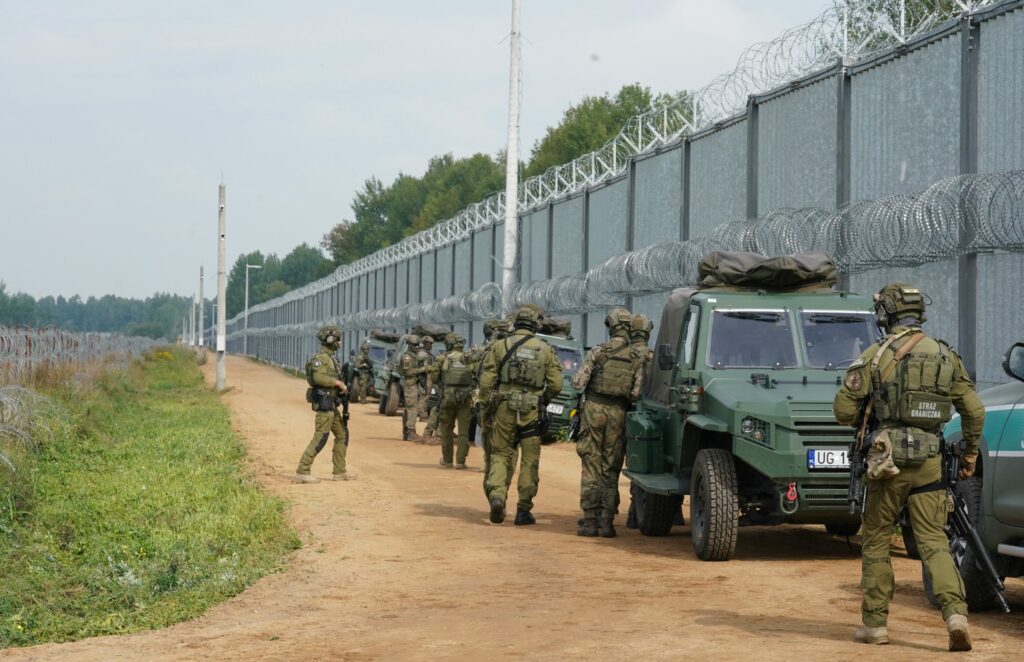
From the Baltic to the Black Sea, Europe’s eastern border regions are no longer outlying corners of the Union. They are where Europe’s security and sovereignty are tested - daily, brutally, and without pretence.
In the shadow of Russia’s war against Ukraine and Belarus’s complicity, these regions have become the EU’s strategic vanguard. Yet Brussels still treats them as a cohesion issue rather than a geopolitical emergency.
The European Commission’s Communication, 'Strong regions for a safe Europe,' moves in the right direction by recognising their strategic role. But the paper reads like a diagnosis without a treatment plan, and without the funding to match.
These regions face a convergence of pressures that standard EU tools cannot address: hybrid warfare, demographic decline with losses of over 17% in a decade, and economic disruption as Russia's invasion has cut growth, driven inflation, and severed trade routes, turning cross-border hubs into dead ends.
This cannot be solved with cohesion tools, as it is a geopolitical fault line.
Resilience as a competitive edge
At the same time, these regions have demonstrated remarkable resilience and rapidly reduced energy dependence on Russia, strengthened defence capabilities, and adapted their economies under extreme pressure. They have become testing grounds for innovation in security, logistics, and crisis response, while maintaining open markets and supporting Ukraine.
This resilience is not only a success story; it is a competitive advantage. It shows that, with the right support, these regions can serve as engines of stability, innovation, and growth for Europe as a whole.
Initiatives like the Eastern Flank Watch and the European Drone Defence Initiative are welcome, but cohesion policy alone cannot withstand a shock of this scale.
What is needed is a unified EU shield — across land, air, sea, cyber and space — backed by dedicated crisis funding. Dual-use infrastructure must be prioritised: TEN-T corridors from the Baltic to the Black Sea and the Aegean; resilient energy grids free from Russian gas; rail links to Ukraine and Moldova for trade recovery; and digital connectivity via fibre and IRIS². These investments must support local jobs, SMEs and regional supply chains.
The Commission’s reliance on reallocating existing funds through mid-term cohesion tweaks and higher co-financing is not a strategy, it is incrementalism. The scale of the challenge exceeds national budgets.
There is no other way than to call for new funding in the 2028–2034 Multiannual Financial Framework: targeted support under the European Competitiveness Fund through specific programme calls for eastern border regions.
From compensation to transformation
An EastInvest Facility should be launched now, combining grants, InvestEU and EIB guarantees to lower SME borrowing costs, and one-stop shops for investors. State aid rules should be revised and adapted for the specific needs of eastern border regions, alongside stronger investment support.
The focus must shift from compensation to transformation, including Horizon Europe missions for defence technologies, bioeconomy, and clean energy clusters. This is not about patching gaps, but about rebuilding resilience.
At the same time, EU youth programmes - ALMA, the Youth Guarantee, the Solidarity Corps - must evolve into retention tools offering skills, housing, and childcare in order to tackle the silent demographic crisis.
A Demographic Revitalisation Initiative should support families and returnees, alongside mental health measures for populations living under sustained pressure. Cultural and educational programmes can strengthen societal resilience: this is a security policy.
The Commission should anchor this approach through an annual high-level dialogue on eastern border regions, a post-MFF strategic framework under the Territorial Agenda 2030, and regular monitoring of socio-economic and security indicators. These regions must be treated as a shared European priority.
Europe’s East is not the periphery; it is the frontline. Strong regions mean a safe Europe, but only if ambition is matched with resources. The European Economic and Social Committee has outlined the path in its opinion 'Strategy for Eastern border regions'. The EU must now follow it.
