

Ukraine’s reconstruction cannot be treated as a post-war exercise. It is already central to Europe’s security, credibility and the future of EU enlargement.
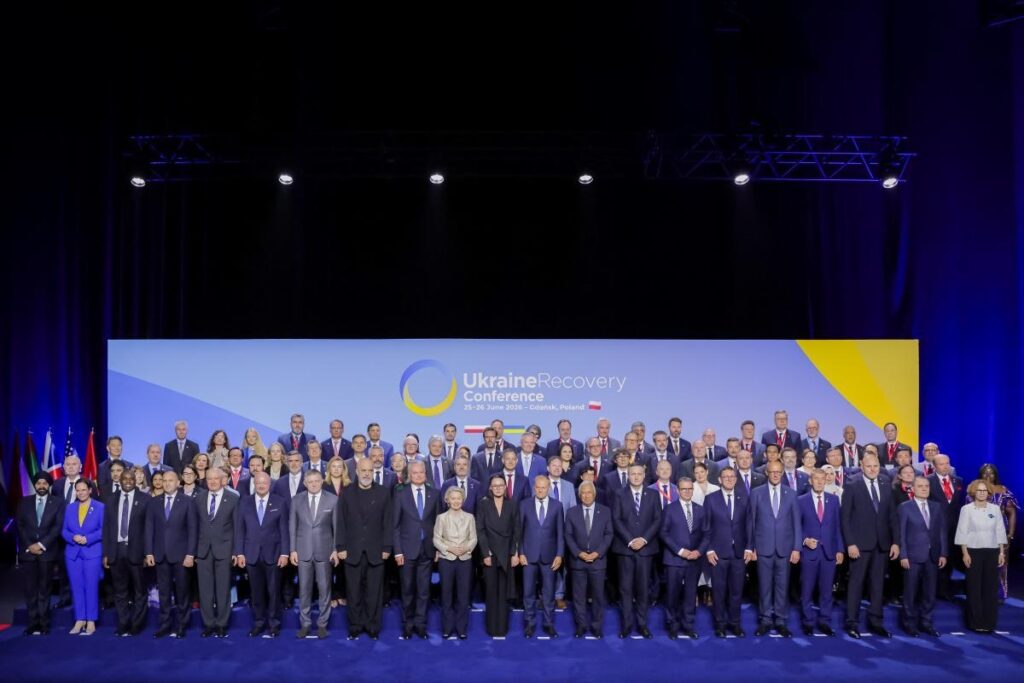
Last week, Poland hosted the fifth Ukraine Recovery Conference (URC). For the first time since the conference series began in Lugano in 2022, President Volodymyr Zelensky did not attend in person, following recent diplomatic tensions with Poland's President Karol Nawrocki. In the run-up to the event, some even questioned whether the conference would proceed as planned.
It did. Prime Minister Donald Tusk hosted the conference in his hometown of Gdańsk, where he received repeated expressions of gratitude from Ukrainian and European leaders for Poland's steadfast support. Ukrainian Prime Minister Yuliia Svyrydenko thanked Poland for standing with Ukraine through its darkest moments, while European Commission President Ursula von der Leyen and leaders from across Europe reaffirmed that Ukraine's future lies firmly within Europe.
The political message was unmistakable: despite the recent tensions between Zelensky and Nawrocki, European support for Ukraine remains united.
Recovery meets security in Gdańsk
Since its launch in Lugano in 2022, the URC has become the principal annual forum for coordinating international support for Ukraine's reconstruction. The inaugural conference produced the Lugano Declaration, establishing seven guiding principles for recovery.
Since then each successive edition, from London and Berlin to Rome and now Gdańsk, has broadened both the scope and ambition of the conference. The Gdańsk edition was structured around five pillars: business, the human dimension, local and regional recovery, EU integration, and — for the first time — security and defence.
The addition of a security dimension, proposed by Poland, reflected a fundamental shift in thinking rather than a simple expansion of the agenda. More than four years into the war, recovery and security have effectively become two sides of the same policy agenda.
What is at stake?
According to the latest Rapid Damage and Needs Assessment (RDNA), Ukraine's reconstruction and recovery needs had reached approximately USD 588 billion by the end of 2025, roughly three times the size of Ukraine's pre-war GDP. As the war continues, so too does the destruction, pushing reconstruction needs ever higher.
The EU, with its Ukraine Facility worth EUR 50 billion, has been Ukraine’s largest financial supporter. The URC also announced the disbursement of the first €3.2 billion tranche under the EUR 90 billion Ukraine Loan. However, these funds are primarily directed toward Ukraine’s budgetary support and immediate emergency recovery rather than long-term reconstruction.
Closing that gap will ultimately require mobilising private capital. Even though the URC resulted in more than 160 agreements worth up to €10 billion, most of the funding announced in Gdańsk came from governments and international financial institutions rather than private investors. Business follows predictability, and predictability requires security.
Without credible security guarantees, Ukraine is unlikely to attract investment at the scale needed for reconstruction. Public funding can keep the country functioning, but it cannot rebuild it alone.
Who will rebuild Ukraine?
As of early 2026, nearly 5.9 million Ukrainian refugees remained abroad, alongside around 3.7 million internally displaced people and 10.8 million people in need of humanitarian assistance. While many Ukrainians still hope to return, according to UNHCR, the share of refugees intending to return declined from 83% in 2022 to 61% in 2024, suggesting that many may remain abroad for years.
This makes investment in human capital just as important as investment in security or infrastructure. Ukraine and its European partners need to create conditions that encourage refugees to return while also enabling those who remain abroad to contribute through investment, entrepreneurship, skills, remittances, and sustained links with Ukraine.
At the same time, Ukraine is home to around 1.8 million veterans, with some estimates suggesting this number could eventually reach five million. Their experience, leadership, and resilience represent one of the country's greatest strategic assets. As European Council President António Costa argued during the conference, veterans should become a central pillar of Ukraine's recovery.
Together with the Ukrainian diaspora, they will shape Ukraine's reconstruction for decades to come. Realising this potential will require policies that support veterans' integration into civilian life, the labour market, public service, and the security and defence sectors, ensuring that their experience continues to strengthen Ukraine long after the war.
EU accession guiding Ukraine’s reconstruction
Ukraine's reconstruction and its EU accession are increasingly inseparable. Beyond financial support, the accession process provides the institutional framework for rebuilding the country in a sustainable way by strengthening the rule of law, fighting corruption, reforming the judiciary, improving public administration, and enhancing the institutional capacity needed to absorb and manage reconstruction funds effectively.
Following the opening of the first negotiating cluster on the fundamentals, Ukraine now faces an ambitious reform agenda. Progress has been uneven, however. According to civil society assessments, implementation of the Kachka–Kos EU integration plan, which focuses on anti-corruption and judicial reform, has so far reached only around 15%, highlighting the scale of the work still ahead.
At the same time, responsibility does not rest with Ukraine alone. The credibility of enlargement depends on both sides delivering. A genuinely merit-based process requires Ukraine to continue implementing reforms, while the EU should also respond when those reforms are delivered. Allowing bilateral disputes to obstruct accession, as illustrated by the year-long delay in opening the first negotiating cluster due to Hungary's veto, risks undermining the credibility of the enlargement process precisely when it is most strategically important.
From a distant prospect to an urgent policy priority
While President Zelensky was absent from Gdańsk, Ukraine’s presence on the battlefield remained impossible to ignore, including successful long-range operations in both Russia and in Russian occupied territories. This will surely accelerate the pressure on Putin to move towards the negotiating table sooner rather than later, shifting reconstruction from a distant prospect to an urgent policy priority.
This raises the need to place Ukraine’s recovery higher on the agenda, structured around three interconnected dimensions: mobilising private capital backed by credible security guarantees, prioritising the human dimension including forced displacement and veteran integration, and ensuring that EU accession remains a fast-moving rather than stalled framework guiding reconstruction.
