

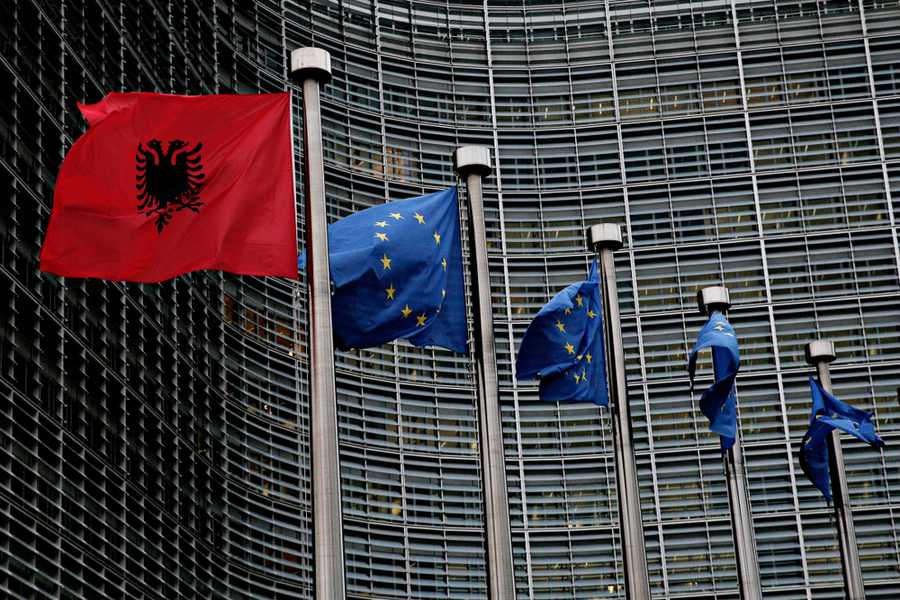
Dear Europe, dear European Union,
Only a profound spiritual bond and an unwavering belief in the values of the European Union give me the courage and confidence to address you through this open letter.
My name is Ariona Bundo. I was born and raised in Albania and, like many Albanians of my generation, I left for France at the age of eighteen. Today, I have lived there for over twenty years.
As the world follows the developments of the Albanian crisis, allow me to share with you, in simple words, a truth that I have witnessed and lived through my own experience and life. This experience, though painful, is unfortunately similar to that of many Albanians. Indeed, I can even say that in certain respects it has been more privileged than the experiences of many of my fellow countrymen.
To understand the present, I must return to my childhood. I was born under communism. My father was frequently the target of attacks and surveillance by the regime. A heavy biographical shadow hung over him permanently, not because he had committed any crime, but because neither he nor his family had ever been members of the “Partia e Punes” (Party of Labour).
My earliest memory in life is a terrible scene between my parents. My mother, pregnant with my brother, experienced this climate as a crushing burden on our future. I will never forget the nights filled with tension and devoid of hope for a better life. I remember myself at four years old, terrified, vomiting from fear and falling asleep in tears.
My father was never interned. I believe he was spared by his unwavering work ethic, his dedication to education, scientific research, and knowledge. Shortly before the fall of communism, he became a university professor.
The regime changed, but that scene remained the invisible thread running through his entire life. It became the central theme connecting every regime that followed, because in Albania systems have often changed, but the behaviour of those in power and the methods of governance have not.
In the 1990s, as Albania was sinking into the catastrophe of the pyramid schemes, my father spent months warning the public. He wrote in newspapers, spoke to anyone willing to listen, and tried to explain to Albanians that pyramid schemes were fraudulent; that rapid enrichment without work, driven by money laundering, could only one day lead to ruin.
The response of the government of the time, led by Sali Berisha, was to remove him from the University of Tirana by using legal mechanisms inherited from the communist era, mechanisms designed precisely to silence dissenting voices.
For our family, this was a tragedy. In the midst of an aggressive and chaotic transition that often seemed anything but post-communist, we were left virtually destitute. For eight years, the four of us lived in a room of only eighteen square metres. We shared toilets with more than eighteen other families on the same floor. Those were difficult years, but also years that taught me a great deal.
My father continued to study, conduct research, write, and teach in both Albania and France. He was a socialist in the noblest sense of the word, believing in humanism, education, solidarity, and love for others. He believed in a society and a state with a human face. But one day another humiliation arrived. In front of the entire leadership of the Socialist Party, Edi Rama publicly called him a “peasant” (we now know he is a bully and that was no exception).
Yes, my father had been born in a poor Albanian village, to poor, non-communist parents. But the insult was not accidental. It was intended to diminish the value of the ideas he brought for the future of Albania and the Socialist Party. It was an insult aimed at crushing the legitimate protest of the students of the University of Tirana against poor governance, supported by several lecturers, among them my father. Ideas that spoke of development without sacrificing sovereignty, modernisation without losing dignity, growth without selling the country’s territory, progress without driving away its intellectual capital and without destroying hope.
Because this is what happens when power becomes inheritance rather than responsibility. It is not always ideology that causes the greatest harm. It is the methods. The methods of moral persecution, arbitrary exclusion, intimidation, and the mafia-like logic of “either with me or against me.” This is precisely why so many of us not only wanted to leave Albania, but ultimately felt that we could never return. For me, this is the era of Edi Rama, the current Prime Minister of my country.
When Edi Rama first became Prime Minister, I too, like many others, was full of hope. At the time, I was already working in the financial markets in France and earning well for my very young age. Nevertheless, I applied to the Prime Minister’s talent platform because I wanted to contribute to Albania voluntarily and without any remuneration if possible in the area of education.
I genuinely believed that the government was sincere in its call to professionals educated abroad, as I was. I was deeply disappointed by the coldness and lack of response from the party loyalists who had filled the courtyards of Rama’s new centres of power. Disappointment is the highest degree of human despair.
You see, I come from a family of teachers, and education has always been an almost sacred value for us. I remember that when my parents struggled immensely to feed us and themselves, we still read books by candlelight. We had only two hours of electricity a day and often only one hour of running water... (In some areas of Albania, this reality is unfortunately still the same today.) Yet we filled our time solving mathematics problems, talking about literature and the stars. It was the protective bubble our parents built around us. It saved us. It preserved us. Very early in life, I understood something that some people realise only at the end of their lives: education, love, and strength of spirit can save a person even from the darkest nightmares.
But Edi Rama, always a master of communication and appearances, a painter who knows how to paint the surface better than the reality, gradually surrounded himself with people similar to himself. Some were former peers of mine, educated at the same school; some were former members of the Karl Popper debating club where I went for a year or two; many came from the same circles and environments. Many of them were children or grandchildren of figures from the communist nomenklatura – of which I wasn’t.
Even more troubling was the fact that they often possessed little experience in leading institutions or governing, yet carried ambitions and responsibilities that exceeded their professional expertise and competence. I was disappointed that I could not bring and place my own small stone in the building of my country. Yet I continued to hope. Until I no longer could.
This brings us to the last five or seven years.
Like many other Albanians, I carry within me a profound love for my country, for its identity, culture, language, people, landscapes, and history. I love my country deeply—its fields, mountains, rivers, sea, coastline, villages, neighbourhoods, roads, and springs.
Abandoned villages are a tragedy for my country and for the Europe into which we seek to integrate. Throughout all the years I have lived in France, I have returned to Albania at least two or three times each year, spending almost all of my holidays there and allocating a significant portion of my savings. I wanted to contribute to the development of my country, support Albanian businesses, consume Albanian products and services, and, in my own modest way, place a small stone in strengthening demand for products made in Albania and in building Albania itself.
Yet year after year I have witnessed, and continue to witness, an increasingly troubling reality. Prices began to reach levels comparable to those of European capitals (really? For the poorest country of Europe?) while the purchasing power of ordinary Albanians, including my own parents, continued to diminish. Fuel, vegetables, electricity, telephone service charges, housing rents, and drinking water in a country blessed with abundant potable water are more expensive than in Europe.
I saw this every time I returned to Albania: in markets, in restaurants, in people’s conversations, and above all in the daily exhaustion of those who work honestly and yet find it increasingly difficult to live with dignity. At the same time, towers seemed to spring from the ground almost overnight, accompanied by questionable stories and even more questionable sources of financing.
Living in Paris and having studied not only finance but also art history and architecture (night courses), I found it difficult to understand the quality of the urban development taking shape in Tirana. I questioned the infrastructure plans, the long-term vision, and the manner in which the city was evolving. But above all, I questioned the financing.
The final shock that left me deeply unsettled came when the notary my husband and I had chosen for the purchase of our apartment in Paris casually mentioned that many of his multimillionaire clients were investing massively in real estate in Albania. I was not entirely surprised. Nevertheless, when the notary spoke to me about this phenomenon, I asked what made Albania so attractive. His answer still sends shivers down my spine today. According to him, Albania represented an opportunity to circumvent the restrictions that exist in other European jurisdictions regarding the circulation of capital, because it required far less transparency and far fewer explanations concerning the origin of funds.
Capital invested in property today could gradually be integrated into the European economy and acquire a form of legitimacy that would be much more difficult to obtain elsewhere. I was speechless. Shocked. Disgusted. And above all, profoundly saddened.
And thus we arrive at the present moment.
The Albanian government has undertaken a series of highly controversial legal and unconstitutional changes, including laws affecting protected areas, the Mountains Package, and the way the country’s territory is treated.
The government has granted and continues to grant concessions to foreign investors, to well-known names with a high degree of influence over Albanian politics and decision-making. In response, citizens from every layer of society have at last, and rightly so; begun to raise their voices.
What is happening today is far greater than a political debate or a clash between parties. People are demanding the rule of law, equality before the law, respect for the Constitution, an end to nepotism, an end to corruption, an end to the capture of public institutions, and an end to shadow economy, but also an end to a system in which connections matter more than merit and where citizens’ trust has been eroded year after year.
Above all, people are demanding the protection of Albania’s sovereignty and of our natural heritage; a heritage that nature has taken thousands of years to shape, but which can be destroyed within a few months or even a single night.
Perhaps many of those observing us from abroad do not fully understand the special bond Albanians have with their land. Yet whether it is a shepherd in the Albanian mountains or a finance professional writing from Paris, that bond remains the same.
Our mountains, rivers, sea, coastline, and villages are not merely landscapes. They are our collective memory, our roots, part of our identity, our culture, and our anthropology. They are where the roots of our life and language lie. This is precisely why so many people are prepared to stand up and defend them. Because they are not defending merely a territory; they are defending their identity, their land, and their nature. They are defending precisely those values that Europe itself claims to protect and promote.
I could say much more about the current crisis and the way the government is responding to it. I could speak about citizens who are labelled “defectives,” mad, or ignorant simply because they dare to raise their voices. I could speak about the vulgar and contemptuous language that a Prime Minister should never use toward his own citizens, even when he disagrees with them. There is one thing I can neither forgive nor tolerate: I cannot tolerate a country’s Prime Minister bullying the citizens of the country he governs simply because they have the courage to oppose him and speak the truth openly. But beyond political debates, there is a simple truth: a leader should elevate his nation, not humiliate it; should embody dignity, not contempt; should unite, not divide.
And this brings me to my final point.
What pains me most is the fact that so many Albanians see Europe as their last hope. The paradox is extraordinary. We are a people asking Europe to accept us, even though we have been part of it throughout our history.
We are European geographically, historically, culturally, and spiritually. We live in the heart of the Mediterranean and within a space that has been part of European history for thousands of years. Our desire to integrate into Europe has nothing to do with particular individuals, even when they hold high political office, but with the enduring ties through which fate and history have bound us to Europe. More than half of our nation’s population lives in Europe.
Nevertheless, I began this letter with Europe, and I wish to conclude it with Europe as well. Whatever the response to our call may be, we are Europeans and we will remain Europeans. History has made us so. Geography has made us so. Our contribution to this continent has made us so. Therefore, when the day comes, please welcome us standing upright, with our heads held high and with dignity.
Not on our knees. Not once more.
With respect, hope, and unwavering faith,
Ariona Bundo
