

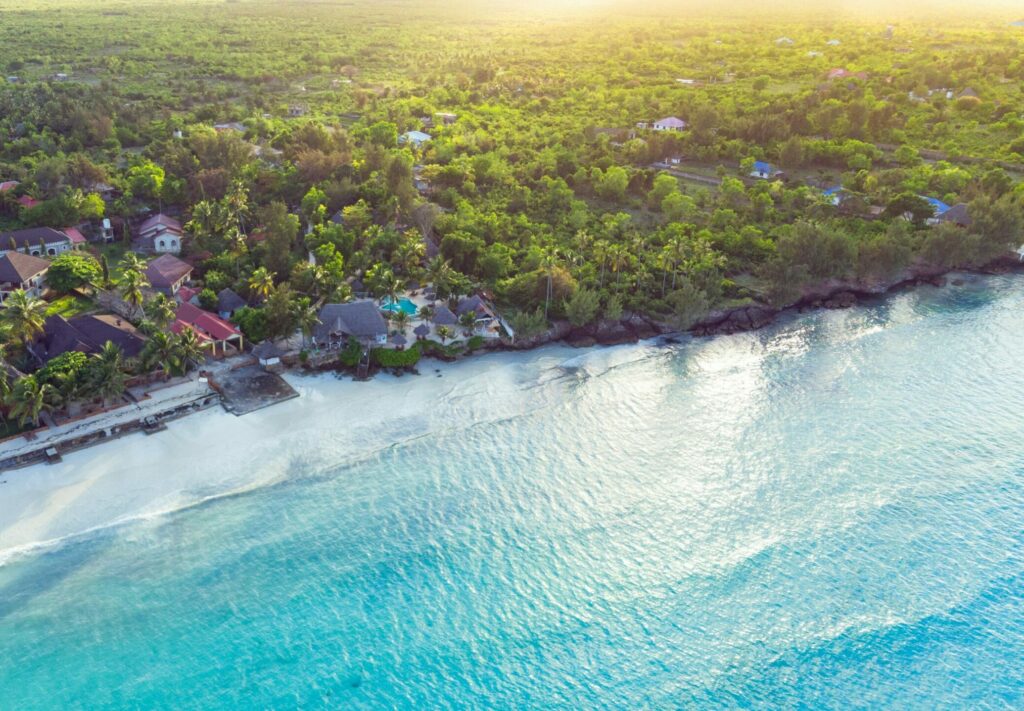
A year ago I was barefoot in the sand on a small island off the coast of Tanzania, taking a break and choosing to do something different than my usual policy expertise work.
I opened an eco-lodge where “the tide meets the wild” as we like to say. We decided to leave the surrounding jungle as it was, alive and unapologetic. Many people told me “cut the trees”, “make a clean garden”, preferring something controlled.
But I could not replace something living with something designed. So the jungle stayed and we built around it.
We did something that is still, strangely, rare in our modern world. We allowed nature to stay and co-exist with us.
In the eco-lodge, we can hear the rustle in the leaves, the calls of bush babies that can sound like distant infant voices, or the tiny bats whistling like birds. Yet, without exception, every guest who stayed with us moved beyond that initial unease within a few days, sleeping more deeply, becoming calmer and more present, as if reconnecting with something instinctive that modern life had long kept quiet.
As a lawyer and policy advocate, I cannot ignore what that means. Coexistence is not a poetic concept. Coexistence depends on how much room you are willing to leave for what you do not own or know, but is still essential to human life.
That is a harder proposition at sea. The ocean looks empty from the beach or the deck of a ship. Beneath the surface it is anything but: currents that regulate the climate, plankton that produce much of the oxygen we breathe, and the longest migrations on the planet.
Whales, turtles and fish cross the lines we draw on maps without any idea that they exist. Cables, container routes, fisheries and wind farms cross them too Everything meets in the same water, and almost none of it is designed to meet well.
Europe has more of that water than any other region. The EU holds the largest marine territory in the world, a fact repeated often in Brussels and acted on rarely.
The upcoming EU Ocean Act is the moment to change that. We need the EU to lead the way and commit to protect 30% of EU waters by 2030 aligned with global ambitions of the High Seas Treaty to connect European ecosystems with the wider ocean including other territories; by strengthening the planning of maritime activities, seeking balance, not just allocation; by advancing ecosystem-based fisheries management and protecting marine life including migratory corridors, what I like to call “corridors of peace” because caring for our shared ocean unites us and offers a powerful path toward peace.
In a fractured global context, as a rare, tangible example of something that could connect us beyond borders rather than divide us.
Because what I saw in Tanzania was simple, but not minor: fear can turn into familiarity. Distance can become relationship. But only if space is allowed for it. Coexistence is not the absence of tension. It is a framework that lets different lives continue side by side. The Ocean Act, with ambitions and financial support, can be a key vehicle to enforce coexistence within the EU and beyond.
This summer if you have the chance to be by the sea, it is time to listen to that instinct. Look at the horizon, and notice that it is not a line dividing anything. It is the one border on earth that nothing respects and everything crosses.
We could write our law to match it.
