

Europe is experiencing the impacts of climate change firsthand: repeated heat waves, massive wildfires, and major financial losses for farmers.
These changes have already contributed to up to 10,000 excess deaths, and Europeans are increasingly recognizing that climate change is not a problem of the future. It is happening now, transforming everyday life.
What Europeans may not fully realize is how their own growing appetite for soy and cattle, sourced far outside their borders, is helping drive the very changes they are living through.
Europeans have grown in their understanding of the need to conserve forests. What has not grown at the same pace is any willingness to change the consumption patterns driving their destruction, or to protect the wider ecosystems that regulate our shared climate. The result is a new EUDR law that, as much as it has the right intentions, risks displacing deforestation from the Amazon rainforest to the Cerrado and other Brazilian biomes rather than preventing it.
As the leader of an organisation representing Brazil’s Indigenous Peoples, I've witnessed the climate crisis unfold for years, much of it driven by environmental damage that feeds supply chains leading straight to European consumers. For us, the consequences of climate change were never hypothetical or distant. We saw our territories change decades ago. This is why this summer I was in Paris, Brussels and London speaking with political and civil society leaders on how the current EUDR could worsen deforestation and threaten clean water availability in the Cerrado.
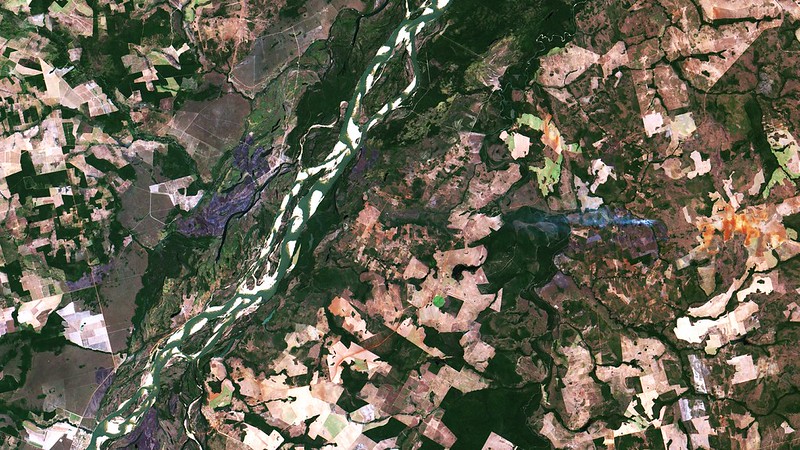
The European Union Deforestation Regulation (EUDR), which comes into force at the end of December, excludes territories in other biomes because they do not meet the regulation’s strict definition of forest, which requires at least 10% tree cover. The Cerrado is a clear example: it contains many of the headwaters that feed the Amazon basin. More than half of Brazil’s soy is grown in this biome, and today European consumption of soy, beef, and leather already causes more damage to the Cerrado than to the Amazon.
Europe’s hidden footprint
Europeans may be surprised to learn that their soy imports carry a higher carbon footprint than soy exported to China. This is because European soy comes largely from Brazil’s Cerrado, a tropical savanna rich in biodiversity that Indigenous Peoples have protected for centuries but that is now being rapidly converted into monocultures. Demand for EU commodity imports is driving the clearing of new areas, while soy exported to China largely comes from lands that were deforested decades ago.
New data released just days ago shows the scale of that cost. The Cerrado remains Brazil's worst-affected biome, with 8.7 million hectares burned last year, an area larger than the whole of Ireland. Up to 80 percent of that burned area was native vegetation. While the burned area in the Amazon fell, it rose in the Cerrado. This is what we mean by displaced harm: deforestation does not disappear, it moves, and it leaves us all with a warmer planet, more lost lives, and greater financial cost.
Over the past 16 years, soy fields across Brazil have grown by an average of 6,000 football fields every day, fuelled in part by Europeans' growing appetite for soy-fed dairy. In the Cerrado, the average pace of expansion over the past two decades has been 713,000 hectares of new soy fields every year, an area three times the size of Luxembourg.
Industry is already exploiting this loophole, aggressively shifting soy and cattle expansion out of the protected Amazon and into the Cerrado, a region that draws far less political attention. Given that the Cerrado is the primary source of Brazil's soy exports to Europe, it is fair to ask whether this loophole is an oversight or a convenience.
Europe must protect ecosystems, not just forests
As the EUDR moves toward implementation, we urge the EU not to delay or weaken the law further, and we encourage European lawmakers to increase its ambition over time to match the scale of the challenge we face. The regulation must be expanded to cover all ecosystems where European consumption drives land conversion, placing Indigenous rights, land tenure, and Free, Prior and Informed Consent (FPIC) at its center.
Studies show that Indigenous Peoples and local communities are the best custodians of the world's forests, with lower deforestation rates and greater biodiversity on the land we steward compared to land managed by private or public entities. Between 2004 and 2019, Indigenous Peoples in Brazil protected 25 million hectares of forest that would otherwise have been cleared for agriculture and extraction.
Here in Europe, and at home in Brazil, Indigenous Peoples are fighting for the preservation of our territories and the protection of our rights. We do this not only for our own peoples, but for everyone who inhabits this warming planet.
We are all living through this crisis together. We must come together to fight it.
