

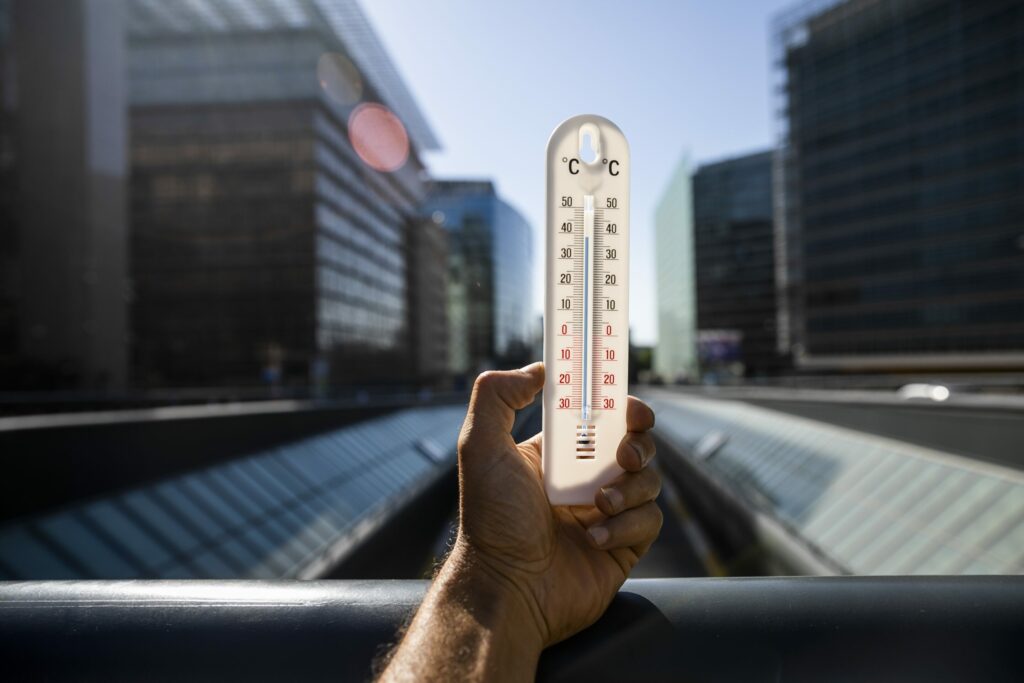
The prospect of mass migration triggered an emergency EU summit, the suspension of open borders, the deployment of troops, and the breakdown of diplomatic ties within a week. Over 10,000 heatwave deaths, 150,000 scorched hectares, and European rivers running dry produced a monitoring bulletin.
Both events unfolded at roughly the same time. Both took place in the same Europe, governed by the same institutions, staffed by the same officials, and bound by the same treaties. One was treated as an emergency. The other was filed.
The Ceuta crossing was a genuine transgression, apparently organised through social media and facilitated by the inaction of Moroccan forces at the border. It had real potential to escalate. But Spain kept it contained: Sánchez's government held the crossing within the enclave and sent most of those who had entered back within 48 hours.
Operationally, the crisis was over almost as soon as it began. Politically, it was a circus.
Europe's far right moved swiftly to hijack the narrative, in a reaction that had little to do with the facts on the ground and everything to do with controlling their meaning. Rome moved most aggressively of all.
Branding it an "invasion of Europe", Italian Prime Minister Giorgia Meloni pushed hard to suspend Schengen free movement with Spain. As fake news and out-of-context footage spread across digital feeds, the Italian demand gained rapid traction across the continent. Far-right actors across the Atlantic joined in, demanding Spain be punished with a cordon sanitaire against Madrid. Morocco, notably, was spared any comparable criticism.
The far right's argument, throughout, rested on a single word: security. It is their favourite word, yelled at every opportunity, so it's worth looking at its meaning:
Merriam-Webster defines security plainly enough: "the quality or state of being secure." It goes further, describing it as "the state of being able to reliably afford or access what is needed to meet one's basic needs." Over the years, european politics has kept the first and quietly dropped the second.
In today's political grammar, security has ceased to be a condition and become a contest, always with someone standing on the other side of it: an opponent poised to breach it, always ready to take it from you. That opponent always has a face - most of the time, a foreign one.
This was the far right's signature contribution to European politics, but it is no longer confined to the fringes. The mainstream has adopted the grammar wholesale, having watched it work. Police deployed, fences raised, crossings closed, press conferences held: the same performance repeated at every level of government. What it offers a frightened electorate is the reassurance that someone is in control and taking action. That reassurance need not correspond to any change in the underlying risk. It only needs to be seen.
What Europe's policymakers do not notice, or choose not to, is that the real breach is not at the frontiers. It is in the riverbeds.
The real security threat
Weeks of severe heat and scant rainfall have opened structural fractures across Europe where one ecological failure feeds the next. Heat has driven the Rhine and the Danube to historic lows, leaving cargo vessels to sail at a fraction of their normal capacity.
The same drought has forced nuclear plants to throttle output for want of cooling water, Hungary coming within millimetres of shutting down the reactor that supplies half its electricity. In the unirrigated fields of central and western France the maize is gone, a crop heading for its smallest harvest in fifty years with roughly a third of it lost.
Economists already put the bill in the hundreds of billions of euros, and it compounds, because this year's drained reservoirs are next year's starting baseline. None of this counts the dead. By the week Ceuta was dominating every front page, excess deaths from the heat had passed 10,000.
None of it is unknown to European policymakers. The EU has treated climate change as a security threat in doctrine since 2008, and linked it directly to crisis management and defence strategy in 2020. In June 2023, Brussels adopted a Joint Communication framing extreme weather, water scarcity and agricultural collapse as risks to peace and stability.
The same document states plainly that water scarcity and crop failure can drive displacement and social unrest. The causal chain, in other words, is written into Europe's own security framework in plain language, and signed by the same capitals that demanded action over Ceuta.
Yet, the continent mobilizes troops only for the final, visible symptom – while treating the underlying cause as an exercise in bureaucratic bookkeeping.
A politics built for the wrong crisis
So why the selective urgency from Europe's self-appointed guardians of security? Because their definition of security demands a performance, and ecological breakdown provides none of the requirements. A performance needs an opponent and a clear ending to satisfy the electorate.
Crises like Ceuta offer a tidy narrative arc – a beginning, a middle, and a conclusion inside a single news cycle. Ecological breakdown does not work that way. There is no victory to declare, only the next installment.
There are no grand initiatives to announce either, because the real answers are unglamorous. Initiatives like the European Green Deal, whether that means overhauling the Common Agricultural Policy, enforcing the Nature Restoration Law or extending carbon pricing to housing and transport, invite immediate backlash from farmers, industry and electorates who see only the cost of the transition. Such measures impose political costs now without offering symbolic returns, so action is systematically deferred.
The institutional failure is not operational, but incentive-driven. Europe has the capacity, the science, and the economic infrastructure to address these issues. But its political system has been hijacked to optimise to execute high-visibility interventions against symbolic threats, while freezing in the face of physical ones.
Urgent state action is reserved exclusively for threats that can be packaged and resolved before the next election.
Europe is guarding its gates while the house burns behind it.
