

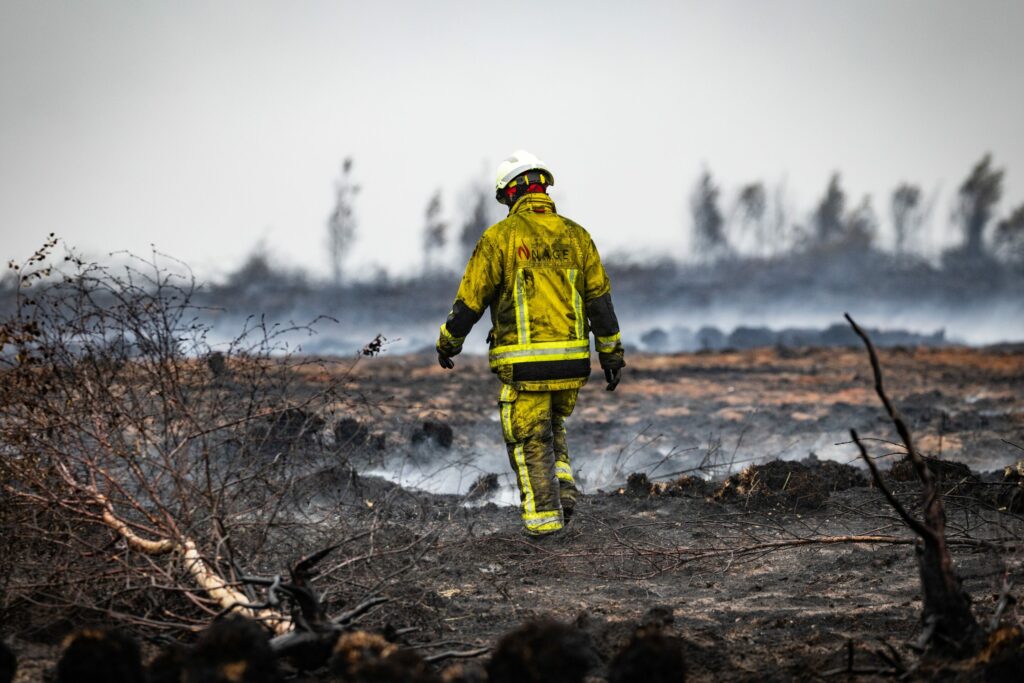
The images coming out of France and Spain, and increasingly across Europe and the Pacific Northwest of the US, are becoming painfully familiar.
Entire hillsides engulfed in flames. Firefighters pushed beyond their limits. Families forced to flee as another summer of record heat turns forests into tinderboxes.
While these stories are horrific for the hundreds of thousands of people displaced from dozens of communities, they are also part of a much larger, interconnected global story that is almost never told in the wall-to-wall breaking news coverage of the devastation.
Climate change is making wildfires more frequent and more destructive around the world. That trend is compounded by business models that clear natural forests for industrial plantations and agriculture. One of the fastest ways to slow this cycle is also one of the most obvious: stop financing the destruction of the world's forests and wetlands.
As Europe and North America burn, South America and Southeast Asia are entering another dangerous fire season. With El Niño expected to intensify dry conditions, vast areas of tropical forest and peatland are once again at risk of widespread fires as they are deliberately burned to clear land for industrial agriculture. Early signs in Indonesia are concerning, as 103,000 hectares have burned in the first half of 2026, well ahead of the typical peak of fire season in September and October.
These infernos should not be dismissed, or even categorized, as wildfires or natural disasters. They are human-caused catastrophes, the predictable outcome of decisions made in corporate boardrooms and bank headquarters that continue to reward forest destruction.
Over the last decade, financial institutions have provided $429 billion in credit to companies operating in sectors driving tropical deforestation such as beef, soy, palm oil, and pulp and paper sectors—the industries responsible for the vast majority of the world's tropical deforestation and peatland degradation.
Many of the world's largest banks—including JPMorgan Chase, Bank of America, Citi, MUFG, HSBC, BNP Paribas, SMBC, Rabobank, DBS, and UOB—have made public commitments to address climate change and biodiversity loss. Yet many continue to finance high-risk companies whose business models depend on expanding monocrop plantations by clearing forests or draining carbon-rich peatlands.
Banks behind the blazes
Recent analysis found that financing for these sectors has continued to grow since the Paris Agreement was signed. In the most recent reporting period alone, banks provided $72 billion to such companies, while investors held $42 billion in their shares and bonds.
For too long, financial institutions have attempted to distance themselves from the environmental destruction tied to the industries they finance. But capital is not neutral. Every loan, bond offering, or underwriting decision helps shape what happens on the ground.
The smoke currently filling lungs across southern Europe and North America should erase any remaining illusion that banks are somehow separate from the problems linked to their clients. Reckless conversion of complex forest ecosystems into industrial-scale, single species plantations, for the purpose of short term profit, is resulting in acute human suffering across the world and even real threats to the fundamental life support systems of our planet.
Instead of rewarding repeat offenders with access to easy capital, banks should require clients to adopt and enforce strong No Deforestation, No Peat, No Exploitation (NDPE) policies that protect natural ecosystems and explicitly prohibit the use of fire. They should verify that those standards are applied throughout supply chains, support fire prevention and local response efforts, and end financial relationships with companies that repeatedly fail to meet them.
Civil society is demanding banks also stop providing new loans, underwriting services, or refinancing to companies that have been found legally responsible for forest and peatland fires until they have completed restoration, compensated affected communities, and fully complied with court orders.
When forests burn in Indonesia, Brazil, or the Congo Basin, they perpetuate a brutal feedback loop by releasing enormous stores of carbon into the atmosphere, accelerating the warming that is making extreme fires more likely from the Mediterranean to North America. The same financial decisions that help drive tropical deforestation contribute to the parched conditions now devastating communities across the globe.
A decade of efforts to achieve systemic change through voluntary 'net zero' style agreements have failed to deliver, and even many of these half-measures are now being abandoned. For the sake of our forests and the well being of future generations, it is clear that the international financial system requires binding regulations to interrupt this vicious cycle.
Nothing else can hold these powerful institutions accountable for their financing and establish a new benchmark for acceptable lending and investment practices.
