
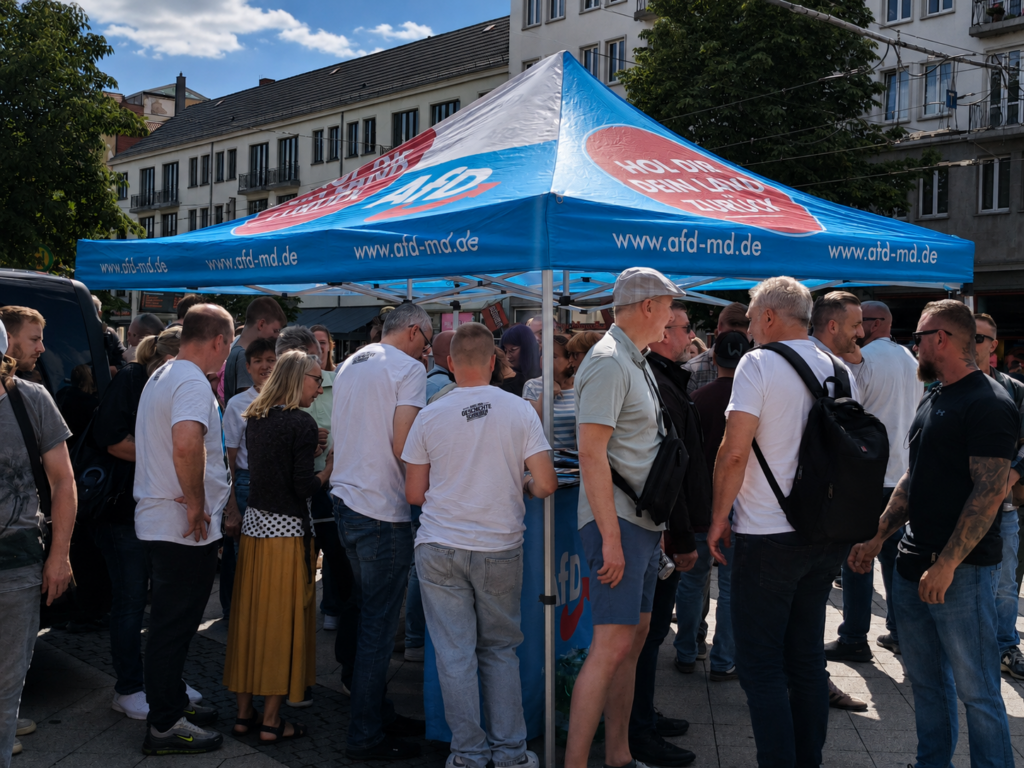
On Sunday, voters in the German state of Saxony-Anhalt will go to the polls. According to current surveys, the AfD is set to become the largest party by a wide margin. When so many people turn away from the political centre, we also need to ask ourselves why.
Saxony-Anhalt is part of former East Germany and has a population of around 2.1 million. It may be a small state, but it has a rich history. Its capital, Magdeburg, was a prosperous Hanseatic city in the Middle Ages, much like Bruges, was once part of Prussia and stood at the heart of the Protestant Reformation.
That rich past was pushed aside during the GDR era, when one loyalty was placed above all others: loyalty to communism.
A warning sign for the political centre
According to the polls, the Alternative für Deutschland (AfD) could win close to 40 percent of the vote. That is deeply worrying, especially in a country like Germany. The AfD has repeatedly flirted with Germany’s Nazi past. In Saxony-Anhalt, the party is therefore classified by the domestic intelligence service as a confirmed right-wing extremist organisation.
If these polls become reality, Sunday will inevitably reignite the debate about the Brandmauer, Germany’s political firewall or cordon sanitaire around the AfD. I am not questioning that firewall, but we must also be willing to look at the deeper causes of what is happening.
When so many people turn away from the political centre, we need to ask ourselves why. People want migration to be under control. They want the economy to grow again and their living standards to improve. And they want to feel safe in their towns and communities. Apparently, the AfD is currently the only party able to channel that discontent.
The European paradox
And therein lies a major paradox. Either Europe gets migration under control together, or it will not get it under control at all. Just ask Pedro Sánchez, Spain’s prime minister. In recent years, the Spanish Socialists have pursued an ambitious migration policy, including regularisation schemes for which more than one million undocumented migrants applied.
At the same time, they were highly critical of the European approach. Yet it was that same Spanish government that called on Europe for help this summer, during the incidents in Ceuta, to enable a stricter migration policy. The AfD, meanwhile, opposes a European approach to migration.
The same applies to the economy. Germany’s economy has been struggling for several years. Returning to stronger growth will only be possible if we also act more decisively at European level: by removing barriers within our single market and better protecting our external economic borders against unfair competition. But here too lies the contradiction. The AfD opposes precisely the kind of stronger European economic approach that is needed.
Russian propaganda undoubtedly also plays a role. Recent reports from Denmark and Leipzig show that Russia is continuing its hybrid war against Europe unabated. In August, Reuters reported, citing sources within Germany’s security services, that Russia was using disinformation in an attempt to influence the state elections. Hundreds of videos containing false accusations against German politicians have been circulating online.
A firewall is not a political answer
Sunday will therefore be a very important test for Germany’s Christian Democrats. Within the CDU, there is of course hope that lead candidate Sven Schulze can perform better than current polls suggest. But whatever the result, it should serve as a warning to all parties of the political centre.
Building a firewall around the AfD is not enough. We must also continue to develop and defend a compelling story of our own. One of a courageous political centre that can win people back and actually solve the problems they face. Of a Europe that protects without closing itself off. Of a Europe that can once again provide people with something to hold on to, rather than allowing itself to be increasingly trapped in a stranglehold.
