

After a sleepless night, the New Delhi Declaration was adopted unanimously at the eighteenth BRICS summit on September 12, after managing to find language that Iran, Saudi Arabia and the United Arab Emirates could all live with.
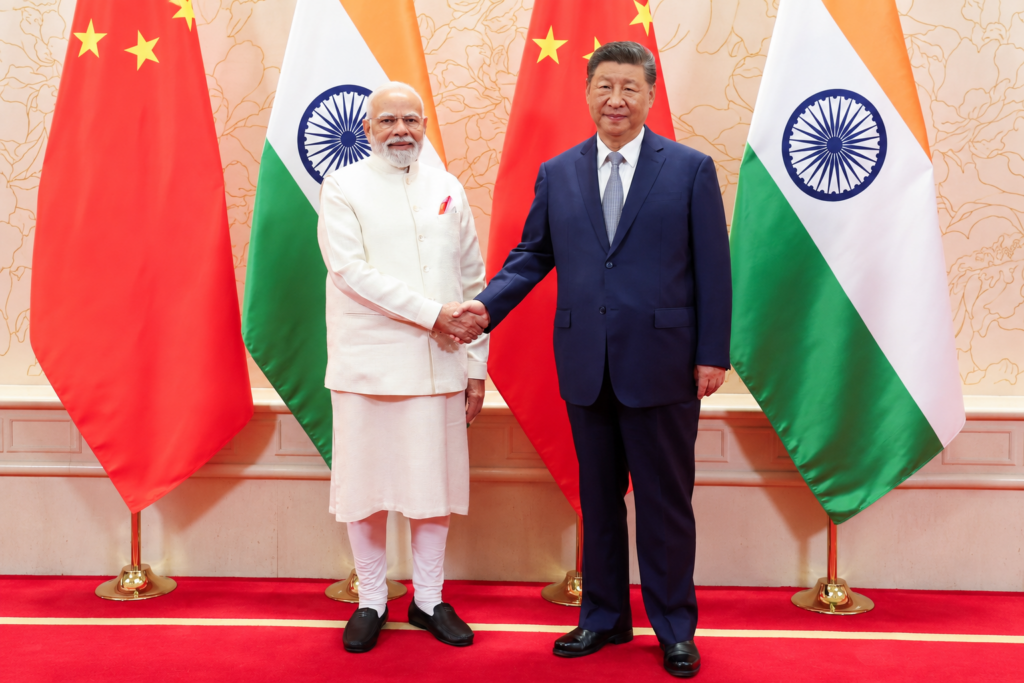
That was the ceremony but the real action happened on the margins, where Narendra Modi received Xi Jinping for the first Chinese visit to India since 2019, and the two men agreed that their differences should not become disputes.
The bilateral meeting between Modi and Xi is yet another example of what the BRICS summit have become: a hub-and-spoke system where China looks for what it needs from each BRICS member (eleven already plus ten partners). The larger the group grows, the easier it is for China to play its cards. In fact, China does not need the grouping to act collectively. It needs the grouping to keep meeting.
Beyond expanding in terms of number of countries, China has also been pushing the Shanghai Cooperation Organisation (SCO) to become some form of BRICS parallel for security and to tie it as close as possible to it. In fact, the latest summit of SCO took place only two earlier in Bishkek and agreeing a centre for countering security threats and a 2026-30 plan for ports and logistics corridors. The membership overlaps heavily with BRICS in Asia, the drafting habits are identical, and the direction of travel is the same.
Both BRICS and SCO have become incremental institutions, Chinese-anchored, that create obligations without creating a bloc. The two bodies now cover most of the Eurasian Global South.
Pressure behind the summit
When it comes to the BRICS chair, India, its difficulty is that it is hosting this architecture from a position of economic weakness, and Beijing knows it. The closure of the Strait of Hormuz has cost India a large share of its crude inflows, pushed the rupee to record lows and driven foreign investors out of Indian equities at a pace that surpassed last year's full-year outflows within four months.
The finance ministry itself has called the duration of the Hormuz disruption the single most consequential variable for India's external and price outlook. For an economy that imports most of its energy through a waterway it does not control, that is an unusually honest admission of exposure.
The second shock is quieter and more structural. India's services exports have financed its goods deficit for two decades, and that engine is now being rebuilt around AI. The largest IT services firms reported falling headcount in the last fiscal year after two years of growth, with the biggest among them cutting roughly two percent of its workforce, concentrated in the middle grades that were the safest jobs in the Indian middle class.
The sector is not collapsing; it is decoupling revenue from employment. For a country that needs to create millions of jobs a year, an export industry that grows without hiring is a fiscal and political problem, not just a corporate one.
That is why New Delhi's China policy has moved faster than its rhetoric. In March, India partially eased the Press Note 3 regime that had subjected investment from land-bordering countries to case-by-case approval since 2020, opening an automatic route for small non-controlling stakes and a sixty-day track for capital goods, electronic components, polysilicon and rare-earth magnets and processing.
The China dilemma
Direct Chinese control remains restricted; joint ventures under Indian majority ownership do not. This is not a normalisation. It is an admission that the capital, components and process know-how India needs to put people into factories are concentrated in the country it is trying to balance against, namely China.
Modi therefore arrived at his own BRICS summit with two incompatible objectives: to lead the Global South's case for institutional reform, which he did by proposing ten governance proposals to be worked into a reform roadmap by the next summit, and to obtain from Beijing the market access and investment that would narrow a trade deficit with the bloc now above $220 billion.
All in all, the BRICS summit has ended with a soft comuniqué, which is both in India’s and, this time around, also in China’s interest. India does not want toconcede anything structural: India’s existing security screening has survived the FDI easing and anti-dumping actions against China’s cheap products continue. Xi has his own reasons for a mild summit, given his official visit to the US later this month.
Europe should still read the signal rather than the communiqué. Brussels keeps asking whether BRICS is becoming an anti-Western bloc, which is the wrong question and reliably produces the reassuring answer.
The relevant development is that the India, not only largest democracy in the Global South but also having signed a landmark free trade agreement (FTA) with the European Union only a few months ago, seems to have concluded that Chinese capital must be part of its industrial endeavour.
