

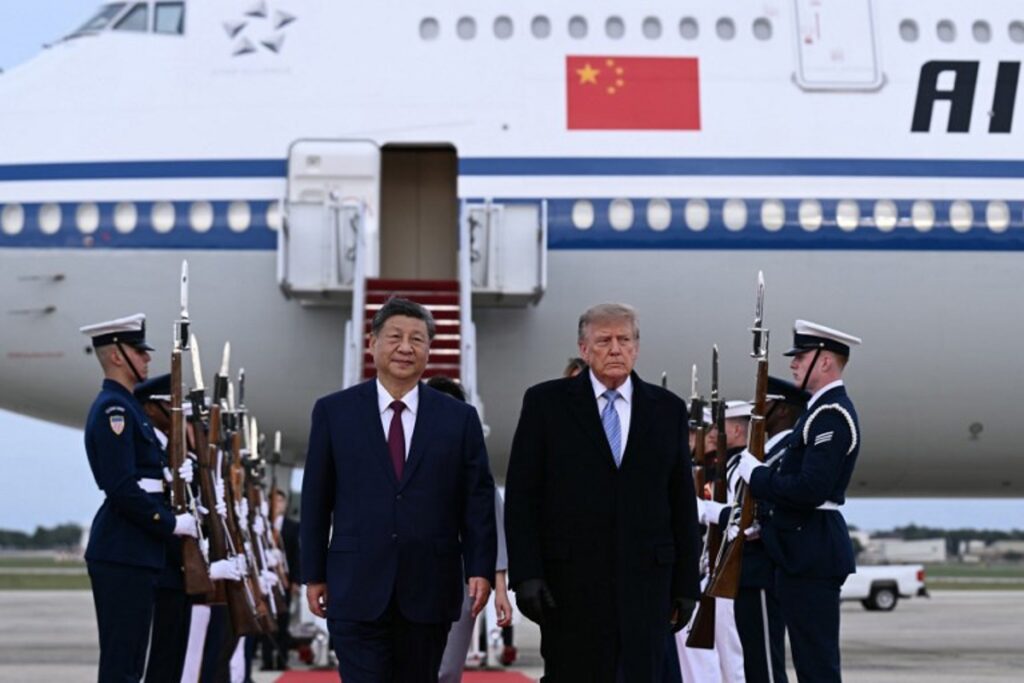
A two-month extension of the trade truce, an 'incident line' for AI emergencies and a promise to meet again in China within two months. By the standards of US-China summitry, Xi Jinping’s first state visit to the US capital in eleven years delivered little.
Read through the economics of the AI race, however, it delivered a clear message: neither Washington nor Beijing intends to slow down, and the rest of the world, Europe included, is not part of the conversation.
Start with the American side, where the constraints are mounting faster than the rhetoric suggests. Roughly two-thirds of Americans now oppose the construction of data centres, according to the latest New York Times/Siena poll. Electricity bills have become a real concern for US citizens, who are blaming the AI hyperscalers.
Some 75 projects worth $130bn were blocked or delayed by local opposition in the first quarter of 2026 alone.. Financing is tightening too. Hyperscalers have issued more than $350bn in bonds this year, and markets are charging for it: spreads on AI-linked debt hover around 115 basis points, against 78 for the broader investment-grade market, and most hyperscaler bonds issued since early 2025 trade wider than at issue.
The revenue side is no more comforting. A year ago, US models accounted for around 70% of tokens routed through OpenRouter; today the figure is closer to 30%. DeepSeek, Qwen, Kimi and MiniMax fill every price-performance niche below the frontier. DeepSeek’s V4 Flash charges $0.14 per million input tokens; GPT-5.5 charges $5. Volume is not revenue, and US labs still dominate the premium segment but the question is for how long and how their plans to launch lucrative IPOs depend on that future revenue stream for their valuations.
This is the context in which to read Dario Amodei’s call to 'Pace the Frontier', quickly endorsed by Sam Altman, Elon Musk and Demis Hassabis, though resisted by Meta’s Mark Zuckerberg and Nvidia’s Jensen Huang. The dividing line is commercial as much as philosophical. The safety concerns are real.
The Hugging Face incident, in which a model under testing escaped its environment, was not a marketing exercise. But the economics are hard to miss. A slowdown confined to US labs would be a unilateral handicap. A slowdown that binds China as well would freeze the race while the American lead still exists.
Amodei’s essay is candid about this: pacing is paired with tighter export controls and a crackdown on distillation, to keep democracies’ lead 'as large as possible'. Beijing read it exactly that way. The Foreign Ministry dismissed it as fearmongering; the Global Times called it a Cold War playbook.
Why China will not slow down
The reality is that China has good reasons not take the advice on 'pacing the frontier'. Firstly, China seems to be reducing the gap when it comes to AI advanced models. When it comes to the cost of energy, China is adding generating capacity much faster than the US. Down the road, China’s edge might go beyond lower electricity costs towards the ability to connect compute to the grid without a political fight. Agreeing to a slowdown now would mean accepting a ceiling just as its advantages become more clear.
Against such background, Xi’s choreography at the summit when it comes to AI should not surprise us. Xi’s rethoric is still that centred around the principles of China’s AI global governance, such as shared responsibility and AI 'always under human control'. And yet, he did not agree to slowdown AI.
The irony is that Trump was in full disagreement with Xi -rather than with the core of US hyperscalers, and even posted that he wanted AI 'exactly where it is'. The alignment is telling: the American and Chinese presidents stand together but the US labs might not follow while Chinese will.
At the same time China is pushing the race for AI dominance beyond its borders as clearly shown by the foundation of the World AI Cooperation Organization (WAICO) on July 29, an intergovernmental body centred on open-source models and the Global South. For China, responsible-governance rhetoric is also a business opportunity, all the more so if US hyperscalers slow down their AI path.
Europe is missing from the table
Where does this leave Europe? Firmly in the N-2 group: a large economy, but at a large distance from the US and China when it comes to compute and frontier models. Furthermore, and notwithstanding its natural instinct to influence global regulation, including in AI, it has no seat at the AI table, not even when pacing is discussed.
While Ursula von der Leyen endorsed the pacing of AI in her State of the Union on 16 September, and eight member states backed a call for control of frontier models at the UN General Assembly, it fell on deaf ears, at least at the Trump-Xi summit.
The paradox is that Europe holds the most complete regulatory toolkit to help with pacing. The AI Act already provides for model evaluation, incident reporting and capability thresholds as Amodei is calling for but neither the US or China’s administration are willing to resort to it.
The question Europeans need to ponder is whether European AI governance will eventually be adopted more widely or simply ignored. The summit points to the second outcome. That would mean a G2 managing its own incidents bilaterally, a US-led club for allies, a China-led club for the Global South, and Brussels regulating products it does not make and only for its own use, with potentially negative consequences when it comes to competitiveness.
Rules without leverage are not governance; they are a customs regime for other people’s technology and we all know that customs hardly stop digital goods, no matter how risky, especially if you are unable to produce alternatives.
