

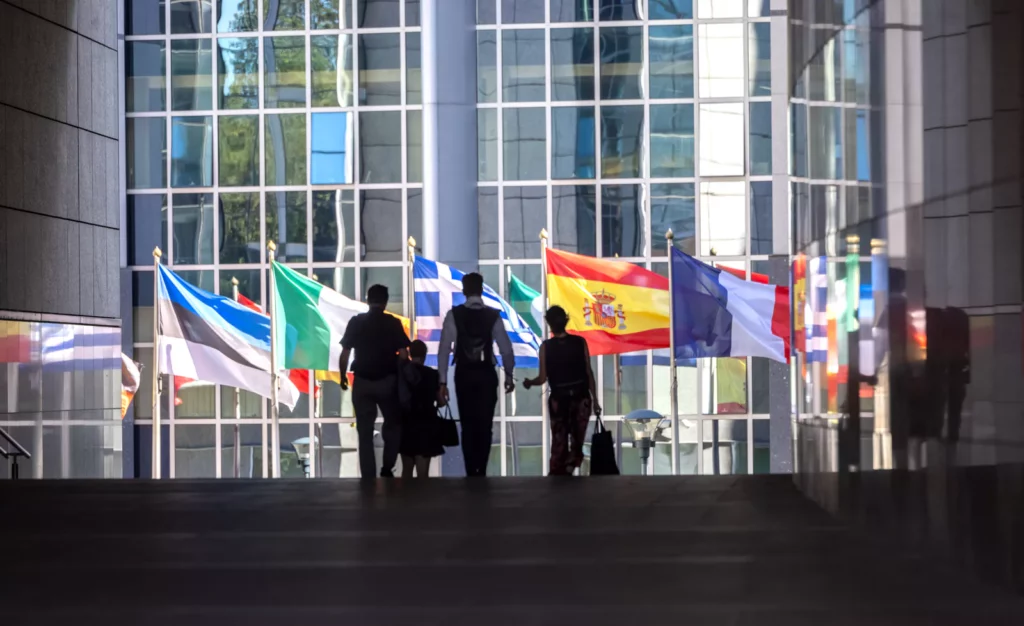
I know the story of a man I will call Hassan. He arrived in Europe while still a minor, after crossing the Mediterranean on a small boat.
He began working as a gardener and over the years built an ordinary life, which may be the least ordinary thing that could have happened to him after that journey.
Today he works for a services company, is married, has three children and is a practising Muslim. He works, pays taxes, supports his family and respects the laws of the country in which he lives. If we had to decide whether Hassan is integrated, what other information would we need?
The question seems simple until we actually try to answer it. Should we know how he prays? What he thinks about European society? What he eats at home? How religious his children are? Whether his wife wears a veil? Which football team he supports? How attached he still feels to the country he came from? And above all: how much of what he once was should he have abandoned to prove that he has become one of us?
European societies need criteria for dealing with immigration. There is nothing scandalous about that. Those who arrive in a country must respect its laws and be able to communicate with the people among whom they live; it is reasonable to require the linguistic and civic tools necessary to participate in a shared life. The problem begins when, almost without noticing it, we move from the possibility of living together to the demand that people become alike.
It is a subtle shift because it is rarely expressed in those terms. No administrative form asks a foreigner how similar they have become to Belgians, Italians or French people. Yet part of the public debate about integration seems to contain precisely this question. Working, respecting the rules, raising children and knowing the language are somehow not enough. There is always something else to verify: a loyalty to demonstrate, a belonging to certify, a distance from one's origins to measure.
A citizen born in Europe can be contradictory without having continually to explain that contradiction. They can be religious or atheist, conservative in private life and progressive in politics, deeply attached to their country while detesting many of its characteristics.
They may know little about national history, take no part in public life, mix with the same people and live for years in the same neighbourhood. Nobody periodically opens an inquiry into their integration.
We grant foreigners this opacity far less readily
We ask them to tell us about themselves. Where do you come from? Why did you come? How much do you feel you belong to this country? How much of your culture have you retained? Which values have you acquired?
These questions may arise from genuine curiosity, but when they become criteria by which we decide whether a person fully belongs to the community, they take on a different meaning. It is as if immigrants must make their identity legible so that we can finally declare it harmless. Perhaps we should recognise a right that we spontaneously grant ourselves: the right not to be entirely explained.
This does not mean abandoning common rules. Quite the opposite. Precisely because a democracy has laws that apply to everyone, it should not need to police people's inner lives. If Hassan respects the law, we do not need to know how intimately he shares every value of the society in which he lives. Nor am I required to share intimately all the values of other Italians in order to remain Italian.
Difference is not a temporary accident of integration, something that should eventually disappear. It can be its outcome. It is possible to learn a new language without forgetting one's mother tongue. One can become a citizen of one country while remaining attached to another. One can participate fully in a society while retaining a religion, a cuisine, a family memory, even habits that the majority finds difficult to understand.
A political community is not necessarily stronger when everyone within it resembles one another. It can be stronger when people who remain different have learned which rules allow them to live together.
Here a curious European double standard emerges. We consider it natural for an Italian who has lived in Brussels for decades to continue cooking Italian food, reading Italian newspapers, speaking Italian with their children and perhaps still feeling Italian even after obtaining Belgian citizenship.
Their dual belonging may even strike us as interesting. We call it European identity, cosmopolitanism, cultural richness. When the same dual belonging concerns someone who arrived from Africa or a Muslim-majority country, however, it can quickly become a source of suspicion: why do they not feel completely one of us?
Perhaps the question should be reversed. Why do we need them to?
Integration cannot mean that the majority decides how much difference it is prepared to tolerate and then measures each individual according to the distance that still separates them from it. It should mean building the conditions in which different people can assume responsibilities towards one another without being required to surrender themselves entirely to each other.
Of course conflicts exist. There are practices incompatible with democratic laws and situations in which a society must establish clear limits. But that is precisely why it matters to distinguish what violates a common rule from what merely appears foreign to us. If we confuse the two, we turn our difficulty in understanding someone into the fault of the person we fail to understand.
Hassan could spend hours telling me who he is. I could learn about his journey, his faith, his relationship with his children, his fears and what he thinks of Europe. In the end, however, something about him would remain unknown to me. What happens with Hassan is exactly what happens with every other person.
Perhaps a truly integrated society begins when it stops treating that fact as a problem
