

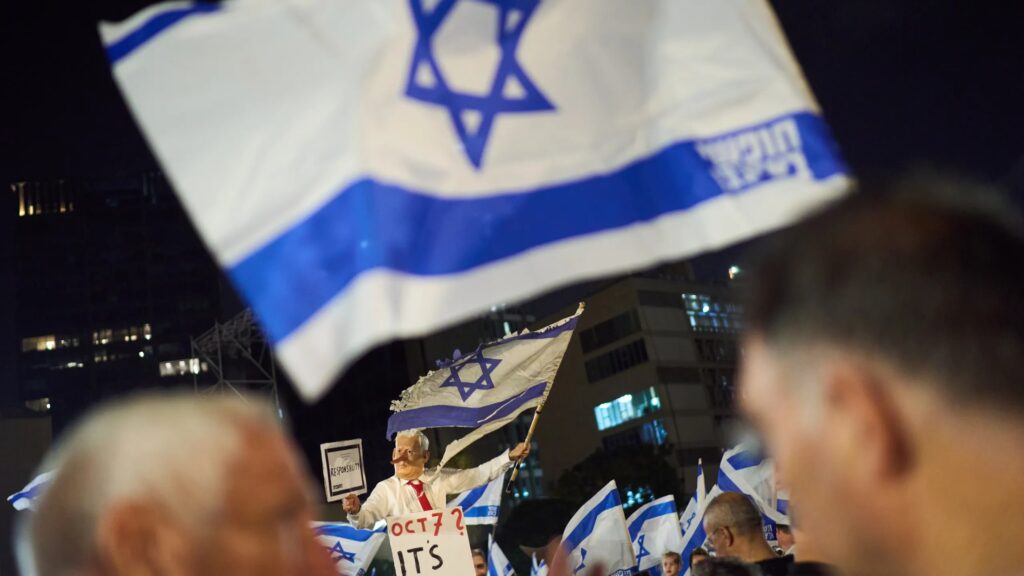
The parliamentary elections in Israel on Tuesday will be the most crucial in its history. They matter not only for its own citizens but also for the EU.
The last election polls were published on Friday and predicted a tight race where neither the incumbent government nor the opposition bloc will gain the required number of votes to win a majority of 61 seats in the 120-seat parliament (Knesset). The two blocs fluctuate between 50 and 56 seats each in the polls with many voters still uncertain for whom to vote.
In most polls, the biggest opposition party Yashar, led by former chief of staff Gadi Eisenkot, holds a narrow lead over Prime Minister Benjamin Netanyahu's Likud party. This could destine Eisenkot to become the first party leader to be asked by the Israeli president, after the votes have been counted, to try to form a government supported by a majority in the new parliament.
What matters is to remove Netanyahu and his corrupt and failed far-right government from power. Eisenkot together with the three other opposition parties - that all have signed surplus-vote agreements contrary to the parties in the coalition government – are able to form a minority government. They should not be lured into forming a “national unity government” with Netanyahu.
After the elections, the opposition bloc could also decide to form a majority government which would include one or both of the two Arab parties. Any way, the new government would need their support to survive. The Arab parties are predicted to gain a record number of 13 – 16 seats which would be closer to their percentage of the electorate.
The overall voter turnout in the previous election was 71% but among Arab-Palestinian voters only 53%. In the past, many of them abstained from voting in protest against the Israeli government. This is likely to change this time. They cannot afford to waste their right to vote and risk a government dominated by extremists that try to disenfranchise them.
They are also affected, or even more, as their Jewish co-citizens alike by the persistent shortcomings in Israeli society. The elections will determine whether Israel will return to normality, stop undermining its own democratic institutions and start a process of healing in a deeply polarised country since 7 October 2023.
End to forever wars
The elections will determine if Israel will end the forever wars along all its borders during Netanyahu’s government or start pursuing political-diplomatic solutions to end the conflicts and bring about peace. Despite his many years in power, his overriding interest continues to be his political survival and not Israel’s long-term security and survival.
Netanyahu has constantly given in to his nationalist-messianic coalition partners. He was even prepared to sacrifice the hostages taken by Hamas to satisfy their demands. He had a chance to get rid of the worst extremist coalition partners and continue as prime minister but refused to accept the opposition’s offer of a security net.
The international legitimacy for the war against Hamas quickly eroded as it continued without an end in sight and the Trump peace plan stalled. Israel’s warfare violated international humanitarian law and resulted in the total destruction of the Gaza Strip.
In fact, Netanyahu was unfit from the very start of the war to govern Israel because of the conflict of interests over his trial on charges of fraud, breach of trust and bribery. The Israeli supreme court of justice made a fatal mistake when it missed the opportunity to rule that he was unfit to serve as prime-minister because of the indictments.
The following short-lived government of change did not initiate legislation limiting the terms of prime ministers to two terms. This would have prevented Netanyahu to return to power after the previous elections. The government was dissolved because disloyal parliament members defected to Netanyahu’s party.
Scaremongering election campaign
To the charges against Netanyahu can now be added treason, according to the opposition bloc. He has tried to provoke Iran to attack Israel so that he could launch a counter-attack and cancel the elections. In his desperation, he is scaring the Israeli public and republished yesterday an AI generated picture of a nuclear strike on Tel Aviv.
After two rounds of war against Iran without achieving the goals, he portrays himself as the only politician who can “finish” the job and save Israel against the existential threat it faces from an Iran armed with nuclear weapons. US President Trump has interfered in the elections and “endorsed” Netanyahu as the only Israeli leader he would support in case the war against Iran would be resumed.
In an interview on Israel’s economy, Netanyahu continued his scaremongering and warned the public that Israel will face international sanctions after the elections – not because of his actions but because all the world is against Israel. But again, he has the solution – circumventing the sanctions with cryptocurrency, as other rogue countries that have been sanctioned are doing.
Any other prime-minister in his situation in a functioning democracy would have resigned by now or been ousted by his own party (Likud). But hardly anyone in his party has dared to oppose him and vote against him. Members of one of the opposition parties changed side during the Gaza war and joined the government in return for minister posts.
Netanyahu is politically responsible for the strategic security doctrine which kept Hamas in power in Gaza, approved the monthly cash transfer from Qatar to Gaza (part of which was diverted to Hamas), and disqualified the Palestinian Authority as a peace partner. To this can be added the disclosures that Netanyahu ignored early warnings in a telephone call from the United Arab Emirates President.
The conception that Hamas was deterred and had no interest or capacity in launching a large-scale border attack turned out be to wishful thinking. It resulted in the failure by the military and the intelligence agencies to interpret the many signs of an imminent attack and left the border with Gaza undefended.
A contributing cause of the attack was the impression among Israel’s enemies that it had become weakened because of the internal rift in the country. Immediately after his return to power in 2022, with a rather-thin majority, his government launched a judicial overhaul or rather coup d’etat which undermined the checks and balances and politicised the judiciary and the public sector.
The judicial measures were not announced before the previous elections and were met by mass demonstrations by all parts of Israeli society. They were the kind of constitutional changes which normally should require broad consensus in society and decisions taken by a qualified majority in the parliament or after two elections. The government even continued with the measures during the war.
The first priorities
Israel is a longtime political and economic partner to the EU, with strong historical and cultural ties. The elections matter also for the EU and its relations with Israel. Until now, the EU has contented itself with protesting against Israel's policies and avoided being seen as interfering in the elections. It has been divided on imposing the sanctions that still are on the table.
The outcome of the elections will determine if Israel will return to the family of liberal democracies sharing the same values as the EU or continue to be boycotted by EU Member States and risk restrictions in its free trade. That will have a devastating effect on its export-oriented and high-tech based economy. The protracted war situation has already resulted in a negative migration balance.
Democracy is defined as the possibility of changing government. As in the other countries, the elections will be followed by political horse-trading and complicated negotiations over the formation of a new government and who will lead it.
The first thing a newly-elected majority consisting of the opposition bloc and the Arab parties must do is to elect a new speaker to replace the current speaker, a Netanyahu-loyalist, and prevent him from sabotaging the change process.
Once in power, the new government must appoint an independent state commission of inquiry to examine the failures which led to the 7 October and attribute accountability for them.
It must come prepared with as set of legal proposals to unravel the undemocratic laws of the previous government and introduce legal safeguards that will ensure that such a judicial coup can never happen again.
It must immediately enforce the rule of law in the West Bank and root out settler violence and terrorism. High on its agenda from the very start must also be to accelerate the implementation of the peace plan for Gaza and start early recovery measures.
