

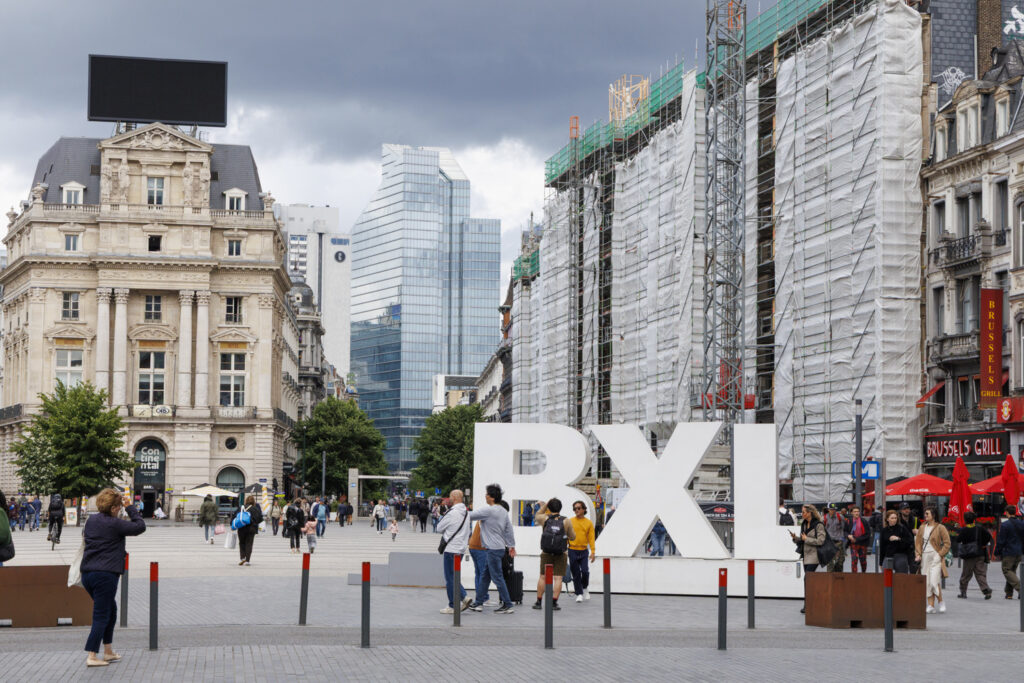
Who does Belgium belong to? Who gets to define what it means to be Belgian? Who is recognised as part of the country's history, and whose contributions remain in the background?
In a country shaped by generations of migration, labour and cultural exchange, belonging should not be measured solely by one's origins, name or heritage. This history is not abstract. Ahmed Taib Mokadem, my grandfather, was one of the many construction workers who helped build the Brussels we know today.
Every morning, on my way to work as an adviser in an urban planning cabinet, I pass the Anspach Galleries, where my grandfather contributed his labour. There is something deeply meaningful about that daily journey: he helped shape the city with his hands, while decades later, his granddaughter has the privilege of contributing to decisions about how that same city is planned and developed.
His story connects two generations, two different roles, and one shared city. It also reminds me that the story of Belgians of Moroccan descent is not simply a story of migration or integration. It is a story of participation, contribution and belonging, woven into the very fabric of Brussels.
The city belongs to the people. Does it really?
This does not mean that heritage policy should be reduced to a politics of ancestry, or that political representation alone can resolve urban inequality. It means recognising
that the people who have contributed to a city should also be visible in the stories it tells about itself and included in decisions about its future.
Perhaps the real test of Brussels's commitment to diversity is not simply how many cultures it contains, but how willing it is to recognise their contributions as part of its common heritage. Heritage is never simply about buildings.
It is about memory, identity and the stories a society chooses to preserve. It determines what we commemorate, whose contributions become visible and which histories remain in the background. A city can preserve its façades while overlooking the people who built them.
The question of heritage becomes even more significant when we consider the relationship between culture and urban space.
The city we inherit can also inherit its inequalities
Urban planning is never entirely and truly neutral. Decisions about housing, transport, public space and heritage influence not only how a city looks, but also who feels entitled to inhabit it and participate in its future.
The challenge for urban planning is therefore not merely to build the city of tomorrow, but to question which aspects of yesterday we are allowing to survive into it. It would also mean ensuring that urban regeneration does not erase the communities whose presence gives neighbourhoods their character.
Good enough to work in, not good enough to live in
Belgium has an awkward relationship with its own capital. Brussels is where the country works, where decisions are made and where wealth is generated. Yet for many Belgians,
it is not where they want to live.
They come in every morning, benefit from its economic opportunities and leave again in the evening. The city becomes a workplace to be used, rather than a community to be invested in. And when Brussels struggles with poverty, housing shortages, segregation or public space, the debate too often turns into a discussion about what is wrong with the city and its people.
And, you guessed it, migration. When Brussels’ problems are discussed, migration too often becomes the convenient explanation.
This is the paradox: Brussels is expected to belong to the whole country economically, while its problems are too easily confined to its own borders. Its residents are asked to live with the consequences of decisions, inequalities and pressures that extend far beyond the city itself.
Meanwhile, those who leave can continue to benefit from Brussels without necessarily sharing the responsibility of making it a better place to live. A capital cannot be treated as Belgium’s common resource by day and as Brussels’ private problem by night.
If we want Brussels to thrive, we must stop asking only what the city can do for Belgium and start asking what Belgium is willing to do for Brussels.
The capital has become an outsider in the very country it represents
I once had a conversation with a friend about Brussels politics and how important it is to stay informed about the decisions shaping the city we live in. She did not seem particularly interested. Politics, to her, was something distant, complicated and easy to tune out.
So, I pointed out something rather simple: Brussels is the city that pays its bills. Her job, her income, her daily routine, all of it was connected, in one way or another, to the capital. It made me think about our peculiar relationship with Brussels.
We depend on the city for our livelihoods, yet we do not always feel invested in its future. We benefit from its opportunities without necessarily feeling responsible for its challenges. And perhaps that is part of the problem: Brussels is treated as a place that must work for us, rather than a place we must also work to make better.
Because the city that pays our bills is also home to people who cannot simply leave when the working day ends, people whose lives are shaped by every decision about housing, mobility, public space and urban development.
If Brussels is important enough to make a living from, surely, it is important enough to care about.
