

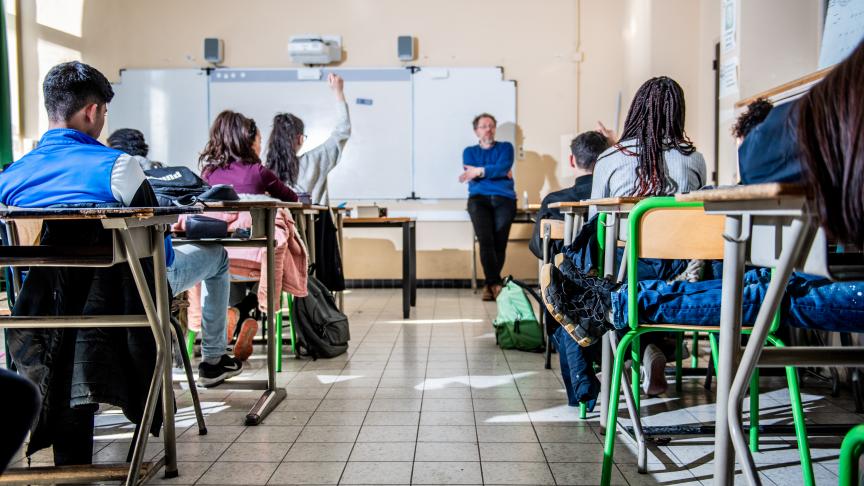
As Belgian schoolchildren join the swelling tide of pro-Palestinian demonstrations against Israel's conduct of the war in Gaza, a disturbing pattern emerges: the educational resources in Belgian schools meant to foster understanding are instead breeding division, intolerance, and danger for Jewish pupils and the local Jewish community.
This happens against the glimmers of hope for an end to the war. President Trump's newly unveiled 20-point peace proposal for Gaza calls for an immediate end to the war, the release of hostages and prisoners, and a credible pathway to Palestinian self-determination and statehood, conditional on the reform of the Palestinian Authority.
That would also include an end to antisemitism and incitement to violence in Palestinian school curriculums. It would be strange if Belgian school materials would continue to be biased, one-sided and inaccurate. Such materials undermine possible diplomatic breakthroughs instead of promoting an understanding of the narratives of both sides in the conflict.
Our report from last year, Shaping Minds, Shaping Society, reveals that Belgian school materials on the Israeli – Palestinian conflict has become overwhelmingly partisan, simplistic, and ideologically anti-Israel, fueling polarisation and radicalisation among pupils in Belgium. That started already in the beginning of the war in Gaza before it had led to an intolerable humanitarian disaster.
The report was recently presented at high-profile conferences, including one in Antwerp on antisemitism attended by prime minister Bart De Wever, and another in the European Parliament attended by the European Commission and international experts.
Since Hamas's October 7, 2023, massacre - where many Israeli civilians, including children, were killed, and hostages were taken of which some still are alive – the Israeli response fueled an increase in antisemitism in Belgium and other EU countries.
Unia, the interfederal equality agency, reported a surge in incidents post-October 7, while VRT noted increased polarisation in Flemish schools. The Flemish Community Education Board and Catholic Schools Board have seen reports of radical comments skyrocket from a handful annually to three or four daily, directly linked to the war.
Educational content providers - partly funded by the taxpayer via the federal Development Cooperation Directorate (DGD) and partners like Enabel - disproportionately fixate on Israel as the sole aggressor, producing more material on this conflict than on other armed conflicts affecting the civilian population disproportionately.
In our study, we analysed 52 representative resources from Flemish and Walloon Federation Wallonie Bruxelles or French speaking providers (KlasCement, Mediawijs, e-classe, and NGOs like Pax Christi Vlaanderen, Amnesty BE, and Oxfam BE). The content analysis uncovered alarming biases.
75% contained intolerant narratives inconsistent with to UNESCO's standards; 98% inhibited critical thinking by presenting one-dimensional, evidence-lacking portrayals; and over 60% posed a risk of radicalisation through inflammatory language and biased questions.
These materials violate also Flemish and Walloon Federation Wallonie Bruxelles education policies mandating objectivity, diversity respect, and anti-polarisation measures. They also contradict the standards of the Council of Europe and the international working definition (IHRA) of antisemitism, which has been adopted by the EU and the Member States.
Furthermore, this politicisation of education is unique to Belgium's implementation of the UN Sustainable Development goal on inclusive and equitable quality education (SDG4). In practice, it transforms classrooms into echo chambers for political advocacy and mobilisation against Israel, sidelining any positive aspects of Israeli society.
Resources like the FWB's "Questions Vives" factsheet, produced under former federal Minister Caroline Gennez's editorial direction, exemplify this: laden with emotional appeals and inaccuracies, the consequences of such inciting curriculum materials are not abstract. It risks dividing pupils rather than educating them. Even worse, they risk to spark terrorist attacks against the local Jewish community.
UK police classified the recent attack against a synagogue in Manchester as terrorism, a grim echo of Europe's rising antisemitic violence. In Belgium, Jewish families fear a similar escalation.
Our report warns that unchecked bias in school materials is a direct catalyst, turning impressionable and malleable children into activists who view Israel and, by extension, Jews living next to them as the enemy.
Belgium must act decisively now. DGD's ideological pipeline - funnelling biased content through NGOs, CSOs, and public broadcasters like VRT and RTBF - has no place in classrooms that are meant to promote critical thinking. An independent, official review is urgently needed to purge prejudiced materials, enforce objectivity, and protect all pupils against hatred.
IMPAC calls on education ministers in Flanders and Wallonie-Bruxelles Fédération, alongside federal authorities and Prime Minister Bart De Wever, to prioritise balanced educational resources that acknowledge Hamas's atrocities, Israel's right to self-defence in compliance with international law, and human suffering on both sides - while highlighting paths like the Trump plan toward peaceful co-existence.
True peace education builds bridges, not red lines of hate.
