

Belgium’s banana research might seem niche, but it’s a quiet geopolitical asset. With the world’s largest banana gene bank and strong ties to the tropics, the country is well placed to lead on global food security if it chooses to invest.
For decades, Belgium has enjoyed strong ties with the tropics built upon our support of international organisations and multilateralism and our ties of history, trade, and people.
While our chocolate industry is perhaps the most visible sign of our links with the tropics, we can also be proud of our long-standing scientific collaborations with partners in the Global South.
The Institute of Tropical Medicine in Antwerp and the Tropical Crop Improvement Laboratory in Leuven, embodied such collaborations, which host the world’s largest collection of banana varieties. These labs are recognised worldwide as centres of excellence and support Belgium in punching above its weight in the worlds of global public health and agricultural innovation.
Why Leuven? A chilling advantage
Bringing the whole diversity of bananas to the capital city of Brabant could appear odd, as there are certainly better places to grow and harvest banana plants.
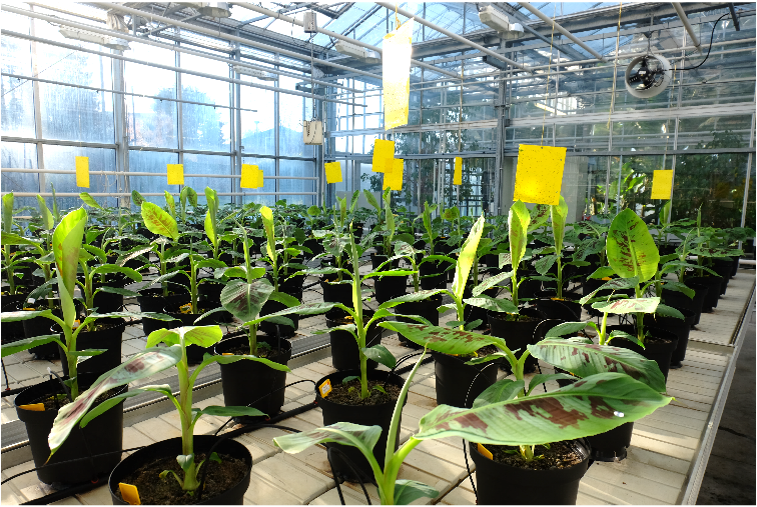
Through several decades of collaboration with institutions in the tropics, researchers from KU Leuven have built a collection of over 1700 bananas stored as in vitro plantlets, which represents the largest collection of banana diversity on the planet.
The main advantage of preserving bananas in the cold climate of Leuven remains the absence of tropical pathogens. Indeed, one purpose of germplasm collection is to provide long term preservation of crop diversity for future generations. But not only! The value of biodiversity lies also in its availability to the growers and consumers.
Because the largest banana collection is in a place where tropical pathogens are absent, it also facilitates the distribution of the Leuven banana collection all over the world. Boosting exchange of banana diversity is indeed key to ensure that improved bananas can be accessed and tested in places where they can meet the demand of growers and consumers.
This also fulfills an increasing demand by banana breeders in tropical countries who are struggling to generate new bananas capable of coping with climate change.
In this way, Leuven as a capital of bananas ensures open access to banana diversity around the globe and to all future generations. However, we can do so much more! The fact that the Leuven Banana Collection is hosted by KU Leuven, a cutting-edge research university, also represents a unique opportunity to leverage advanced agricultural technologies to develop new banana varieties that support more sustainable agriculture.
Using the top-notch technologies available at KU Leuven, we are pioneering novel genomic tools and innovative platforms to advance the generation of improved bananas. These technologies are vital to increase the sustainability of the agrosystems and certainly the banana plantations that provide over 6 million tons of bananas to European consumers every year through Antwerp, the largest banana port in Europe.
From science to soft power
Science has long been used to build international alliances, share knowledge and influence global norms, thereby enhancing the so-called “soft power” of countries wise enough to invest in it. As the Prime Minister of Finland recently explained to the UN General Assembly, “the power of a small country arises from its capacity to cooperate with others”.
In a world facing increasing geopolitical instability, it is key for small countries like Belgium to diversify and strengthen alliances globally including with countries located in the tropics.
The recent dismantling of USAID illustrates a general trend towards isolationism that has dramatically impacted our partners in the Global South. However, this vacuum can also open new opportunities for countries that are willing to strengthen their collaboration with the tropics.
This is highly strategic because the balance of power in the new world order is shifting towards the South and the East, with many countries in Africa, South America and Asia becoming key players through economic and demographic growth. Nevertheless, the ongoing rationalisation of budgets for international cooperation in many European countries bears the risk of indiscriminate dismantling of national expertise which should instead be spearheaded, including technological innovation.
An opportunity too ripe to miss
Our Prime Minister recently reaffirmed Belgium’s core value for international collaboration and innovation at the UN. In line with this, development of new agricultural technologies and their associated training that are relevant to many partner countries is in Belgian’s core national interest.
The increasing demand for agricultural innovation shows that it is also time for our policymakers to stop thinking of development cooperation as funding low-tech interventions and rather as a critical investment in building the technologies of the future to increase the global sustainability of agricultural production.
This approach will certainly strengthen our soft-power in the most populous parts of the globe. Almost uniquely in Europe, Belgium now has a golden opportunity to increase its geopolitical influence by charting a new path to cooperation with the tropics built upon shared technological innovation.
