
As global rivalries intensify, Europe’s caution risks hollowing out the very principles it was built on. It’s a dynamic that recalls a story from fiction, and one that now feels uncomfortably real.
In one of his novels, Ian McEwan depicts a fictional book titled “Her Slow Reduction”. It tells the story of a Green German chancellor (married to a chef, hence the culinary analogy) whose ideals erode once in power.
She becomes a champion of nuclear energy, backs the US invasion of Iraq, and closes Germany’s borders—all to stay in power. Her political and moral collapse is inevitable.
Europe is now going through a similar process of slow reduction. Careful not to antagonise US President Donald Trump—whose military support it badly needs—the EU institutions and member states keep compromising.
Once the champion of a rules-based trading system, the EU now seems to have accepted a world where might is right. This is evidenced by its asymmetric trade arrangement with the US, which also hints at a readiness to dilute environmental rules.
The EU struggles to defend its digital sovereignty, too — because enforcing the Digital Services Act and anti-monopoly laws would likely mean a major clash with Washington.
By caving to Trump in these areas, EU leaders show that their talk of a “geopolitical Europe” and, most recently, of Europe’s “independence” is just that — a talk.
To make matters worse, many mainstream parties are also abandoning their values on migration or climate, or shy away from calling out the far-right’s extremism, all of that in the hope of stemming the loss of voters. And the second von der Leyen Commission seems intent on dismantling parts of what her first built.
Europe’s quiet deregulatory turn
Under the banner of boosting competitiveness, it has embraced a deregulatory turn that neatly mirrors the priorities of Trump’s America and echoes the rhetoric of Europe’s far right.
In doing so, it risks undermining what has long been the EU’s most distinctive geopolitical strength — its ability to project power through rules and standards.
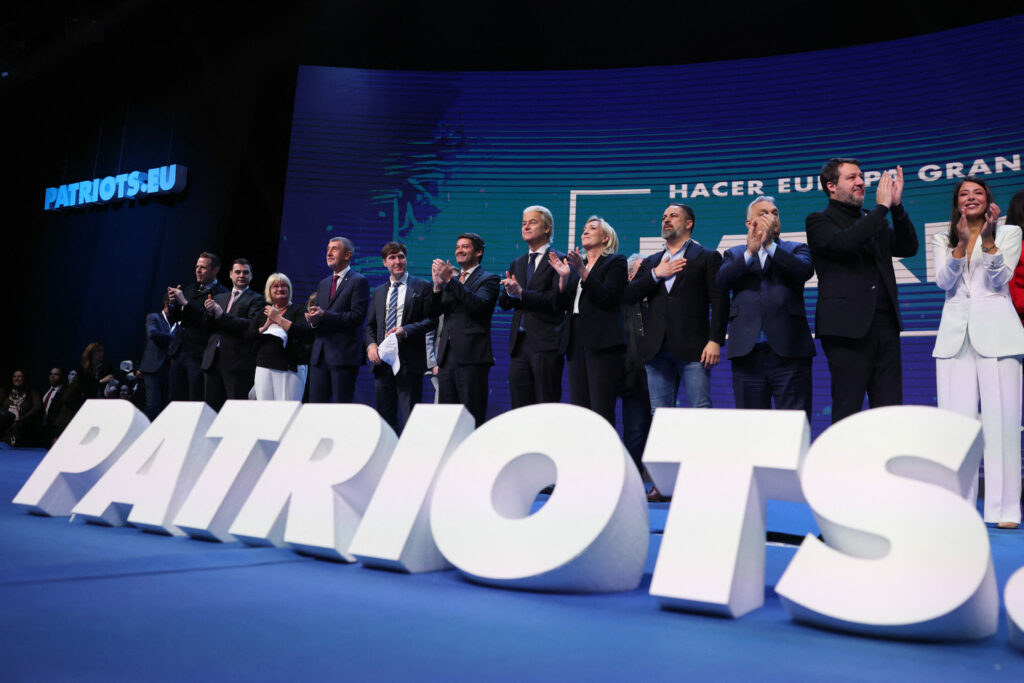
Meanwhile, the far right is increasingly rebranding itself as pro-European. The new “Patriots for Europe” group in the European Parliament, uniting Viktor Orbán, Marine Le Pen and others, claims to defend the real Europe.
A few of these parties now call for leaving the EU; instead, they aim at a hostile takeover, innocently called a change from within.This lets the far right blur the very meaning of pro-Europeanism and appropriate the public’s trust in the EU for its own ends.
Before the summer, public trust in the EU was the highest since 2007, according to Eurobarometer. Trust in the EU was also higher than trust in national governments everywhere except for Luxembourg, where majorities trusted both.
Absolute majorities in all but three member states wanted the EU to play a greater role in protecting European citizens against global crises and security risks. That follows the pattern of the European sentiment solidifying in the wake of COVID-19 and the war in Ukraine.
Yet that trust is fragile — and there is no reason to believe it will always side with the mainstream. Watching their leaders cave to Trump’s culture war against Europe may have, over the past few months, disillusioned many of the EU’s strongest supporters.
They may not immediately turn to the far right — but they could grow indifferent to a political mainstream that seems unable to defend Europe’s values and dignity.
When elections come, they may stay home or scatter their votes. As French MEP Valérie Hayer recently warned Ursula von der Leyen, “we are losing Europeans.”
Early signs of that shift are emerging. A few weeks ago, a poll for Le Grand Continent showed that many Western Europeans associated von der Leyen’s trade deal with the US with “humiliation”; they also saw the US, not Europe, as benefiting the most from the promised increase in Europe’s purchases of American military equipment.
Can Europe regain its nerve?
The task for pro-European leaders is not just to regain the narrative — to prevent the far right from monopolising the language of “Europeanness” — but to make their own narrative credible again.
The victory of Rob Jetten’s D66 party in the Dutch legislative election shows there’s an appetite for a genuinely pro-European political force, at least among parts of the public.
Rather than conceding ground on Europe to the extreme right, mainstream politicians should “own” the story, building on the high public trust in the EU. But that means also doing what they preach: showing strength, making real progress towards independence, and defending the values that were supposed to be non-negotiable.
Over the next few months, three tests will decide whether they can.
First, can the EU stand up to Big Tech — opposing its monopolies and polarising algorithms — even at the risk of angering Washington?
Second, can it resist trading its climate and digital rules for America’s security guarantees?
And third, can Europe finally reduce its dependence on the US in defence and Ukraine support, a sine qua non for a truly assertive EU?
It is probably clear, by now, to most European leaders that all of that would be the right thing to do. But the fear of political consequences might be paralysing them.
If so, it’s high time they realise that standing up to Trump, and exercising European power, is also in their best political interest.
It may sound dramatic to call Trump’s second term a “make-or-break” moment for Europe — we’ve heard that warning before. But it’s hard to see how the EU could recover its moral and political authority vis-à-vis its domestic as well as the external audience if it fails today.
That wouldn’t mark the end of the EU — only the beginning of its much-reduced version. Europe won’t be shrunk by Trump — but by the fear of standing up to him and leaving its comfort zone.
