

Olena Yahupova had hoped she would one day be free, but she never quite believed it.
The Ukrainian civilian told The Brussels Times she was detained by Russian forces in her home city of Enerhodar in October 2022, months after Russia's full-scale invasion of Ukraine. The city, home to the Zaporizhzhia nuclear plant, remains under Russian occupation.
“They brought me to the police station, where they beat me, they tortured me, and then they left me there,” says Yahupova, 53.
It wasn't until around six months later that she was able to speak to her family again, after being freed from Russian captivity. She still remembers that first call.
“They all cried. My eldest daughter cried. My husband was crying,” she says. “I was the only one who didn't cry. You need to understand that when you are in prison, they teach you not to cry - you cannot afford to cry there.”
Undress if you want to live
Over two years since she was freed, Yahupova still isn't quite sure why she was taken in the first place. But she says there didn't seem to be a need for a reason.
"It's enough to be a citizen of Ukraine. It's enough not to be willing to collaborate, to work for them, practically, and that already means that you are unreliable,” she says.
In the detention centre, Yahupova shared a cell with several other women, but the exact number would often change. She isn't sure how many cells there were in the whole facility.
Yahupova recalls being woken up during the night and forced to sing the Russian national anthem with other prisoners.
"They would walk along the corridors, and if somebody was not singing, they would beat them,” she claims. “Sometimes after that beating, people had to be carried out unconscious.”
On one particular night, while others sang the national anthem, Yahupova says a chief of police asked her to go to his office for interrogation.
Once inside, she recalls him handing her a police baton and telling her to undress and put the baton inside her if she wanted to live.
‘We were extremely lucky’
Following the detention centres, Yahupova alleges that she and other detainees were sold into slavery and sent to a labour camp.
There, they were reportedly forced to dig trenches and de-mine fields, while the women were forced to do housework for Russian commanders. "They used that opportunity to sexually abuse them,” she claims.
At one point, according to Yahupova, a man who was in captivity was able to get a phone from one of the guards. The man was able to contact his family, who were in occupied territory.
They contacted Moscow to explain that civilians had been kidnapped and forced to work in Russian-claimed territory.
“They kept calling and calling, and that resulted in the representatives of the criminal police from Moscow coming to get us,” she says, emphasising that this was not a typical situation. “We were extremely lucky.”
She says she felt sure that she would be prevented from telling her story. ”I knew they would try to get rid of me, but quietly, and they have tried that numerous times,” she claims.
Making sure politicians understand
The moment Yahupova stepped on Ukrainian-controlled territory again, she felt compelled to talk about what she went through.
The desire was strengthened when she met with a lawyer who told her that for crimes to be punished, people like her need to speak up and give evidence.
Her story echoes the findings of the conditions faced by several Ukrainian civilians highlighted in a recent United Nations Human Rights report.
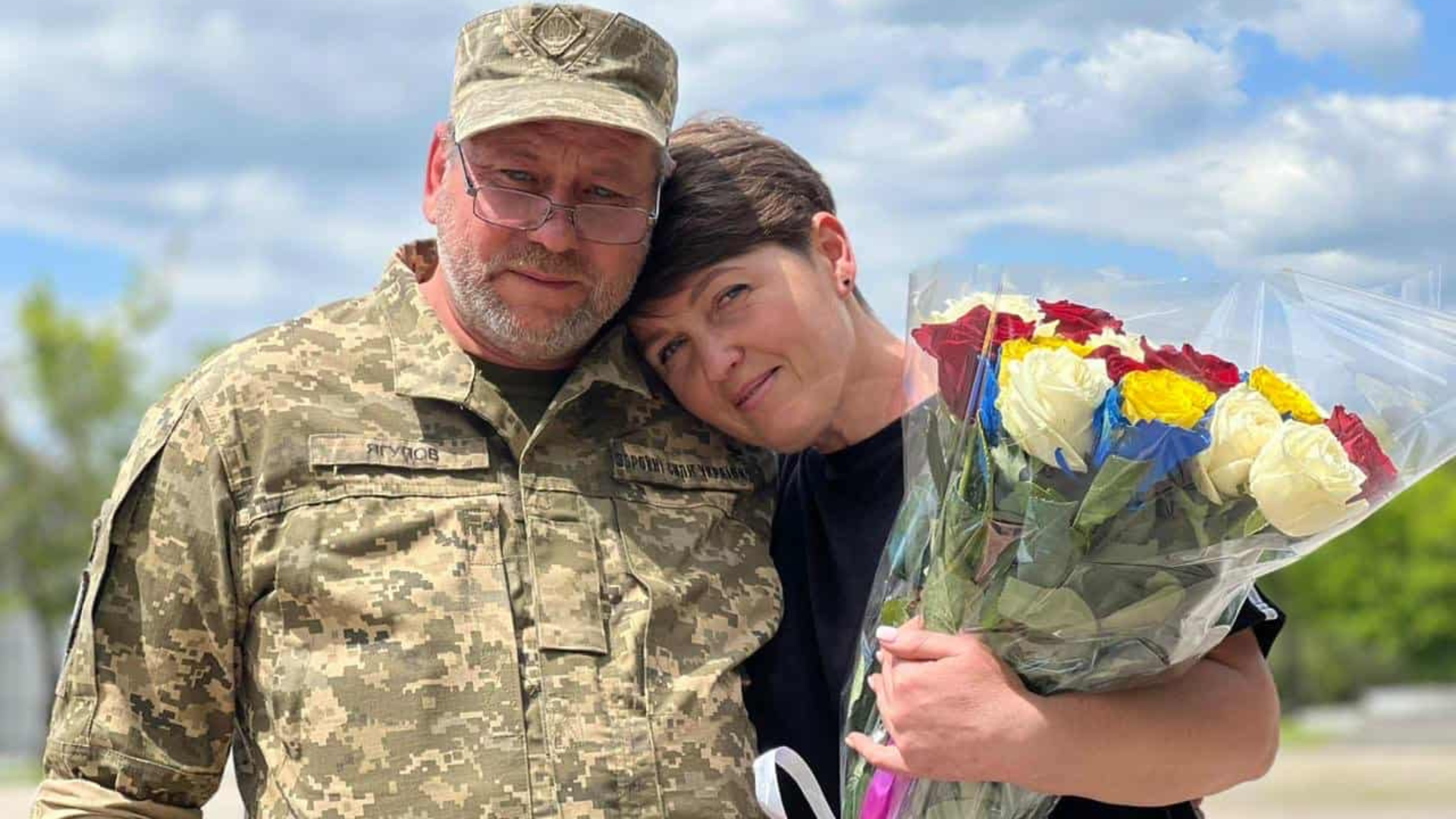
Olena Yahupova and her husband. Credit: Handout
She visited Brussels in early November this year to share her story before the Flemish Parliament. “I need to make sure that politicians at such a high level understand what is really going on there, because the decisions they make later impact everything,” she says.
Yahupova called for continued support for the Ukrainian fight and flagged to the parliament a need for more psychological support in her country.
The next day, she shared her story at the University of Brussels (ULB). “Young people are our future," she says. "They will be the ones who will be establishing relations between us, who will be engaged in that reconstruction and recovery in the future.”
‘Why would I leave?’
Despite the horrors and dangers she recounts, Yahupova remains in Ukraine today, as her husband continues to fight the occupying forces from the front lines.
“When your country is at war, you need to do everything to help,” she said. “If you want to stay away while the bad times last and then you want to return, my question would be, where were you when we were living through those bad times?”
Yahupova doesn't see herself leaving anytime soon. “I like my country. I was born there. I have lived all my life there. Why would I leave?”
‘I would ask Putin to show me his passport’
In the years since Russia's full scale invasion of Ukraine in 2022, Yahupova had never previously contemplated what she would say to Russian President Vladimir Putin if given a chance to speak to him.
When asked the question by The Brussels Times, it didn't take her long to come up with an answer. “I would ask him to show me his passport.”
She explained that, as members of the occupying forces are tried in absentia, a common defence is that witnesses and victims cannot be certain that the person they are accusing is the perpetrator, as they never saw a valid identification document.
“So I would ask Putin to show me his passport. So at the tribunal I would be able to say: ‘This is really him.’”
The Brussels Times approached the Russian Embassy in Brussels for comment on Yahupova's accusations.
“Regarding the specific allegations made by Ms. Olena Yahupova, it is difficult for us to comment on this individual situation from Brussels,” the embassy responded.
They further referred to allegations of “a consistent pattern of crimes against civilians by the Kyiv regime.”
Related News
- 3 years of war in Ukraine: ‘I don’t know if I will see my home again’
- Lives in limbo: What next for the thousands of Ukrainians living in Belgium?
- Belgian mother gets 25 years in jail for torturing her 3 year-old daughter
- 'Venezuela is treated like a cake and everyone wants a piece of it'
- Staying in Belgium after Temporary Protection ends: It's complicated
