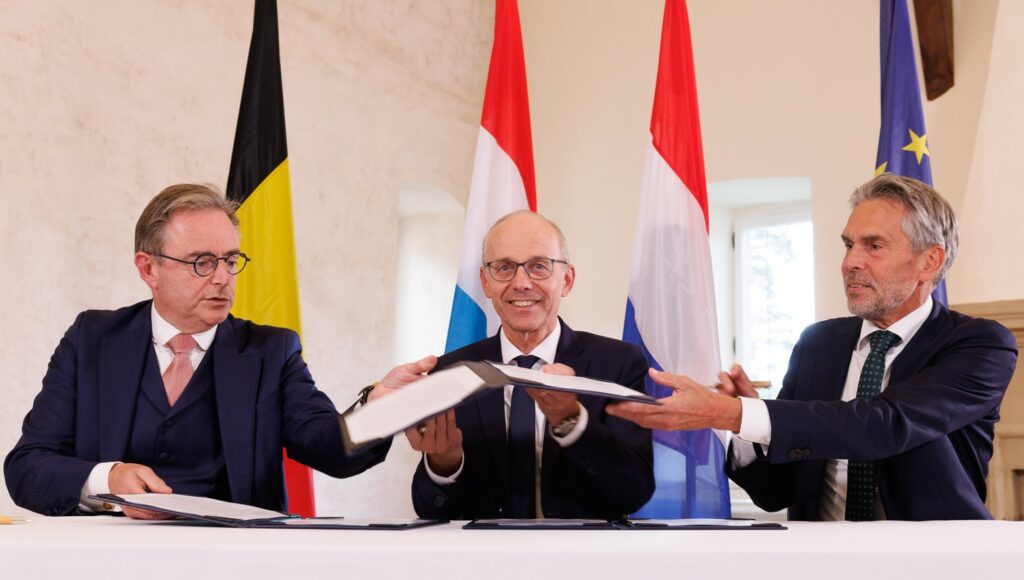
Belgium and the Netherlands becoming one country again, and potentially adding Luxembourg into the mix?
The Belgian Prime Minister has repeatedly suggested it, and the Flemish Minister-President is up for it – but political experts say that it is easier said than done.
In June, Belgium's Prime Minister Bart De Wever (N-VA) said that the separation of the former Netherlands in the 16th century was "the greatest disaster that has ever befallen us" – a sentiment he repeated earlier this month during a lecture in Amsterdam.
There, De Wever advocated for an "intimate union" of Belgium, the Netherlands, and Luxembourg, which he believes could become the "beating heart of Europe."
Now, Flemish Minister-President Matthias Diependaele (also of the Flemish nationalist N-VA party) has weighed in on the issue, professing wholehearted agreement with De Wever in the Dutch radio programme 'Sven op 1'.
"For Bart [De Wever], it has a historical basis, because he's a historian," he said. "I fully support it, but with a more forward-looking approach."
"If you look at what is happening in the world, with the geopolitical shifts, the way the United States views free trade, how China is positioning itself, the threat to defence from Russia...then I think Flanders and the Netherlands, Belgium and the Netherlands, can act together on many points and tackle these challenges together," Diependaele said.
Fourth-largest EU economy
The countries already collaborate very closely in many areas. "To give a very good example: we really do make a difference globally in the field of innovation," he added.
For Diependaele, the opportunities are endless: he advocated building an "innovation alliance" and pointed to the existing links between Flemish knowledge institutions, such as Leuven-based IMEC (world-leading in chip research) and the Dutch ASML (world-leading in chip machines).
The beating heart of Europe that he and De Wever envision would have a combined population of 30 million, plus 700,000 Luxembourgers – if that country also joins. The Benelux would then be the fourth-largest economy in the EU.
In reality, however, it is not so simple, political expert Caroline Sägesser at the Centre for Socio-Political Research and Information (CRISP) told The Brussels Times. "This seems like an idea that is alive only in Flanders, not in the French-speaking part of Belgium at all," she said.
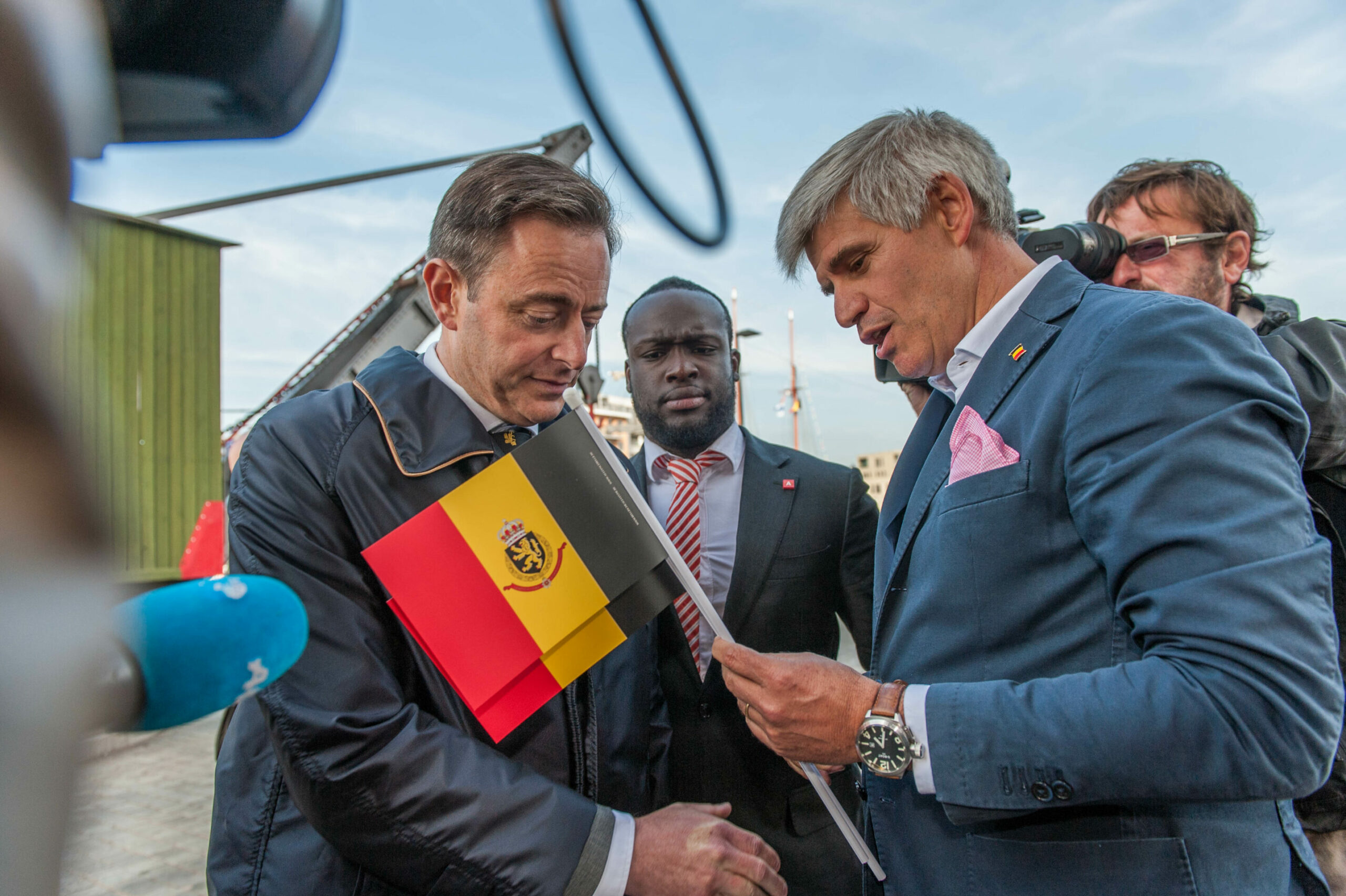
A bemused Bart De Wever (L) is seen being offered a Belgian flag by a monarchist ahead of the 'Joyous Entry' of King Philippe and Queen Mathilde, September 2013. Credit: Belga/Jonas Roosens
She believes that reinforcing cooperation between Belgium, the Netherlands, and Luxembourg makes a lot of sense because European integration is not moving fast enough. But actually merging the three countries is a whole different animal.
"As far as nationalism is concerned, Belgium has never been a very strong state. It is also a recent state, and of course, a sizeable share of the Dutch-speaking population has never felt fully recognised by Belgium," Sägesser said.
From the Flemish nationalist points of view of De Wever and Diependaele, there are also very strong economic motives behind this idea, such as merging the ports of Rotterdam and Antwerp.
"Additionally, Flemish nationalists have never felt fully acknowledged by the Belgian State. So from that point of view, trying to merge it into a bigger ensemble – one where Dutch would be the majority language – it makes sense for them to want this, on several levels," she added.
What about Luxembourg?
Luxembourg, as the most prosperous country in the EU, would only be an added benefit, Sägesser pointed out. "However, I am sure that the Luxembourg people would not be keen on this."
As a tiny minority, they would be even more at risk of losing their identity. "I do not know what the Luxembourg language status would be. It is very difficult to imagine what benefits such a merger could bring."
On top of that, Luxembourg does not have a fond memory of the Netherlands – which Luxembourg was tied to for longer than Belgium was.
"Throughout the 19th century, there was a single king for both countries," said Sägesser. "There is not a lot of love remaining in Luxembourg towards the Netherlands. And their economic integration is more geared towards neighbouring Germany. So in short: I don't think anybody asked them what they thought about this idea."
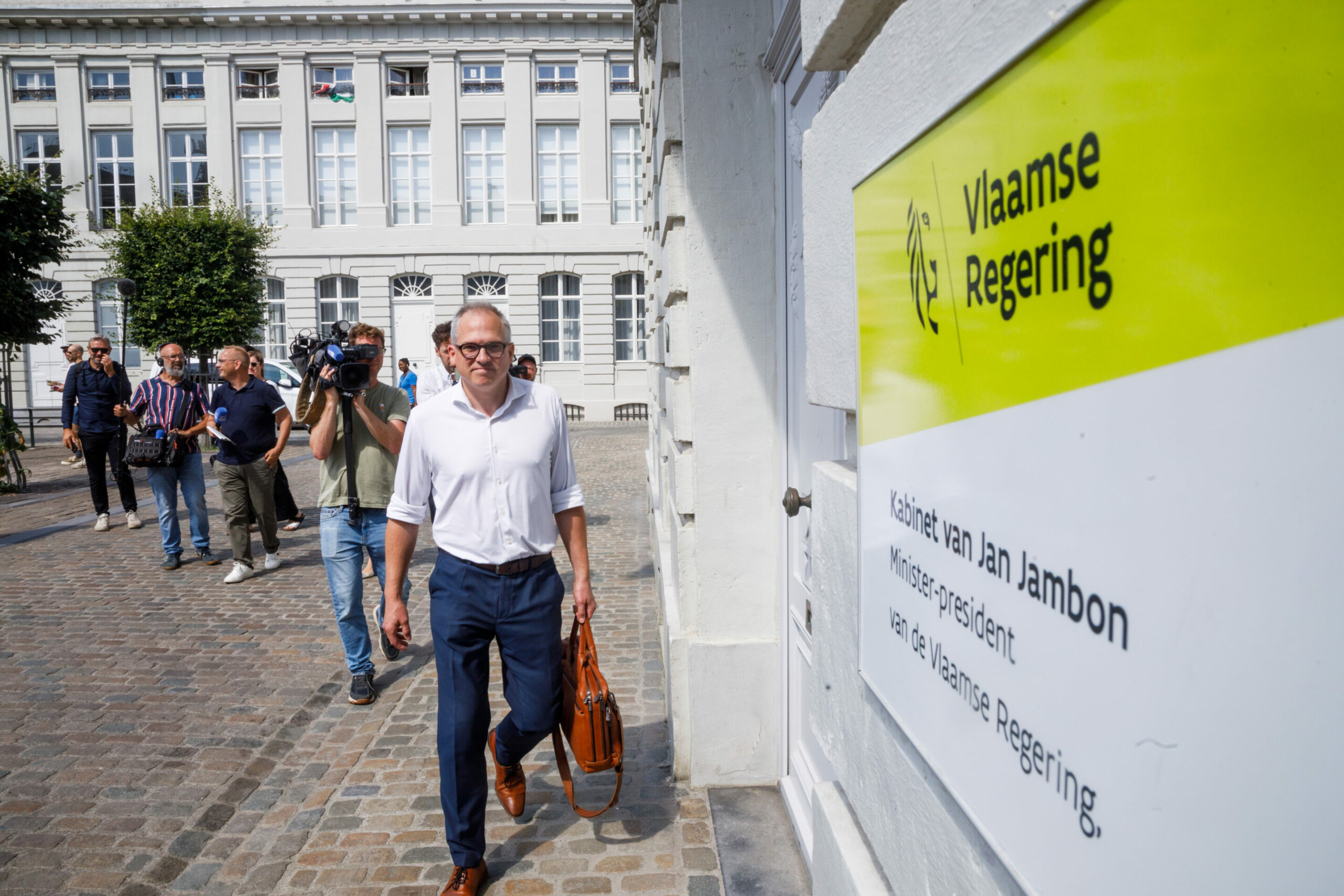
Flemish Minister-President Matthias Diependaele (N-VA). Credit: Belga/Hatim Kaghat
'The eternal problem of Brussels'
In French-speaking Belgium, meanwhile, people do not seem to be expressing strong opinions on the subject, and Sägesser believes people there do not take the idea too seriously.
She has a suggestion: "Maybe the underlying prospect might be that Flanders could merge with the Netherlands, but that Wallonia would rather tie its lot with France?"
While she admits that this would rid Belgium of its weakest economic region, it still leaves "the eternal problem of Brussels."
The Capital Region, she says, remains the "main obstacle" in all the plans of the Flemish nationalists. "They can neither take it nor leave it. Brussels enormously complicates all the plans they have proposed. It is a schizophrenic love-hate relationship."
Sägesser remains optimistic that Belgium will survive in its current form. "When it took the country forever to form a Federal Government in 2010-2011, there was a lot of fear that that would be the end of Belgium, and we would never again have a government," she said.
"But in 2019-2020 and last year, people had no fear," Sägesser said. "They thought: 'Okay, it is taking time. It is difficult, but it is Belgium.' We will endure. We will survive."
'The context has to be right'
However, it would be wrong to write off the Benelux entirely. Article 350 of the EU Treaty explicitly states that the Benelux is the only region with the right to initiate cooperation that goes beyond what the EU does.
In fact, the Benelux Union, a political and economic alliance between Belgium, the Netherlands and Luxembourg, still has a general secretariat in Brussels and contributed its DNA to what grew up to be the European Union.
But does that mean a formal merging of the countries will ever happen? "You never know," Diependaele said. "The context has to be right."
The Brussels Times has contacted the embassies of the Netherlands and Luxembourg for comment.
