
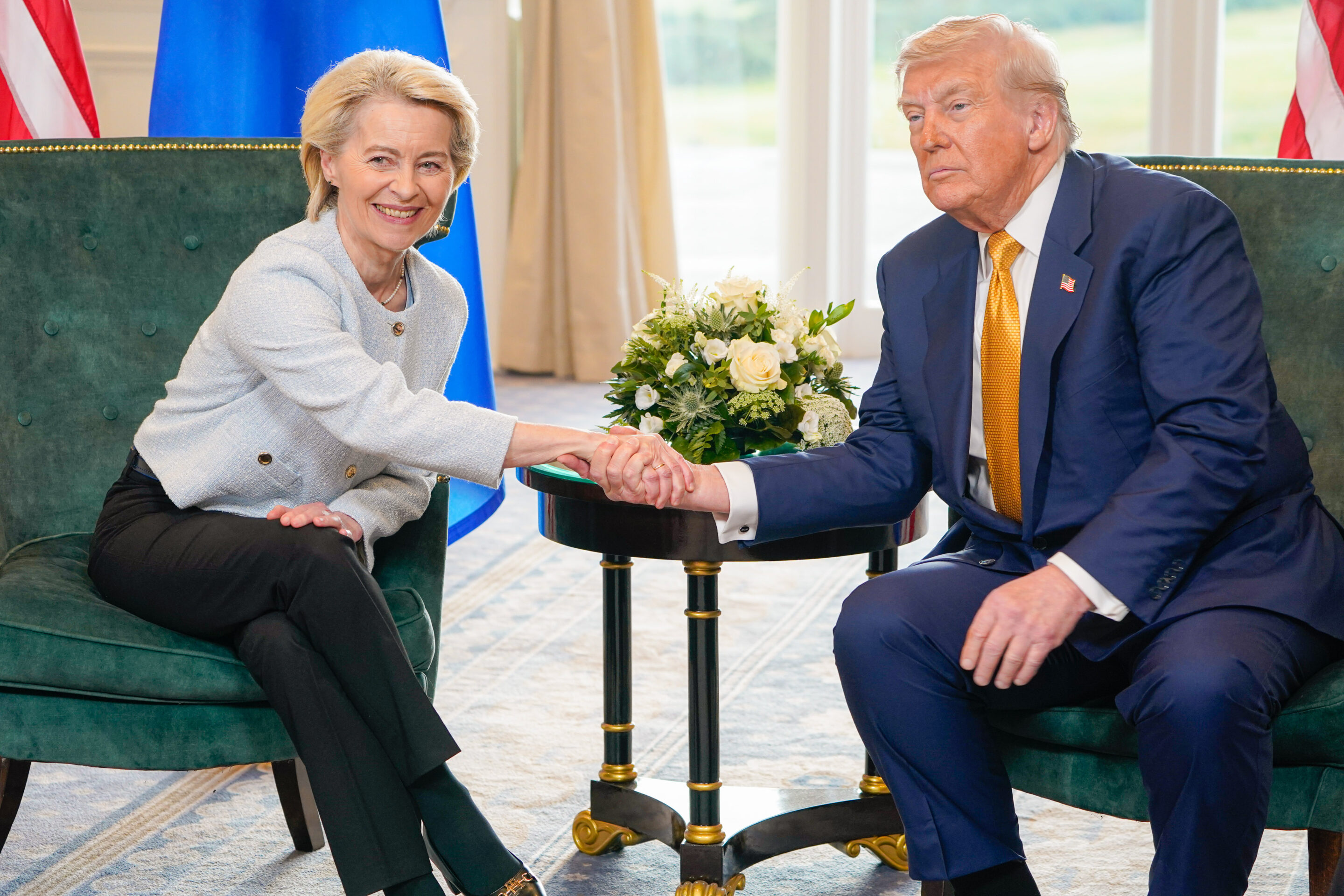
As part of the sabre-rattling, Trump has threatened to impose economically crippling tariffs on European exports to the US - for the second time in less than a year.
The threats have increased scrutiny on Europe’s growing reliance on US liquefied natural gas (LNG) imports, and how the continent would be impacted if Trump were to use energy supplies as leverage. The IEA revealed this week that Europe is expected to import a record amount of LNG this year, much of it from the US. Europe is rightly sensitive to threats to its energy imports as the continent is still grappling with the consequences of its decision to phase out Russian energy imports, after Russia’s most recent invasion of Ukraine in 2022.
Before the invasion, Europe imported around 40% of its fossil gas from Russia, mostly through piped gas but also via LNG. A central part of the EU’s response was to end Russian gas imports and replace them with supplies from other countries such as the US and Qatar. Agreements were hurriedly signed with Azerbaijan, Egypt and others. Political support was thrown behind LNG projects in Mozambique, Senegal and Nigeria.
The centrepiece of this European dash for gas was the landmark agreement between Joe Biden and Ursula von der Leyen in March 2022. Under the deal, the US agreed to increase shipments of LNG to Europe by 15bcm the same year and work towards importing 50bcm per year, equivalent to the entire annual gas consumption of France. Less than a year ago, the EU agreed to buy $750 billion of US oil and gas by the end of Trump’s term.
The role of the gas industry in these negotiations cannot be underestimated. The US LNG lobby publicly claimed credit for the idea of the deal with the EU, having proposed it to Biden in a letter sent a month before the agreement was finalised. Trump’s administration is known for being even closer to the US oil and gas industry with Trump openly asking for $1 billion of donations for his campaign in 2024. Similarly, the power and influence of the oil and gas industry in Europe is well documented.
The result of these choices can already be seen. Europe’s reliance on gas imports from Russia fell to 13% last year - a welcome development. But the EU now sources almost two thirds of its LNG from the US and European LNG imports are set to rise 7% to a record high this year. Research from the Institute for Energy Economics and Financial Analysis shows that the biggest importers are France, Spain, Italy, the Netherlands and Belgium as well as the UK.
The most frustrating aspect of Europe’s growing dependence on energy supplies from the US is how predictable it was. When Russia first invaded Ukraine in 2014, civil society organisations called on Europe to focus on building more renewable energy and boosting energy savings to enhance energy sovereignty and cut Europe’s overall gas demand, rather than seeking alternative gas suppliers. This call was repeated again in 2024 during Russia’s new offensive in Ukraine, and in the middle of a global energy crunch caused by volatile global gas markets pushing up prices.
The EU’s decision to focus on gas supply diversification adopted after Russia invaded Ukraine in 2014 was a bad idea - yet it was again a central part of the Commission’s RePowerEU response in 2022. Since then, global gas markets have not become any less volatile. European gas prices are again experiencing extreme volatility as gas markets react to Trump’s tariff threats over Greenland, the protests in Iran, and severely cold weather in the US, which is boosting domestic demand but also threatening to halt gas production as pipelines freeze. This is the reality of how gas markets work.
While European leaders did agree to a higher target for renewables and energy savings as part of RePowerEU, political momentum has since stalled amidst the European Commission’s insistence on reopening of recently agreed laws under the guise of simplification - much to the dismay of Europe’s clean industry and NGOs alike. Fossil gas still meets around a quarter of Europe’s energy demand - mostly for heavy industry and heating buildings, but also for producing electricity.
Worse yet, many governments across Europe are considering building a new fleet of gas power plants, an important market for US LNG. Most notably, in Germany, where there seems to be agreement around 12GW of new capacity, and fund them through capacity market subsidies. Such schemes already exist in six European countries with discussions underway for new schemes in Greece, Spain, Czechia and Denmark. This creates an artificial demand for gas, allowing more US gas to be sold and increasing industry profits, while passing the costs on to consumers.
If such gas expansion plans were to materialize, it would chain Europe even more tightly to gas imports and allow importers to threaten Europe's economic independence all too easily. They would join the fleet of underused LNG terminals as a testament to European leaders’ blind spot when it comes to investing in costly and unnecessary gas infrastructure.
The good news is that this could be the moment when European leaders really commit to homegrown renewables and accelerate the change that is already happening: wind and solar overtook fossil fuels in the EU electricity mix for the first time ever in 2025.
Energy sovereignty has become an urgent national security matter and the solutions are tried and tested: set ambitious targets for renewables and energy savings, agree on a clear legislative framework to derisk investments and create certainty for investors, and double down on implementation. For the electricity sector, that also means removing the barriers to fossil-free flexibility, which offers a cleaner and cheaper alternative to gas-fired plants. A key opportunity in 2026 for Member States to scale-up these solutions will be through the Flexibility Needs Assessments; taking steps to remove the market barriers for these fossil-free alternatives which can replace the role of gas in the energy system.
They say humans are the only animals that trip over the same stone twice. Hopefully, this time Europe will learn the lesson that fossil gas is not secure, stop listening to the gas industry and finally commit to solutions that genuinely strengthen Europe's energy independence, security and resilience. When fossil gas is a weapon, renewables are a shield.
By Tara Connolly, Campaigner at Beyond Fossil Fuels
