
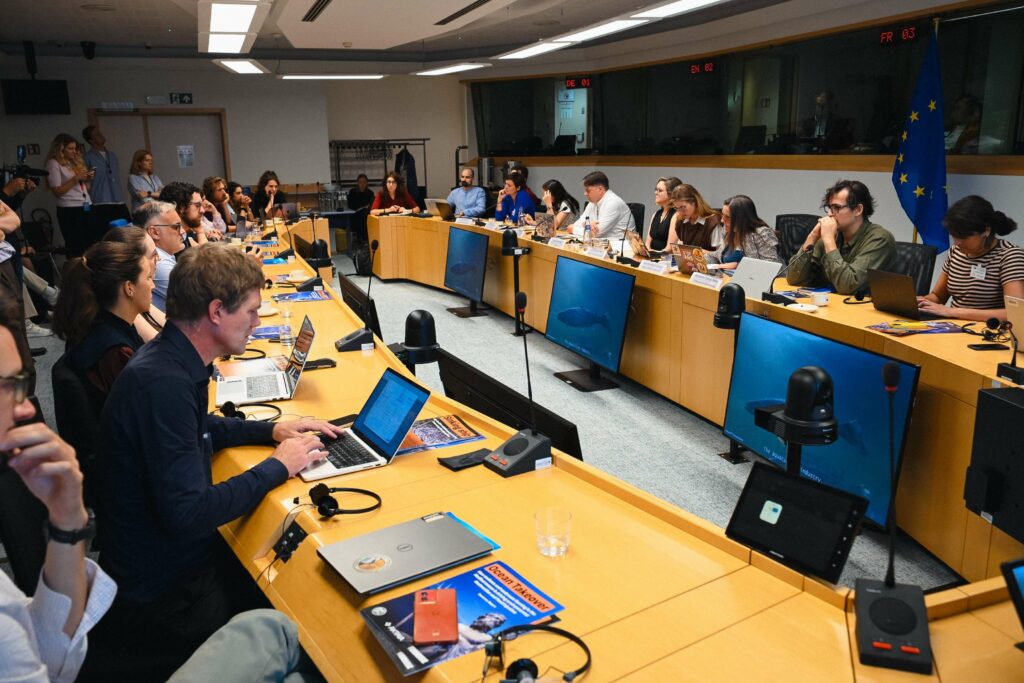
The practice of using fish food to breed other fish in fish farming is not only cruel but puts pressure on already stressed marine ecosystems and exacerbates food insecurity, according to a report which was discussed at an event in the European Parliament during Ocean Week in Brussels.
The event, which was organized by NGOs Compassion in World Farming and Foodrise, gathered policymakers, experts, and campaigners in the European Parliament to discuss the hidden costs of carnivorous aquaculture.
As global wild fish populations decline due to overfishing and pollution, fish farming has become the fastest-growing sector in food production, providing over half of the seafood consumed globally. The rapid expansion of carnivorous fish farming – in particular tuna and salmon production – heavily relies on wild-caught fish for feed.
As previously reported, another report by Compassion in World Farming revealed that Atlantic bluefin tuna farming risks threatening the population of one of the ocean’s giants. The report warned that bluefin tuna farming in the Mediterranean Sea by mainly EU Member States causes animal suffering and biodiversity loss, as well as weakening global food security.
The new report by Foodrise, an environmental and food justice NGO which campaigns and investigations target food supply chains globally. Aquaculture accounted for over a quarter (28.5%) of fish consumed in the EU in 2025. Salmon, almost all of which is farmed, was the most consumed species.
The report discloses, based on EU data and other sources, that nearly one-fifth (17%) of EU fishery landings - fish that are brought to shore and unloaded in EU ports - are converted into fishmeal and fish oil (FMFO). However, the proportion of fish processed into FMFO varied considerably across EU Member States. Denmark is the EU’s largest producer of FMFO, accounting for 35% – 50% of total EU production.
The majority of the EU’s FMFO exports supply the salmon aquaculture industry in Norway and Scotland. FMFO exported to feed their salmon farming return to the EU as salmon imports with lower nutritional value than the wild fish used as feed, according to Foodrise. It can take up to 6 kilograms of wild fish to produce just 1 kilogram of farmed salmon.
This 6:1 "Fish In, Fish Out" (FIFO) ratio is an established environmental metric for intensive salmon farming. The fishing industry claims that the small fish currently used for feed have little demand for human consumption. The industry average has trended closer to 1.2 to 2.5 kg of wild fish per kilo of salmon over the last decade due to the introduction of plant-based proteins.
The industry also counters that the industry's shift toward a circular economy is overlooked. 30% of fishmeal and over 50% of fish oil is now manufactured directly from fish by-products left over after fish are filleted for human consumption.
Foodrise told The Brussels Times that it can be assumed, based on the species landed, that a significant share of the fishery landings comes from European waters. At least one of the fishing companies has been identified as sourcing sardinella from West Africa.
“The EU must stop contributing to the overexploitation of West Africa’s aquatic resources through its market for fishmeal and fish oil,” commented French MEP Emma Fourreau (GUE/NGL), who hosted the event.
“Beyond the environmental impacts and consequences for animal welfare of such activities, boosting the growth of carnivorous aquaculture in Europe is the wrong answer to food security. Small pelagic fish, essential to local food systems and economies, are increasingly turned into fishmeal and fish oil to feed farmed fish and supply industrial feed chains linked to European aquaculture.”
“EU decisionmakers have a blind spot when it comes to acknowledging fish farming’s impact on European fisheries,” said Natasha Hurley, Deputy Director of Foodrise. “The rise of extractive aquaculture is taking a huge toll on communities and wild fish populations across Europe.”
“Salmon farming is a sector dominated by multinational corporations. That’s why we’re calling on the EU to stop providing financial support to extractive aquaculture and feed fisheries, prioritising instead the development of low-impact fisheries and aquaculture systems.”
With the Vision 2040 for Fisheries and Aquaculture expected to be published soon, the NGOs believe this is a crucial moment to identify and promote truly sustainable practices within the aquaculture sector while banning those that harm animals, people, and the planet.
The European Commission had planned to adopt Vision 2040 for Fisheries and Aquaculture on 30 September during the Ocean Week but last-minute political negotiations prevented that from happening. Among its focal points are aquatic food demand and supply and strengthening long-term food security.
The Commission’s position
Asked for a comment, a Commission spokesperson replied that the EU policy on aquaculture is embedded in the Common Fisheries Policy Regulation and the Strategic guidelines for a more sustainable and competitive EU aquaculture for the period 2021-2030. This policy aims at ensuring the growth of aquaculture in the EU as a more sustainable, resilient and competitive sector.
The EU policy on aquaculture for fed-species focuses on sustainable feed systems, as reflected in the Strategic Guidelines. This means using feed ingredients that are sourced in the way that is most respectful of ecosystems and biodiversity and which, at the same time, are appropriate for ensuring the health and welfare of the animals.
It also means limiting feed producers’ reliance on fish meal and fish oil taken from wild stocks, e.g. using by-products from fisheries, aquaculture and the processing industry, alternative protein ingredients such as algae or insects, etc.
A combination of improved feed efficiency, increased share of marine ingredients (fish meal and fish oil) coming from by-products, increasing use of novel ingredients (decoupled from marine ecosystems) in the aquafeed formulation (microalgae, SCP-single cell proteins, fermentation technologies) or insect protein can keep building sustainable feed systems for aquaculture.
EU funding supports this objective with innovation towards the use of alternative and more sustainable ingredients.
Furthermore, the Commission published last August a study on ‘Feed for Aquaculture (Aquafeed)’. This study assesses the current state of the aquafeeds for primary farmed and consumed species in the EU across key areas of policy and regulatory frameworks, market trends, traceability and transparency, alternative and emerging materials, and sustainability aspects.
Update: The article has been updated to include the Commission’s comments.
