
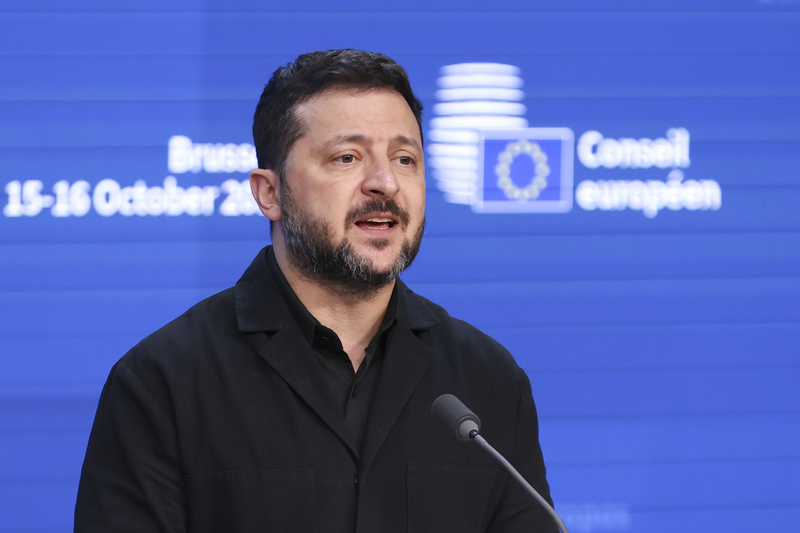
EU leaders met in Brussels last week for a two-day summit which covered several topics but was dominated by the latest development on the ground in Ukraine and EU’s support for the country.
However, there is still uncertainty whether Ukraine will have enough air defence interceptors to counter Russia’s ballistic missile strikes against its critical infrastructure. The issue was reportedly discussed in the talks but is not directly mentioned in the conclusions.
In the conclusions, the EU expressed its “full and resolute support to the people of Ukraine as they face particularly brutal attacks by Russia”. The EU “will continue to provide, in coordination with like-minded partners and allies, comprehensive political, financial, economic, humanitarian, military and diplomatic support to Ukraine and its people.”
To help Ukraine prepare for winter, the EU called for further intensified efforts and coordination to urgently strengthen Ukraine’s air and missile defence capabilities, the resilience of its critical infrastructure and energy system, including through the Ukraine Energy Support Fund, and to address other immediate needs.
The EU stressed the “importance of defence industrial cooperation with Ukraine, which contributes to strengthening Europe’s defence readiness”. It underlined the need to deepen defence industrial partnerships with Ukraine by integrating its defence industry into the European defence technological and industrial base.
It also reiterated its call on all countries to immediately cease any assistance to Russia in its war of aggression against Ukraine and notably through the provision of dual-use goods and components. In particular, it strongly condemned the deployment of North Korean soldiers in the war against Ukraine and the military support provided to Russia by Iran and Belarus, among other unnamed countries.
During the summit, EU leaders exchanged views with Ukraine’s President Volodymyr Zelenskyy. He reportedly asked for a "winter package" of 300 American Patriot interceptors.
Hundreds of the older generation of Patriot interceptors (PAC-2 and PAC-3 models) are kept in stock by EU Member States, among them Spain (classified figure), Greece (ca 200) and Sweden (ca 300), but they are reluctant to deliver them to Ukraine and risk their own national defence readiness. Other countries (Germany, Poland, The Netherlands and Romania) have recently approved or signed contracts for the purchase of Patriot interceptors.
According to Swedish Daily ‘Dagens Nyheter’, Sweden is one of the countries that holds a stockpile of Patriot missiles. In 2018, it signed a framework agreement with the United States to acquire the Patriot system along with 300 missiles. A military expert told the newspaper that Sweden could spare missiles for Ukraine but Prime Minister Ulf Kristersson insists that they are needed for Sweden’s own defense.
Zelenskyy usually asks for them, Kristersson said, but he already knows the answer. “We have been very consistent. We possess a limited supply of the most advanced systems, and we are constantly weighing the balance between Sweden’s own defense needs and capabilities, and the defense that Ukraine is, in effect, providing on our behalf.”
In the conclusions, the EU stated that “all military support as well as security guarantees for Ukraine will be provided in full respect of the security and defence policy of certain Member States and taking into account the security and defence interests of all Member States.”
In a press conference, Zelenskyy expressed his gratitude for EU’s united support for Ukraine. He stressed that it was important to work with Ukraine’s European and American partners as regards the Patriot interceptors. They are not for free and financed by the EU.
He is aware of that the US is running out of Patriot interceptors because of the situation in the Middle East and the risk of the resumption of the war against Iran. “Ukraine is not a priority destination for these interceptors.” EU Member States would not be able to easily refill their own stocks if they would transfer them to Ukraine.
Zelenskyy explained that Ukraine is asking for the very minimum of interceptors it needs. “We aren’t going to use two interceptors to shoot down one missile.” He was sure that the EU will support Ukraine with interceptors but did not know how many it will receive. “The EU has the minimum number we need”. Ukraine has also signed a contract with Germany which has a license to produce the air defence system.
He added vaguely that Ukraine is also working with other countries without disclosing any figures. He sees also challenges as regards ballistic missile launchers. “I also expect that we together with the EU will produce anti-ballistic systems,” he said. He even promised that Ukraine will share them not only with its European partners but also with other countries that might need them.
Ukraine has also faced difficulties in defending itself against Russian drones because of “speed limits” in the Starlink satellite system operated by SpaceX. According to Zelenskyy, the White House has indicated that this would soon be resolved.
If there is no ‘energy ceasefire’, at least provide us with anti-ballistic interceptors so that we can protect our energy infrastructure, he said, referring to the US one-sided proposal for an emergency energy ceasefire. He found the American-Russian ‘diesel deal’ strange. President Trump decided on 9 October to import Russian diesel oil to lower fuel prices in the US ahead of the mid-term elections in November.
“We’ll keep on living – living with dignity – and fighting,” Zelenskyy concluded the press conference.
Besides Ukraine, EU leaders adopted conclusions on competitiveness, the Republic of Moldova, the next multiannual financial framework, the Middle East, European defence and security, migration, enlargement and reforms, as well as other items, which covered the Arctic region, Ceuta and Melilla, a safer digital sphere, the UN climate change conference and international jurisdiction.
