
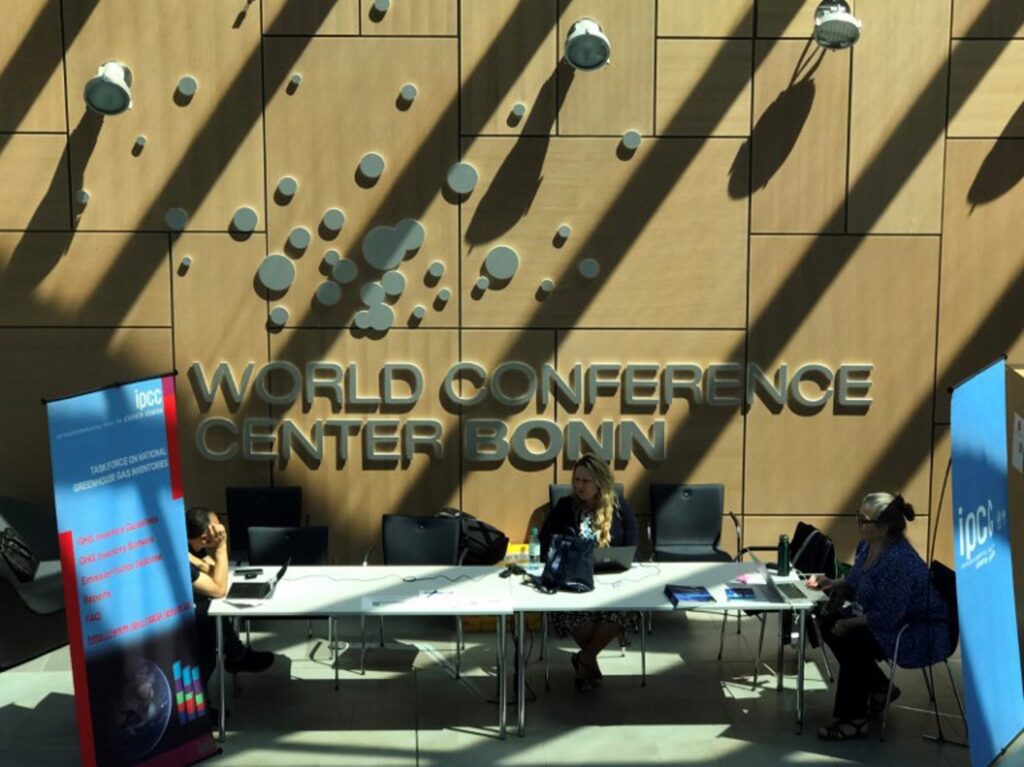
About 5,000 participants from nearly 200 countries party to the UN Framework Convention on Climate Change (UNFCCC) will gather in Bonn, Germany, from Monday for a new round of climate negotiations.
Their aim will be to reach consensus on key issues ahead of the UN Climate Change Conference (COP30), scheduled for 10-21 November in Belém, Brazil.
The UNFCCC secretariat in Bonn annually hosts these mainly technical and preparatory discussions between the major COP climate summits. This year’s discussions, the 62nd sessions of the “subsidiary bodies” (SB62), are scheduled from 16 to 26 June.
National determined contributions (NDCs)
The chairs of these bodies have urged negotiators to operate “efficiently and transparently,” as the agenda includes around 50 items, while they acknowledged financial constraints due to the end of US contributions.
The Bonn meeting will examine the state of multilateralism, strained by global conflicts and the US withdrawal from the Paris Agreement, for the second time, under Donald Trump.
While then US President Joe Biden submitted the US national determined contribution (NDC) before leaving office, many countries have yet to submit their new national commitments for 2035, expected in 2025.
These commitments aim to limit global temperature rise well below 2°C and ideally below 1.5°C compared to pre-industrial levels. Only about twenty countries, responsible for roughly 20% of global emissions, have fulfilled this requirement. Key players like China, India, and the EU are still pending.
Climate financing for developing nations
Climate financing for developing nations is expected to be a major concern, even if not formally on Bonn’s agenda. The developing countries were dissatisfied with the outcome of COP29 in Baku, which proposed $300 billion in funding from developed nations by 2035, falling short of the $1.3 trillion per year they requested, starting in 2030.
Progress on the Global Goal on Adaptation to climate change is also anticipated. Negotiators have identified 490 indicators, which they plan to reduce to about 100.
Adaptation has historically been underfunded, frustrating southern nations most affected by climate change. In 2021, at COP26 in Glasgow, countries committed to doubling adaptation funding from 2019 to 2025, aiming for €40 billion annually.
Gender issues and the advancement of the Global Stocktake will be discussed in Germany.
Global stocktake
The Global Stocktake, confirmed at COP28 in Dubai, aims for a symbolic but important transition away from fossil fuels and seeks to triple renewable energy’s share in the global energy mix by 2030.
It is a key process established under the Paris Agreement to assess collective progress towards achieving its goals, including limiting global temperature rise. It occurs every five years and involves a comprehensive review of countries' climate actions as well as their effectiveness in reducing greenhouse gas emissions.
Finally, the Bonn discussions will likely address the host country for COP31 next year, with Australia a strong contender, although Turkey remains a potential candidate.
