
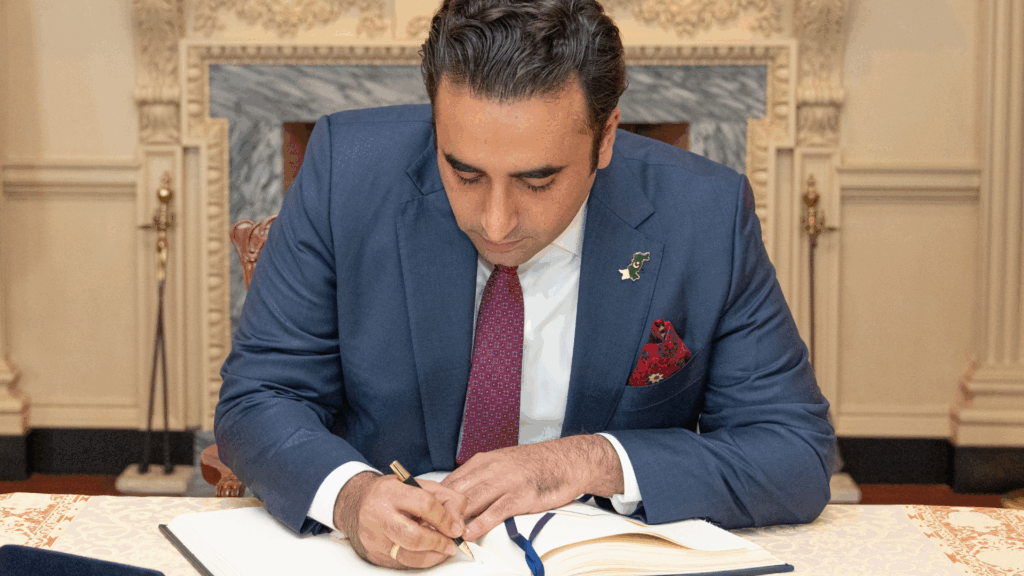
"The level for full-blown military conflict between India and Pakistan lowered to a level that we've never seen in our history," said Bilawal Bhutto Zardari, leader of the Pakistan Peoples Party (PPP) and former foreign minister.
Bhutto Zardari arrived in Brussels last week as the leader of a delegation sent by Pakistan's PM to engage the international community towards achieving "more permanent" peace in South Asia, and The Brussels Times sat down for a conversation with him at his hotel in the centre of the city.
Tensions rose between India and Pakistan following a deadly attack on Hindu tourists in India-administered Kashmir on 22 April. India accused Islamabad of backing the militant attack, a claim that Pakistan has denied.
In early May, India launched a series of "punitive" strikes. According to New Delhi, the strikes targeted "terror infrastructures" in Pakistan-administered Kashmir and Pakistan. Pakistan responded to the action with its own strikes. A ceasefire was reached on 10 May.
But more efforts are needed from the international community, as the threat of further escalations is far from over, according to Bhutto Zardari.
'We haven’t achieved peace'
With restricted dialogue between the two nations, the former minister sees the closer ties the EU has formed with India as beneficial. "We appreciate the level of engagement that the EU and other countries have with India [...] that positions [them] in such a way that they can speak to India as a friend." Bhutto Zardari told The Brussels Times.
Although he acknowledged the support of the EU and the US in de-escalating tensions and mediating the ceasefire, he encouraged further efforts for prolonged peace.
"While we've achieved a ceasefire, we haven't achieved peace. A large part of the international community has a false sense of calm," he said.
For Bhutto Zardari, statements made following the ceasefire have put hopes for overcoming the escalated tensions on hold.
"We [agreed to the ceasefire] on the condition that there would be another conversation at a neutral location that covered all friction points. But then we saw India's reaction, where they stopped calling it a ceasefire. They said this is a pause."
'Red lines'
Amid the tensions in April and May, diplomatic ties between the two countries were downgraded, with India notably suspending the water-sharing pact, the Indus Water Treaty. New Delhi currently holds the treaty "in abeyance."
For Bhutto Zardari, this is a "red line" that needs to be taken seriously. "We expect many of the people of Europe to take the principal stand. The weaponisation of water cannot be allowed," he said. "Just the threat to cut off the water supply to 240 million people is a violation of the UN Charter."
He added: "If the Indus water treaty doesn't hold, all treaties then are just worth the paper that they're written on."
The threat is further alarming amid the context of increasing climate pressures. "We're fighting in a region where we're supposed to see cooperation," he said. "This is the last place we needed a new fault line to emerge."
With water supplies on the line, Bhutto Zardari believes international reaction has become more complex. "Everybody wants to be seen as a neutral advocate of this peace."
However, he underscored that EU officials he has communicated with have been receptive to Pakistan’s concerns. "The way in which they differ is in how they believe it's best to raise this issue diplomatically with India."
'Terrorist menace still remains'
The path to lasting peace also needs terrorism to be addressed. "What we've seen since the fall of Kabul is that the Western world has left the region, but the terrorist menace still remains."
Bhutto Zardari remarked that Pakistan has seen terrorist groups coordinate regardless of their ideological lines.
"Pakistan is witnessing its bloodiest year vis-a-vis terrorism," he added. "We need to all focus on how we're going to combat and deal with the vacuum that's been left behind and the consequences of that." he told The Brussels Times.
This is an area where cooperation is key. "We would like to see international cooperation but also regional cooperation."
"The fact that India and Pakistan have absolutely no conversation or coordination, the last time we talked about terrorist coordination was in 2012, I think is extremely damaging," he said.
'Perpetual state of war'
Bhutto Zardari further warned that the consequences of future Pakistan and India relations can have international repercussions, both in terms of migration and extremism.
But peace in his country isn’t only dependent on solving tensions with India."We've had one border with Afghanistan [...] where war was raging and we've been left to pick up the pieces. We have a nuclear fault line with India. Now we have war on our border with Iran. Geopolitical tensions of the international community always concern us because we share the other border we share with China."
He added: "We'd like to see all these disputes, conflict, fault lines addressed [...] We want to be able to transition away from a security state to a welfare state. You were only able to do that here in Europe and the UK after the war."
Above all, the former minister underscored the need for peace in the area. "We fought a war in one way or the other and we certainly don't want to be caught in a potential perpetual state of war with India."
