
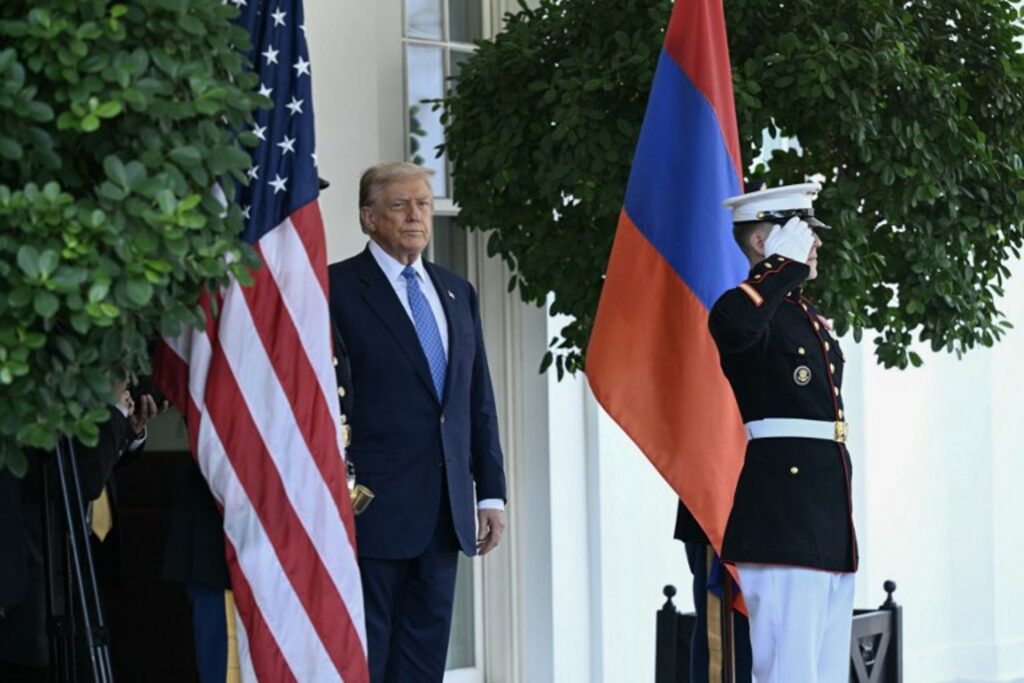
Armenia and Azerbaijan, embroiled in a territorial conflict for decades, pledged in Washington on Friday to “permanently cease” all hostilities, according to US President Donald Trump.
Standing alongside Azerbaijani President Ilham Aliyev and Armenian Prime Minister Nikol Pashinyan at the White House, Trump was praised by both leaders, who suggested that his mediation efforts merited the Nobel Peace Prize.
The two former Soviet republics committed to ending all conflict, establishing trade and diplomatic relations, and respecting each other’s sovereignty and territorial integrity, Trump said.
“Thirty-five years they fought and now they’re friends and they’re going to be friends for a long time,” Trump said. “They're going to be able to really live and work together.”
Still, the binding nature of this commitment remained unclear.
Ilham Aliyev hailed the day as “historic” and thanked Trump for lifting longstanding restrictions on US military cooperation with Azerbaijan, a decision also announced on Friday.
The two leaders shook hands under Trump’s approving gaze and signed a document referred to by the White House as a “joint declaration.”
“We are establishing peace in the Caucasus today,” the Azerbaijani president remarked. The Armenian prime minister stated that the agreement “paved the way to ending decades of conflict.”
The agreement provides for the creation of a transit corridor through Armenia, linking Azerbaijan with its exclave Nakhchivan further west.
This transit corridor, fulfilling a long-standing demand from Baku, will be named the “Trump Route for International Peace and Prosperity” (TRIPP).
The United States will have development rights over this corridor, positioning itself strategically in a region rich in hydrocarbons.
The contested region of Nagorno Karabakh is internationally recognised as part of Azerbaijan, but was controlled by Armenian separatists for nearly three decades following the Soviet Union’s collapse, leading to the exodus of nearly all ethnic Azeris.
Baku partially reclaimed this enclave in a renewed conflict in autumn 2020, and fully recaptured it in a lightning offensive in September 2023, causing over 100,000 Armenians to flee.
Keen to move past the conflict, Baku and Yerevan agreed in March on the text of a peace treaty.
However, victorious Azerbaijan has been demanding that Armenia amend its Constitution to formally renounce any territorial claims on Karabakh.
Nikol Pashinyan expressed willingness to comply, announcing plans for a constitutional referendum in 2027. Yet, the trauma of losing Karabakh, known as Artsakh in Armenian, continues to divide his country.
