
It is nighttime in Belém and we are past the midway point of COP30. Ministers are arriving and we can already see some of the most contentious issues as the talks are transitioning from the technical level to the political level.
“For example, on adaptation finance, can COP30 agree on a tripling of adaptation finance until 2035?”, Soenke Kreft, a Senior Scientist at United Nations University Institute for Environment and Human Security (UNU-EHS) writes to The Brussels Times.
There is one Nationally Determined Contribution (NDC) submitted for the EU as a whole as the Members States do not submit NDCs individually. The EU NDC was submitted just before the start of COP30. “The NDCs, the climate plans of countries, are also in focus for the fact that they are not measuring up to the 1.5 °C temperature goal.”
“On just transition, there is a text forming, but the question is how to institutionalize the topic within the UNFCCC architecture (United Nations Framework Convention on Climate Change) or whether there will be, for example, a new mechanism,” he writes.
A particularly difficult topic is the global adaptation, specifically the list of indicators. Here, some countries made it clear that they are not ready to accept a list of indicators at COP 30. So, there is a question on how to keep up the momentum.
“At the same time, on loss and damage, we've seen some text coming, but still some far-ranging options on how to move forward. These concern the different institutions that have been created under the UNFCCC to work on loss and damage, and what specific guidance to give to the fund for responding to loss and damage.”
“We’ve also seen in the streets of Belém big demonstrations by climate activists and indigenous people, asking for more climate ambition and more climate justice;” he concludes. “I think this is the right framing for the ministers to now pick up the issues in the second week and bring COP30 to a success.”
What are the indicators as regards to the Global Goal on Adaptation (GGA)? “The Global Goal on Adaptation is part of the Paris Agreement, although it is vague. The UAE Framework for Global Climate Resilience, adopted at COP28, puts into effect the Paris Agreement's Global Goal on Adaptation. This framework established 11 global targets across key thematic areas such as water, health and ecosystems.”
Prior to COP 30, a group of experts came up with around 100 indicators for these targets. An example indicator is the implementation of early warning systems. At the beginning of COP 30, it was clear that some countries (especially the Africa Group) were not ready to accept the indicators and suggested another process for two years to give further substance to the indicators. Now, the GGA decision is part of the Belém political package.
Do you see any alliances between the EU and other countries? "Ahead of COP30 and at the outset of the UN General Assembly (UNGA) this year, the High Ambition Coalition, an informal coalition of developed and developing countries, made a joint statement calling on countries to align their national climate plans to the 1.5°C target and increase ambition.”
“The group has been impactful before, helping to deliver COP21’s Paris Agreement. We have not witnessed public statements so far in Belém. Several EU ministers and the EU Climate Commissioner, alongside ministers from Small Island States and other vulnerable countries, were part of the UNGA statement directed at COP 30.”
How does the absence of the US impact the conference? “The mood in Belém is that the work must move forward with the nations here,” Soenke Kreft replied.
“The Advisory Opinion by the International Court of Justice issued in July this year also made it clear that climate commitments do not come only from the Paris Agreement but are also anchored in general customary international law. At COP, the US would have the chance to actively shape international policy, an opportunity they are now no longer utilizing. But the process will still continue.”
Cautious optimism
What is the feeling of Wopke Hoekstra, the European Commissioner for Climate, Net Zero and Clean Growth? He had a similar role at the previous COP29 in Baku, Azerbaijan. That conference was on the verge of collapse until the last evening when it reached a new global target to channel $1.3 trillion of climate finance to developing countries by 2035.
As regards the other main issue, reducing emissions, he admitted that COP29 had failed and that the world has lost a year. “It was not the focus of this COP… We did manage to safeguard Dubai and take some steps forward. It is less than what we have liked, but it is better than we feared. We are unhappy to lose a year, but we are happy not to lose this fight.”
In remarks at a press conference at COP30 on Monday with the Danish Presidency, the Commissioner seemed cautiously optimistic.
“We need to bring emissions down. And we need to bring them down everywhere,” he said. “We need to do more and we need to do it all over the world. If you look at Europe, we are setting ambitious goals and we're doing the work from the ground. We came to Belém with our new contribution to 2035, from 66.25 to 72.5%. That shows that we are walking the talk.”
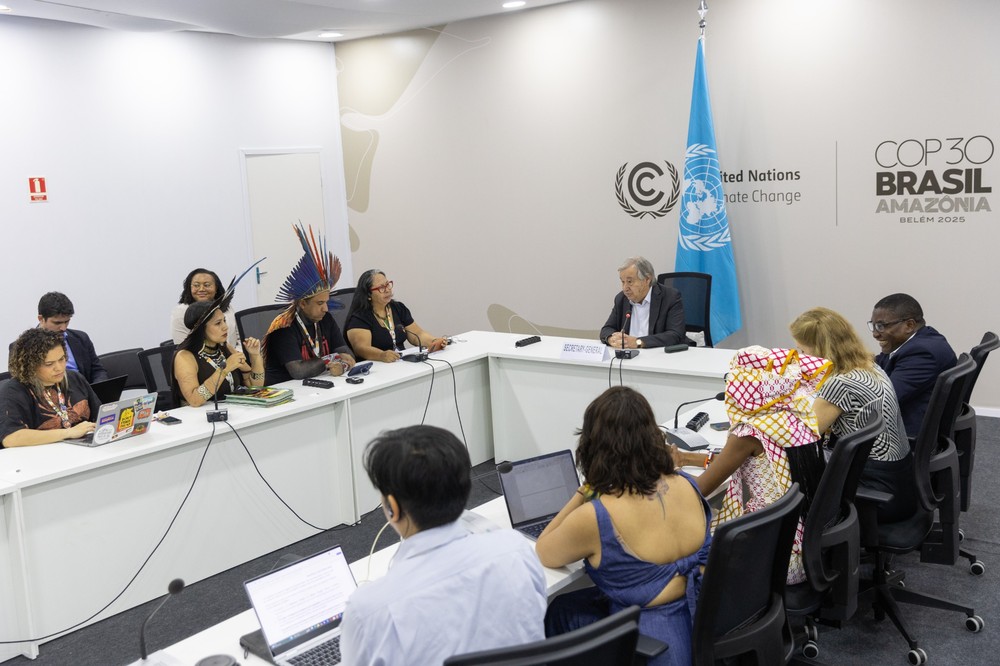
Behind the scene with United Nations Secretary-General António Guterres, © UN Climate Change - Kiara Worth
But what is success at COP this year? He listed a couple of things of huge importance. “We need to make sure that we speed up. Because indeed, the clean transition we are all in is unstoppable, it's going in the right direction. The trend is the right one. We are significantly outpacing the investment in fossil fuels if you look at how much we are doing in the domain of electrification.
Important things “are adaptation and the development of new adaptation indicators, climate finance and making sure that we are making this as concrete as possible, the just transition, which is hugely important all over the globe, and a new gender action plan, which is truly something that involves everyone from everywhere.”
At the end, what matters are the targets in the NDC’s. “While our targets are of course ‘nationally determined', we need to check collectively, that is why we are here together, if we are doing enough to keep global warming in check. And you know the answer to that: we are not. We do need to do more together.”
