
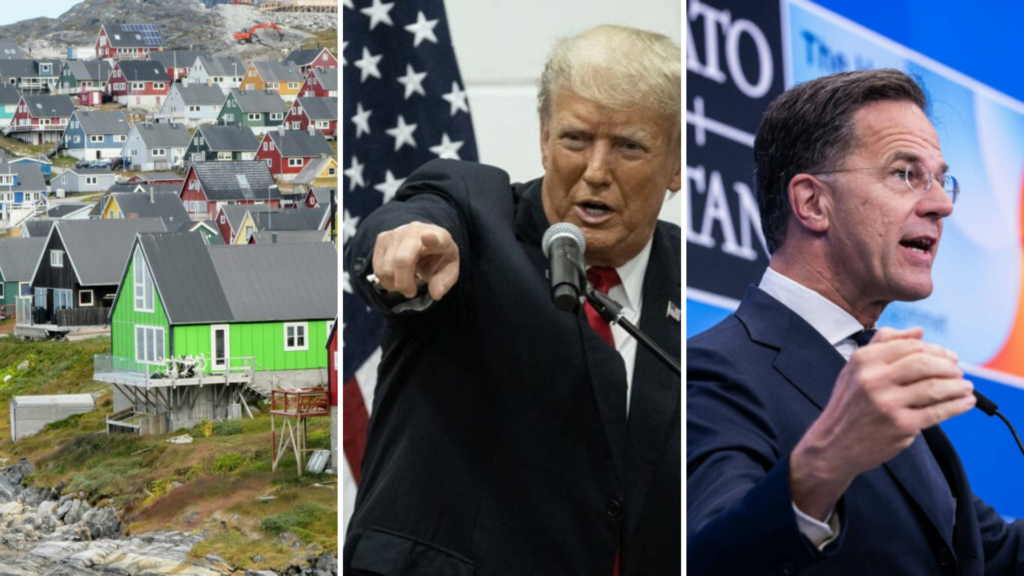
A day after snatching Venezuelan President Nicolas Maduro from his home in Caracas, US President Donald Trump had already moved onto his next target: the Arctic island of Greenland.
“We need Greenland from the standpoint of national security,” Trump said on 4 January. “It’s so strategic. Greenland is covered with Russian and Chinese ships all over the place.”
A subsequent White House statement said the US was “looking into a range of options” to acquire Greenland, a semi-autonomous Danish territory populated by around 57,000 inhabitants. Ominously, it said it would not rule out a military intervention.
Over the past few years, Trump has intermittently raised the prospect of the US “buying” the strategically located island, which is seen as an ideal location for installing early warning systems against missile attacks – as well as keeping tabs on Russian and Chinese activities in the Arctic.
The president has offered up a range of justifications for a US takeover, from increasing the prosperity of “the incredible people of Greenland” to opening up US access the island’s wealth of natural resources.
Previous suggestions from Trump that Greenland should be part of the US were largely met with scepticism and derision. Not so long ago, Denmark dismissed the idea as “absurd”.
Following recent events in Venezuela, however, analysts are taking the president’s threats against the island much more seriously. Political leaders in Europe are genuinely fearful for what might come next.
NATO's strategic bind
Here in Brussels, talk has centred on how NATO and the EU might respond should the US follow through on its rhetoric.
Danish Prime Minister Mette Frederiksen argued this week that any US invasion of Greenland would spell the end for NATO.
“If the US chooses to attack another NATO country militarily, then everything stops, including NATO and thus the security that has been established since the end of the Second World War,” Frederiksen told Danish broadcaster TV2.
Ed Arnold, a senior research fellow at think tank the Royal United Services Institute (RUSI), believes such concerns are justified.
“If something were to happen which brought the US and Denmark into a sort of direct confrontation, it would certainly be the end of NATO as we know it,” he told The Brussels Times.
However, Arnold thinks armed conflict between allies is unlikely, not least because Washington already has an established military presence on the island, which, he argues, obviates the need for a full-scale invasion.
“There's nothing to attack because there's only one military installation there, and it's actually American,” he says. He thinks a more likely scenario than a full-scale invasion is a US takeover of Greenland by stealth, via a gradual increase in troop numbers.
The US base on Greenland was established under a 1951 bilateral agreement which was updated last year. Troop numbers have fallen to around 200 from a peak of around 10,000 at the height of the Cold War. However, the agreement allows Washington to increase its military presence on Greenland if it judges it necessary.
According to Arnold, a gradual increase of US military presence would not constitute an armed attack against Danish territory. Consequently, he says, Denmark would not be able to trigger Article 5 of the North Atlantic Treaty, which says that an armed attack against one or more members will be considered an attack against all.
He believes NATO would be “bizarrely impotent” in this kind of scenario. “No European is going to fire on an American troop transport. So I don't think militarily there's anything to do,” he says.
Politically, too, NATO’s hands would be tied. “There would definitely not be any Article 5 discussions to be had,” says Arnold. “There is the potential for Article 4 discussions [which allows member countries to start a discussion with allies about threats to their security], but I think the Americans would just likely block it.”
The EU (and Canada) to the rescue?
If Greenland is seriously threatened by the US, Arnold believes Denmark would be better served by turning to the EU and Canada for support, rather than to NATO.
It could ask the EU to put economic pressure on Washington, for example, by introducing punitive regulations on US technology companies.
“It’s less about what Denmark can do individually – which I don't think is actually that much – it's what Denmark can leverage other Europeans to do, either as an EU bloc...or more likely a sort of coalition of EU states led by France and Germany and also the Nordic Baltic countries,” he says.
There would, of course, be consequences for Europe if the continent’s leaders decide to stand up to the US in this manner. “It could have completely the opposite effect and potentially make it a little worse,” says Arnold.
The US may simply withdraw its support from NATO and from Ukraine, putting Europe in an even greater strategic bind.
So far, Europe’s response has been fairly tepid. Earlier this week, six European allies – the UK, France, Germany, Italy, Poland and Spain – backed Denmark with a joint statement which said, "Greenland belongs to its people, and only Denmark and Greenland can decide on matters concerning their relations.”
However, there was no common statement from all 27 EU members, underlining just how divided the bloc remains over its response to the Trump administration’s increasingly belligerent rhetoric and actions.
A Christmas present for Putin
And what of Russia in all of this? According to Arnold, the Greenland situation is “like a Christmas present” for Vladimir Putin, because it shows deep fissures within the NATO alliance.
“Putin knows that he can't defeat NATO militarily but he can potentially defeat NATO politically,” he says. “Putin doesn't have the power to create the level of discord in the alliance that we're up to today. I think you're likely to see a lot more Russian activity now as well disinformation...to try and build a bigger wedge within the alliance.”
While NATO members were galvanised by Russian aggression in Ukraine, Arnold believes “instability brought about by the actions of the pre-eminent ally” will have the opposite effect.
“Even if everything de-escalates and we move on to other things, I think the damage has pretty much already been done,” says Arnold. “It's an alliance based on trust, and for the US to act in this manner towards an ally is something pretty extraordinary.”
Difficult times lie ahead for NATO, then. But Arnold points out that the alliance has faced challenges before and proved itself to be resilient. At various stages in its history, people have sounded the death knell for NATO, but were always proven wrong.
Arnold assesses that NATO will not allow things to escalate to armed conflict between allies. “I don't think that NATO as an organisation would let it get that far because the optics of it would be terrible,” he says, noting that such a scenario would be a big win for Putin.
He only envisages a full-scale military intervention by the US if there is significant pushback from the Danes and Greenlanders over a troop build-up.
“There might be a bit of a trap brewing by Trump and his people to have the Europeans forcefully say the US can’t do more in Greenland without further agreements,” he says.
“And then that actually creates the rationale for the US to do it [take the island by force].”
