
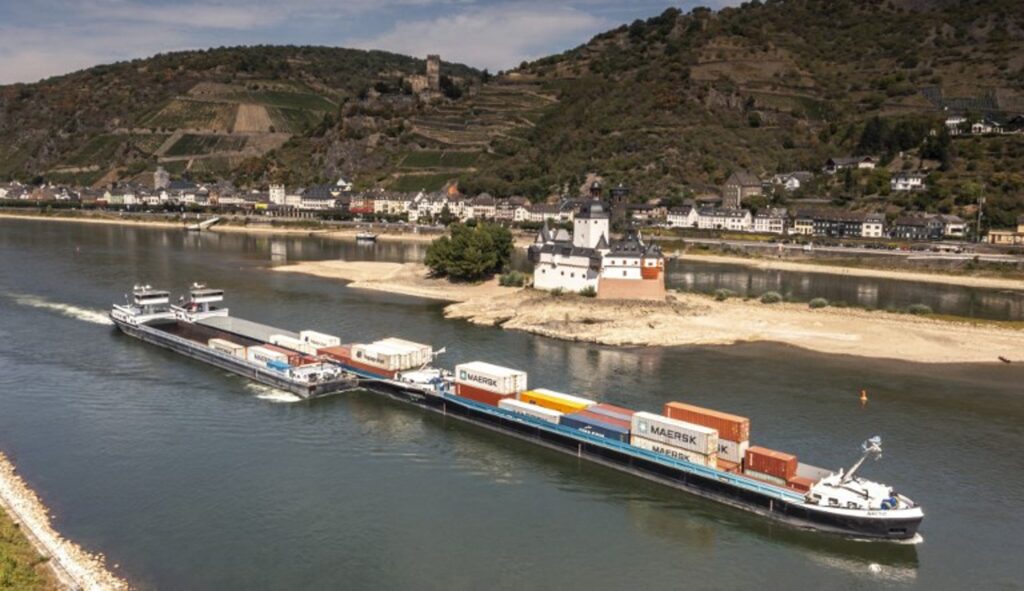
Exceptionally low water levels on the Rhine in Germany could halt inland shipping this week on a crucial stretch near Kaub, effectively splitting the river into two separate navigable sections.
The warning was issued on Monday by BDB, the German inland shipping federation.
BDB director Jens Schwanen told Rheinische Post that the water level at Kaub, a key bottleneck for Rhine shipping, is expected to fall below 10 centimetres for the first time because of a lack of rainfall. On Monday morning, the level there stood at 16 centimetres.
Kaub, south of Koblenz, is one of the shallowest parts of the Middle Rhine and a critical point for commercial traffic on the river.
Schwanen said commercial vessels would no longer be able to transport goods in the area if water levels fall that low. He said the same would apply to day-trip boats and river cruises.
“In practice, the Rhine would no longer be navigable along its full length and would therefore be split in two,” he said.
According to Schwanen, shipping would still be possible between Belgium, the Netherlands and Germany. However, from ports such as Antwerp, Amsterdam and Rotterdam, only the northern section of the German Rhine and western Germany’s canal network would remain accessible.
Further south, shipping would also still be possible on other waterways, including tributaries such as the Main and the Neckar, as well as on the Main-Danube Canal.
Low water levels have already been causing major disruption for some time, with vessels forced to reduce their cargo loads.
Since last weekend, several German states have therefore made the unusual decision to allow lorries onto the roads on Sundays. The move is intended to increase road transport capacity and help prevent supply chains from seizing up as inland shipping becomes more restricted.
