
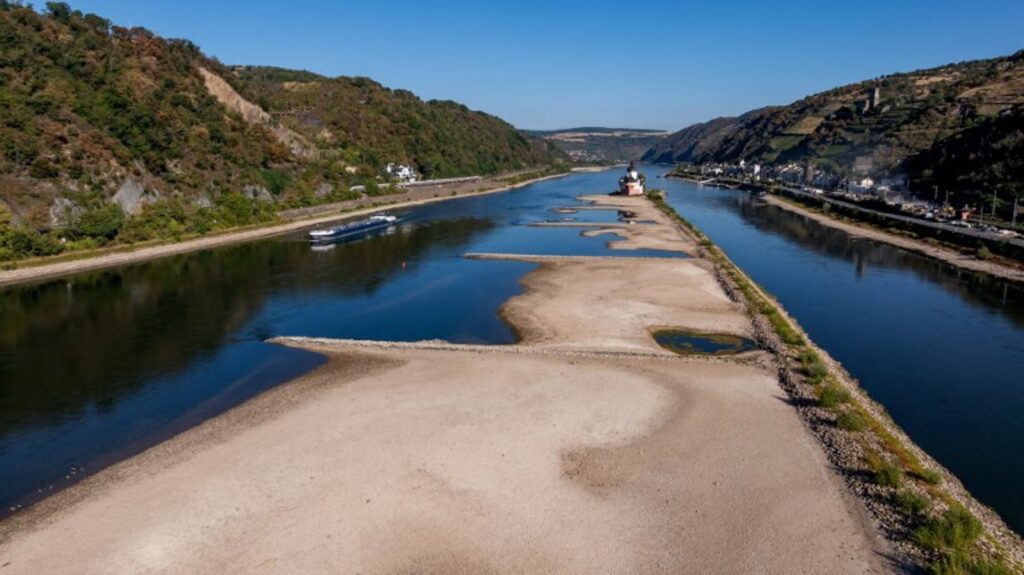
Water levels on the Rhine have fallen to exceptionally low levels again, breaking last month’s record low and raising the prospect of further disruption on one of Europe’s most important shipping routes.
The local branch of Germany’s waterways agency, WSA Rhein, said the river remains under severe pressure after months of drought and heat.
At Kaub, near Mainz in Rhineland-Palatinate, the water level dropped to 2 centimetres at the gauge station. That is 5 centimetres below the previous record set on 17 August.
A spokesperson said the situation remained tense. Kaub is a critical bottleneck on the Rhine and a key reference point for river traffic.
Record lows have also been approached or broken at several measuring stations in North Rhine-Westphalia in recent days.
In Düsseldorf, the water level was expected to fall below zero on Saturday, undercutting last month’s record of minus 1 centimetre. In Duisburg, the previous record low of 129 centimetres could also be surpassed.
In Cologne, the record low of 45 centimetres could be broken on Monday. However, water levels at different stations cannot be directly compared because they do not share a common zero point.
Low water levels have been affecting shipping on the Rhine for months. Cargo vessels have had to sail with reduced loads so they draw less water, limiting transport capacity.
The depth of the navigation channel remains restricted and is continuing to decrease as water levels fall, the spokesperson said.
Germany’s federal hydrology institute, BfG, said there was no improvement in sight for now. Rain forecast for the first week of October may bring only temporary relief.
