
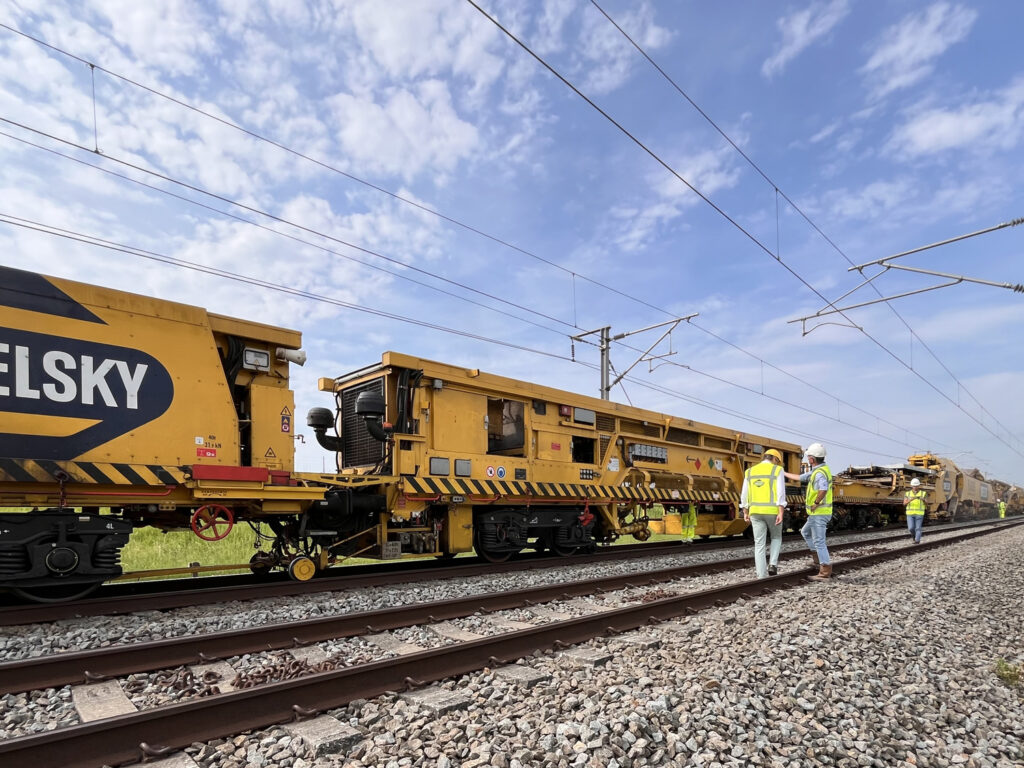
Following almost two weeks of track renewal works, the rail services on the high-speed line between Brussels and the French border are set to resume on Friday morning, according to a spokesperson for Infrabel, the Belgian rail infrastructure manager.
Before completely reopening, a final 24-hour inspection will ensure the safety of the upgraded section. If this final check verifies safety compliance, high-speed trains will regain their usual path via the LGV1 train line.
However, the TGV trains will not immediately reach speeds of 300 km/h. They must maintain a maximum speed of 170 km/h for a week to allow the ballast to settle. Train journeys may therefore take slightly longer during this initial resumption period.
This large-scale project was completed in around 18 days and nights and involved the round-the-clock mobilisation of 90 workers.
The improvements involved renewing one of the lines along a 17.6 kilometre stretch between Leuze-en-Hainaut and Brugelette.
Infrabel teams installed 35.2 kilometres of new rail tracks, roughly 30,000 new sleepers, and about 5,500 tonnes of ballast – the stone bed upon which the tracks are laid.
Further track renewal works on the 74-kilometre line from Hal to Esplechin are planned until 2035.
