
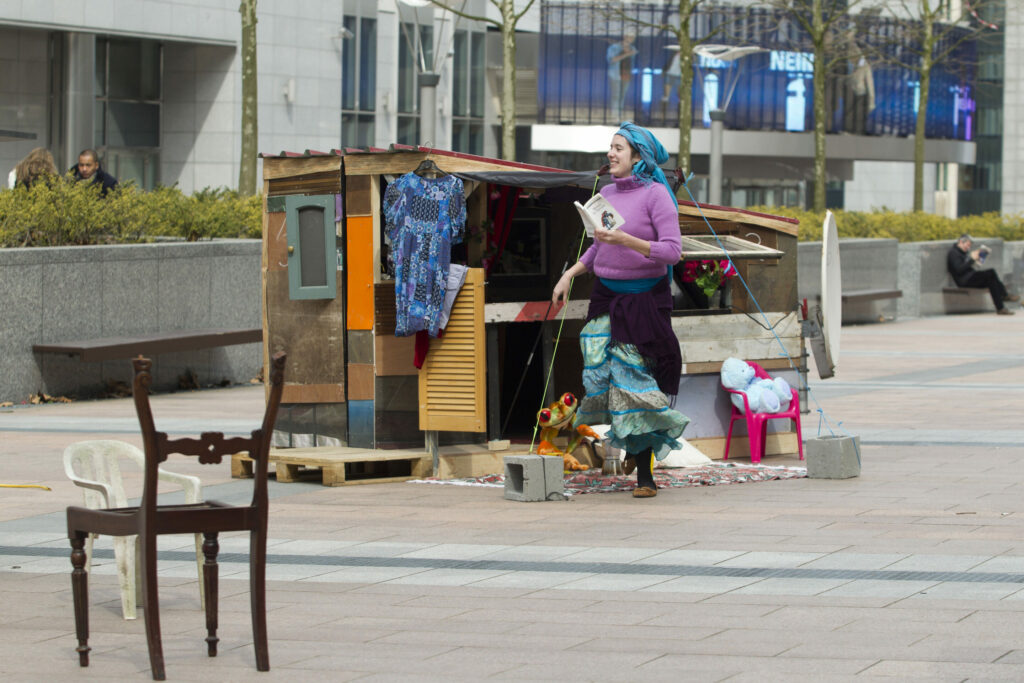
In Brussels, Roma begging is a highly visible yet widely misunderstood phenomenon. Many assume it is part of a criminal network, but experts and organisations working closely with the Roma community paint a different picture.
Studies suggest that while 70% of beggars in Brussels are of Roma origin, their situation is far from a well-organised scheme.On the other hand, Roma beggars create significant discomfort for city shop owners, who often have to deal with people sleeping in front of their storefronts.
Stef Adriaenssens, a researcher at KU Leuven who did several studies about Roma beggars in Brussels, explains that the public and the media often have fixed ideas about begging, despite limited data. While Roma begging has existed for decades, its dynamics have shifted. Two decades ago, most Roma beggars were women, sometimes with children. Today, more men are seen begging, often in small groups.
From housing to homelessness
"20 years ago, most Roma beggars in Brussels lived in poor but stable housing, mainly in neighbourhoods like Saint-Josse and Schaerbeek. They often shared homes within their extended families and, despite economic hardships, were not entirely homeless," explains Professor Adriaenssens. However, Romania's EU accession in 2007 changed migration patterns. "With easier and cheaper travel, more Roma began coming to Brussels for short stays, avoiding the cost of renting by sleeping on the streets instead," he adds. Today, we see a population of approximately 12,000 Roma in Brussels.
Today, the situation has worsened: many Roma beggars no longer seek housing, instead choosing to live on the streets for a few months before returning to Romania. A study** led by Adriaenssens and other researchers shows that those who beg where they sleep often continue begging non-stop while awake, as a way to avoid homelessness.
This study also highlights how Roma respondents have a different relationship with housing compared to other homeless populations. They often rent at lower prices, which may indicate poorer housing quality. However, they do not necessarily perceive their housing as overcrowded, possibly due to different reference points shaped by previous living conditions.
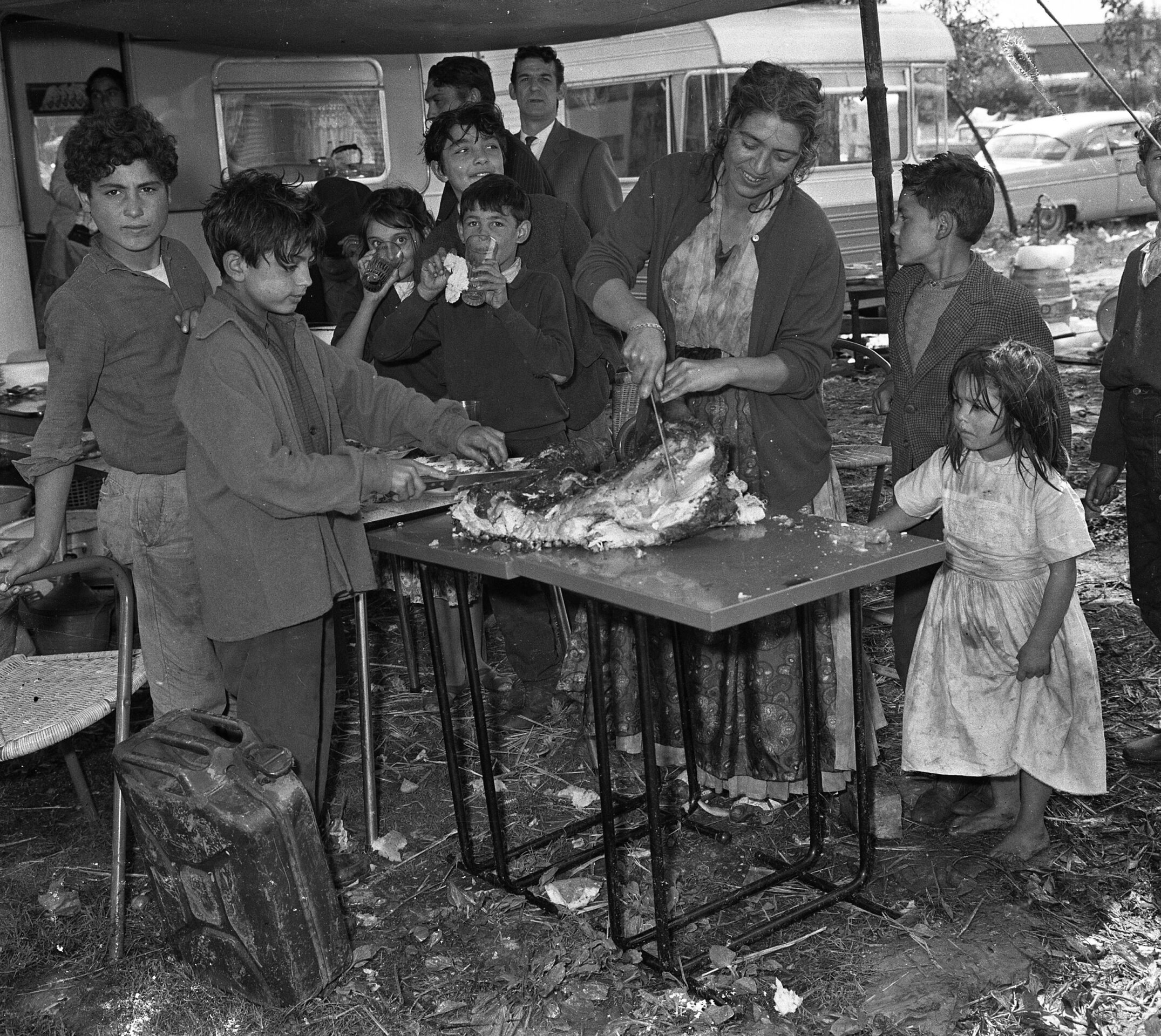
Romani people celebrating the French National Day on Thursday 14 July 1966. Credit: Belga Archives
The myth of organised begging
One of the most persistent stereotypes is that Roma begging is controlled by criminal networks. As Adriaenssens explains, in reality, there is no evidence of large-scale mafia-like operations. "Roma beggars tend to stick together because they come from the same regions – many from Bucharest, in Romania – and often belong to the same extended families," he explains.
While they coordinate informally to avoid trouble, such as warning each other if the police approach, there is no strict organisation dictating their actions. "Women usually do the begging, while men may collect money throughout the day to keep it safe or transport their wives to different locations," says Koen Geurts, head of the Roma department at Le Foyer.
Despite common misconceptions, their earnings from begging are low. Adriaenssens found in his study that Roma people who beg need social support and are not part of a criminal organisation. The research also showed that the high visibility of Roma beggars does not equate to higher earnings. In fact, the larger number of Roma beggars may actually reduce individual income, as more people compete for the same limited generosity from passersby.
A dangerous life on the streets
Begging is far from an easy way to make a living. Roma beggars frequently face harassment, violence, and theft – sometimes even from other beggars. Sleeping on the streets increases their vulnerability, and children living in these conditions are particularly at risk.
One of the most striking findings from academic research is the connection between begging and homelessness among Roma children. This exposure to life on the streets creates significant risks for children, both in terms of physical safety and barriers to education.
In response, Brussels authorities have introduced measures to protect Roma children. A law from the City of Brussels now prohibits begging with children under 16. While mothers can still bring their infants (as many refuse to be separated from breastfeeding babies), older children must be placed in daycare or sent to school. This regulation, which came into effect in 2022, was largely driven by concerns about child welfare. "Some people may be more likely to give a mother with a child, while others might withhold money due to negative perceptions," he explains.
The role of NGOs in the Roma community
Non-profit organisations such as Le Foyer play a crucial role in Roma integration, offering training, employment support, and mediation services. "We serve as a key support point for all individuals and institutions that interact with the Roma community, including schools, public services, and other organisations working with Roma people," explains Geurts.
The association provides language courses, vocational training, and individual guidance to help Roma families transition away from begging and towards stable employment in Belgium.
Education is a major focus of Le Foyer. Many Roma children do not attend school regularly due to high illiteracy rates and language barriers. In Belgium, adapting to French or Dutch education can be even more challenging. "We are actively involved in the education of Roma children. If a child is found on the streets, we intervene to ensure they are not involved in begging. We educate parents about Belgium's mandatory schooling laws and we help them to enrol their children in schools," Geurts explains.
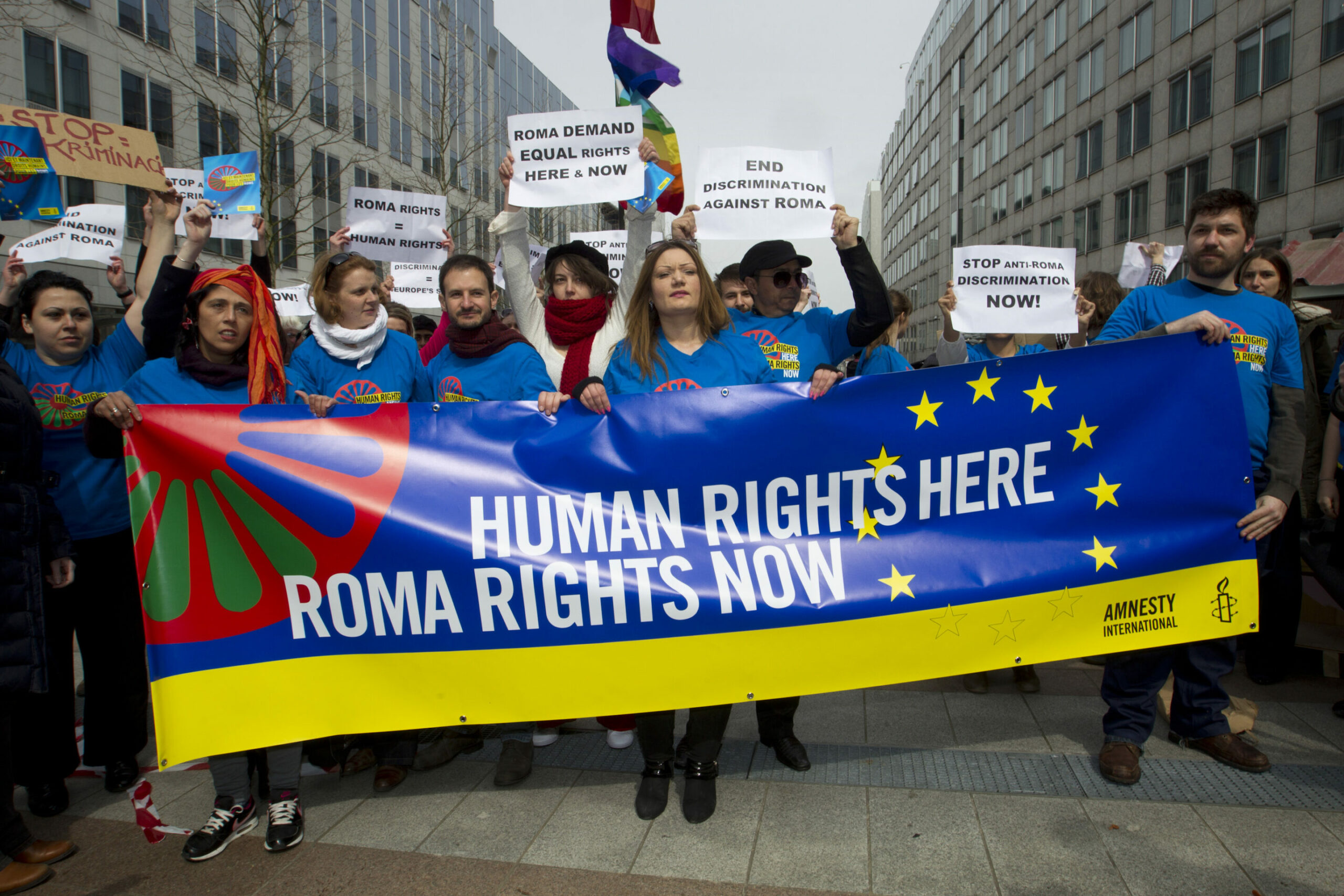
Activists of Amnesty International pictured during a protest of Amnesty International to protest against 'discrimination of the Romani People in Europe', Monday 8 April 2013 in Brussels. Credit: Belga / Kristof Van Accom
A path forward?
While some Roma beggars remain trapped in cycles of poverty, others have managed to improve their lives. "In some families, older women still beg because it is the only occupation they have ever known, while younger generations increasingly seek stable employment and send their children to school, leading to vastly different lifestyles," Geurts says.
Some Roma families even qualify for social assistance (CPAS) but continue to beg out of habit or necessity. However, such cases remain rare.
Still, Roma begging remains a contentious issue in Brussels, fuelled by persistent stereotypes and socio-economic inequalities. The challenge for policymakers and NGOs is to address the root causes – poverty, discrimination, and lack of education – rather than merely criminalising begging itself.
Commercial tensions
The concentration of street begging in central Brussels – particularly along Boulevard Anspach, De Brouckère, and Rue Neuve – poses a significant challenge for local businesses.
Quentin Huet, director of Shopera, an association representing shops from Rue Neuve to Bourse, openly expresses the frustration of local merchants. "Without Shopera, there wouldn't even be a regulation on child begging in Brussels," he says. "We've had to email every councillor ourselves to get this legislation."
According to Huet, business owners face daily challenges tied to street homelessness and begging, especially in front of their shops. "When you arrive as a salesperson on Rue Neuve early in the morning and see people who have just woken up, carrying their suitcases and crossing Rue Neuve, it doesn't give a feeling of safety," Huet says.
He claims that many thefts in the area are committed by undocumented individuals, including Roma who are involved in street begging. "We're dealing with this ourselves because the city is doing very little," he says, adding that despite existing rules, minors are still begging on the streets. "As long as there is no police presence in the streets, it won't stop."
Unlike other cities that ban begging near schools, shops, or banks, Brussels has no such legislation. "A person has the right to beg in front of a store in Brussels," Huet says. "Some of these people need help, and they should be supported. But others refuse help – and they can't be allowed to infringe on others' right to work in a safe environment."
Related News
- Who are the Brussels police helping the homeless?
- No alcohol or begging: STIB updates transport rules
- Ban on begging: 253 Belgian municipalities violate beggars' rights
Huet is advocating for change. "All we can do is report what's illegal, like child begging. But I keep pushing for the legislation to evolve." He believes that a clear distinction needs to be made between those who can be supported and those whose actions affect others. "Most Roma don't want help – they see this as a way of life. And they're only in Brussels for a few months, so they have no desire to integrate in our society."
For him, short-term settlement should not be tolerated. "It cannot be acceptable for people to come to Brussels for a few weeks and then leave, disrupting the social fabric in the meantime." His solution: a ban on begging near schools, tourist sites, and commercial areas.
For many Roma migrants, begging is not a choice but a survival strategy. As Brussels authorities continue to grapple with this complex issue, the focus must remain on long-term solutions: education, employment opportunities, and greater social inclusion.
**Adriaenssens, S., & Hendrickx, J. (2011). Street level informal economic activities: estimating the yield of begging in Brussels. Urban Studies, 48(1), 23-40.
