
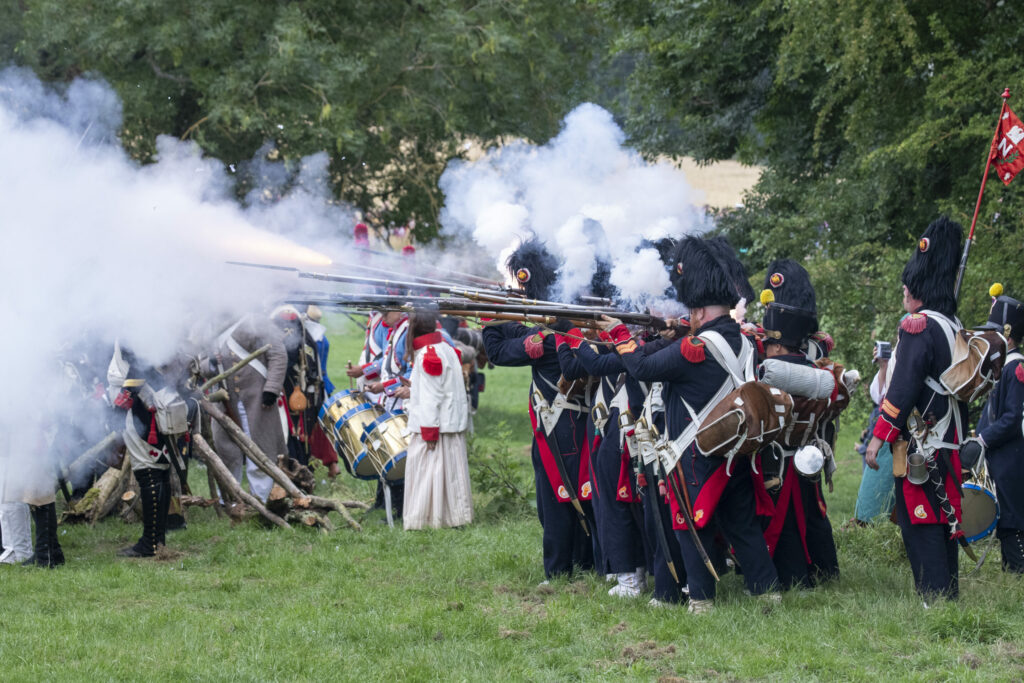
In Wallonia, a two-century-long battle still rumbles on. Smoke still fills the air, and cannon fire, rifles and cavalry charges still drown out the calmness of the Walloon countryside. Waterloo, the pivotal battle in the Napoleonic Wars, will be remembered once again as part of an annual re-enactment which draws thousands of visitors each year.
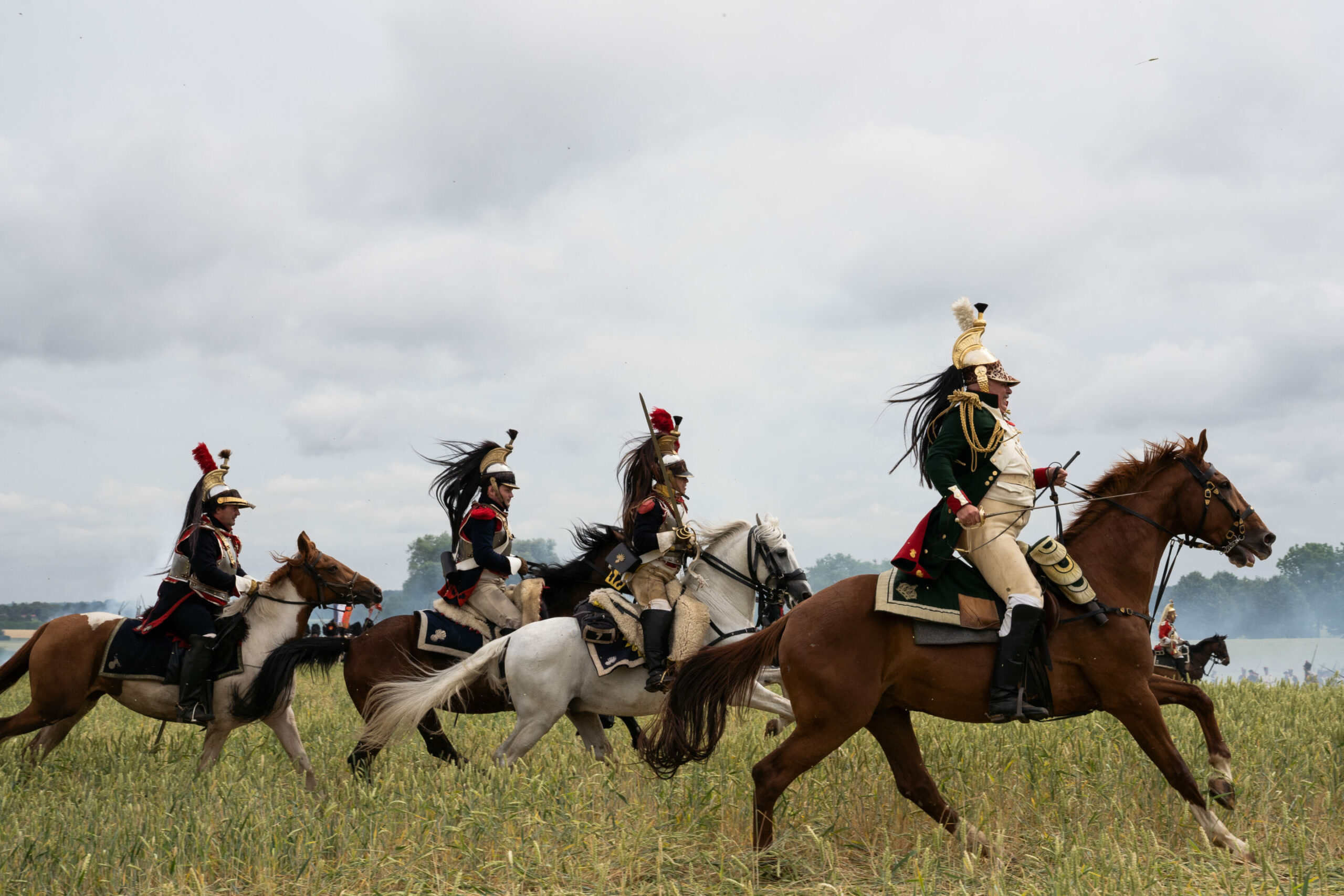
On 28–29 June, 2,000 military re-enactors, 100 horses and 25 cannons will bring Waterloo back to life in a spectacular event, commemorating the battle which saw Britain and the armies of the Seventh Coalition defeat Napoleon soundly, abdicating just four days later and returning to exile.
For the dedicated community of re-enactors, the annual Battle of Waterloo event is a crucial date on the historical re-enactment calendar. Enthusiasts, equipped with realistic uniforms and black-powder rifles, travel from all across Europe to take part in the event, even if that means falling dead and lying silently in a field.
Europe at war
After returning from exile on Elba and regaining power in France during the “Hundred Days,” French 'Emperor' Napoleon Bonaparte sought to defeat the allied armies of the Seventh Coalition before they could fully unite. He quickly toppled the restored Bourbon government and re-established the First French Empire.
In response, the mostly British, Dutch and Prussian armies rallied to prevent his return to dominance on the continent, clashing with his forces in modern-day Belgium.
The Battle of Waterloo, fought on 18 June 1815, was a decisive and bloody confrontation which concluded more than two decades of war in Europe, ushering in a new era of relative stability on the European continent.
The British-led forces, under the Duke of Wellington, held their ground on a ridge near the village of Waterloo. As the day wore on, they were joined by the Prussian army under Gebhard von Blücher, tipping the balance against the French. By evening, Napoleon’s forces were in retreat. Four days later, he abdicated for the second and final time, ushering in a period of relative peace across Europe.
Credit: Belga/ Nicolas Maeterlinck
The Battle of Waterloo was a truly international affair, with a European coalition uniting to oppose the First French Empire’s expansionist plans, and its contemporary re-enactment reflects this. The battlefield itself remains one of the most visited military heritage sites on the continent, with Belgium preserving numerous memorials and farmsteads that played a significant role in the events of the day.
Germans travel to Belgium to play the role of the Prussian, Hanoverian, Nassauer and Brunswicker forces, who numbered some 70,000 men at the time of the real battle. Similarly, large contingents of British and Dutch travel to Belgium to play the role of Wellington’s army, which totalled 48,000 men at the time, not including the Germans. In 1815, the Coalition troops faced Napoleon’s Imperial forces, which comprised roughly 72,000 men.
Yet for many of those gathered this weekend in period dress, muskets in hand, the pull of Waterloo is not simply the scale or legacy of the battle, but something more personal.
Remembrance and education
Lisa Stanhope, president of the UK Napoleonic Association and a former British police officer, has returned to Waterloo year-on-year with one of the biggest delegations of British historical re-enactors.
“Everybody is drawn to it for many, many different reasons,” she said. “Either family regimental history, interest in a regiment because of geography, or sometimes because people have done a history degree and stumbled across a regiment in a memorial in a church or a book and thought, ‘God, that’s really interesting.’ It's the personal stories that are interesting.”
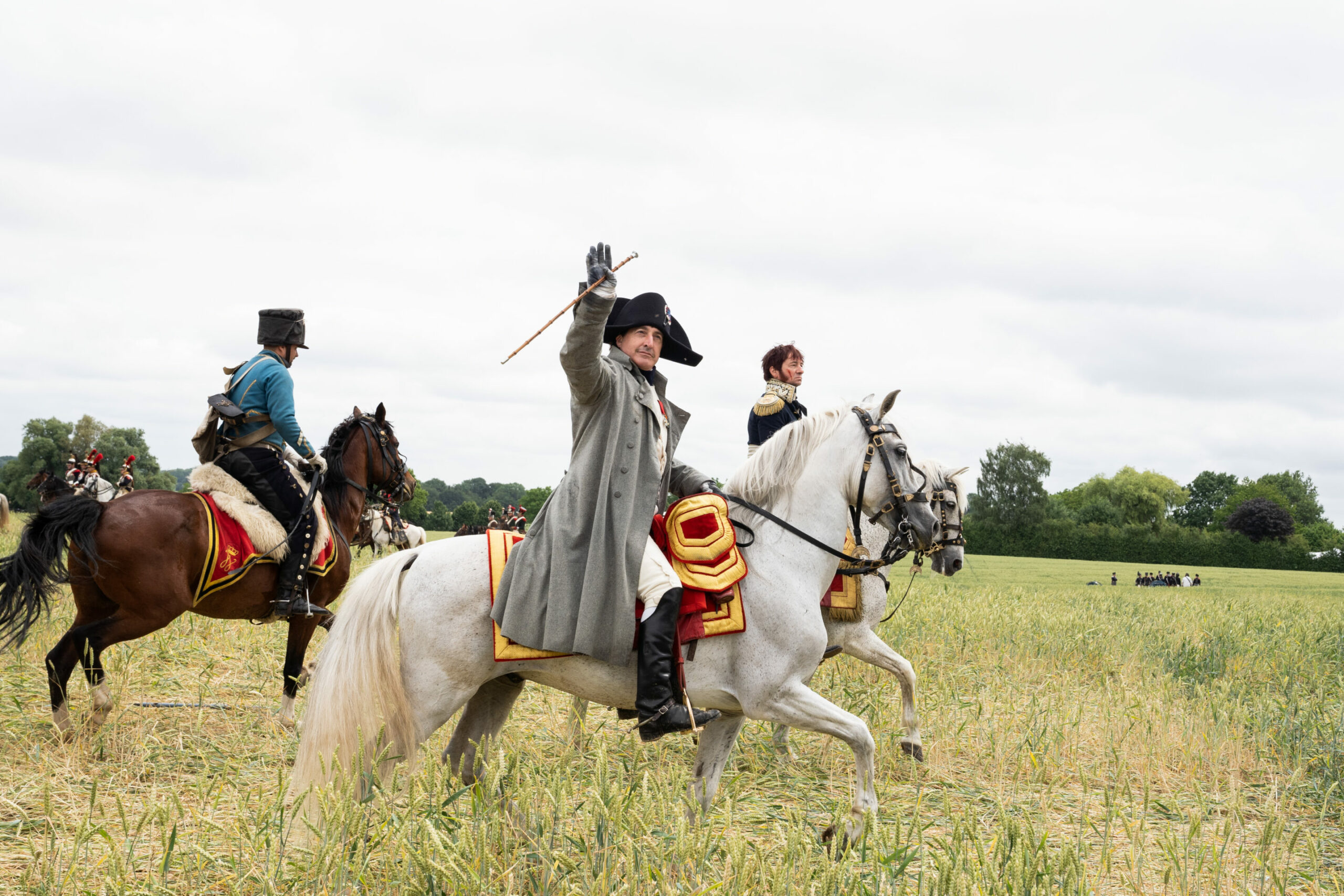
The British re-enactors will be found on both sides of the battlefield this weekend. The event draws enthusiasts from across the world. Some Spanish play the role of redcoats, while Brits portray the French, and there are even Maltese Highlanders. Stanhope’s Napoleonic Association is just one of the dozens of re-enacting bodies that make up the troops on the Walloon frontline, with similar organisations existing in Belgium and across Europe.
Credit: Belga/ Nicolas Maeterlinck
Far from romanticising war, she stressed that the motivation isn’t about glorification, but education and respect. “It’s about being interested in the weapons, how they were maintained, how they were carried, how people’s lives were so changed when they joined the British Army,” she said. “They understand how the British Army recruited, how it was quite a good option for people during those periods when poverty was just horrendous.”
"That was a pull for people to be employed, to be given a regular wage, a bed to sleep in, and be able to send some money home,” she added. “That social history is really important to people.”
Women, too, play a growing role in re-enactments, and the enthusiasts try to give greater representation to the women who were present at Waterloo. “We have quite a lot of women now who get involved in re-enactment because of camp followers,” she explained. “People go, ‘Why would you re-enact being a woman with no rights and no social standing?’ Well, because you need to know where you came from to be able to know how lucky you are and how far forward we’ve come.”
Immersion
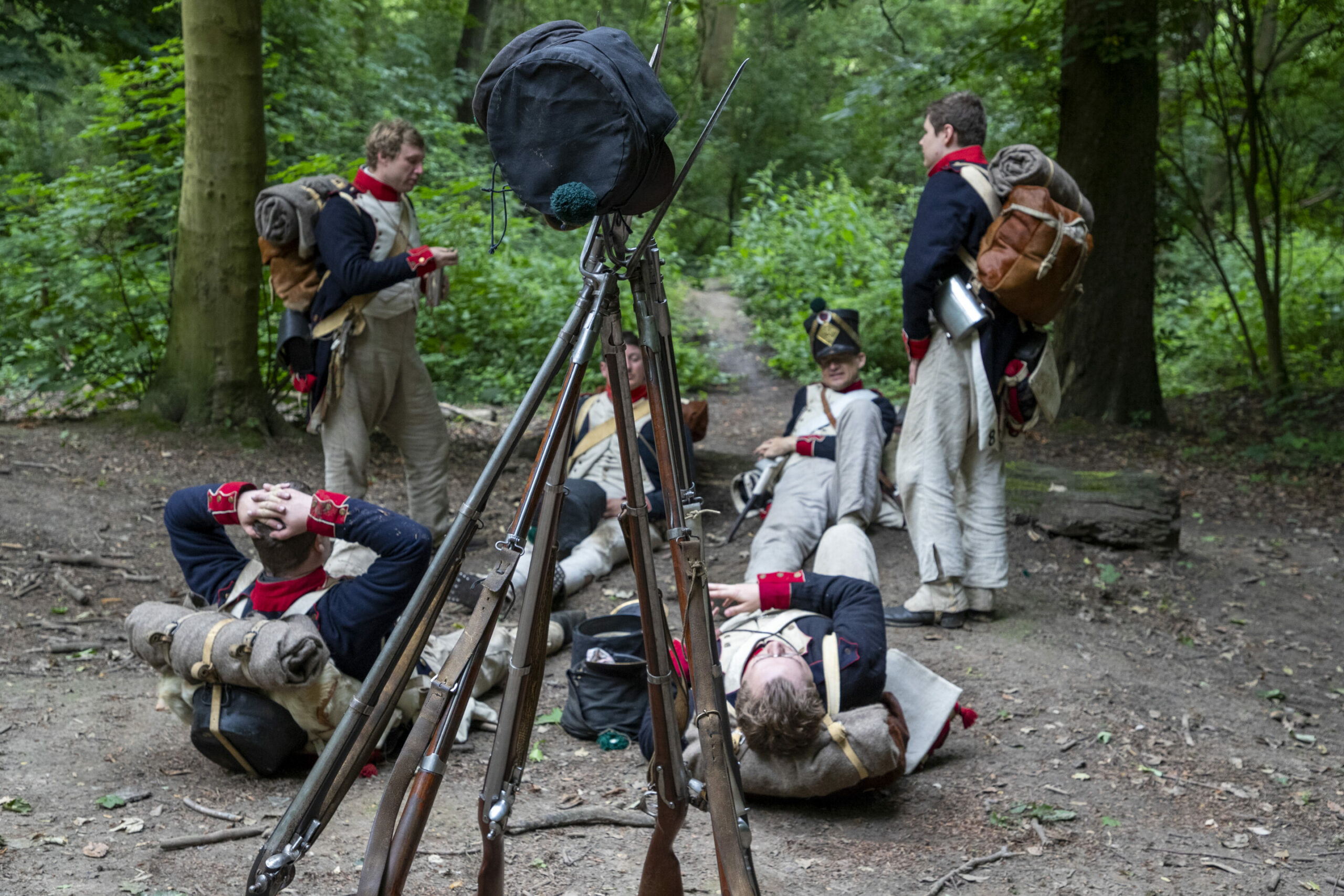
The simulation of Napoleonic life starts long before the battle. Arriving several days in advance, the re-enactors form bivouacs and live as Wellington and Napoleon’s troops would have done. Napoleon famously set up camp near La Belle Alliance farmhouse, while Wellington’s troops bivouacked along the ridge just south of the village of Waterloo.
Stanhope described the daily routine as fully immersive: “They change into their kit. They light their fire, get their cooking pots on. They cook and have some beer. They clean their kit sometimes, just socially sit around chatting, making sure that everything is in working order, that all the buttons are on," she explained. All modern items, including plastic products, mobile phones, and digital watches, are hidden from view once the public arrives. “We expect everything to be as it should be: no modern things on display,” she said.
Credit: Belga/ Nicolas Maeterlinck
Re-enacting is a serious passion, but also a costly one. “You have to source your own kit: uniform, musket, tent, cooking gear,” she said. “You can only travel with what you own because post-Brexit, you’ve got to be able to show you’re not importing or exporting goods.”
Horses, too, have become increasingly difficult to manage. “In 2015, I brought my horse here and it cost me £900. Now it’s nearly £2,000,” she said. “So we’re hiring from a stables in the Netherlands this year. The vetting process here is absolutely second to none, the welfare of the animal is paramount. If the horse isn’t quite right, hasn’t got the right vaccinations, they will say no. Even if you’ve paid.”
The battle is a massive feat of logistics, with the Belgian and Dutch organisers coordinating the arrival of dozens of convoys of vehicles, horses, weaponry and participants. “People do it because they absolutely love it,” she said. “It’s a bit like when you get together with your like-minded friends and you memorialise the sacrifice of these people.”
“Some people arrive with a single car, a small fire pit and a musket. Others turn up with transit vans, four big tents, flags, cooking pots, and a whole kitchen. But everyone’s doing it for the same reason—they love it, they believe in it.”
Related News
- Cannons ready as Waterloo re-enactment returns next weekend
- Ligny takes a trip back to 1815 for a weekend
Even the battles themselves are rehearsed, ensuring accuracy and safety. With so many swords and sparks flying, proper coordination is paramount. “Commanders have already got together on Zoom before this. They’ve already had lots of meetings. They try to keep the scenario as close to the historical thread as possible, including the Prussians coming on later,” she said. “That causes some issues, because people have spent a lot of money, they’ve had time off work, they don’t want to wait for an hour. But they try.”
Credit: Belga/ Nicolas Maeterlinck
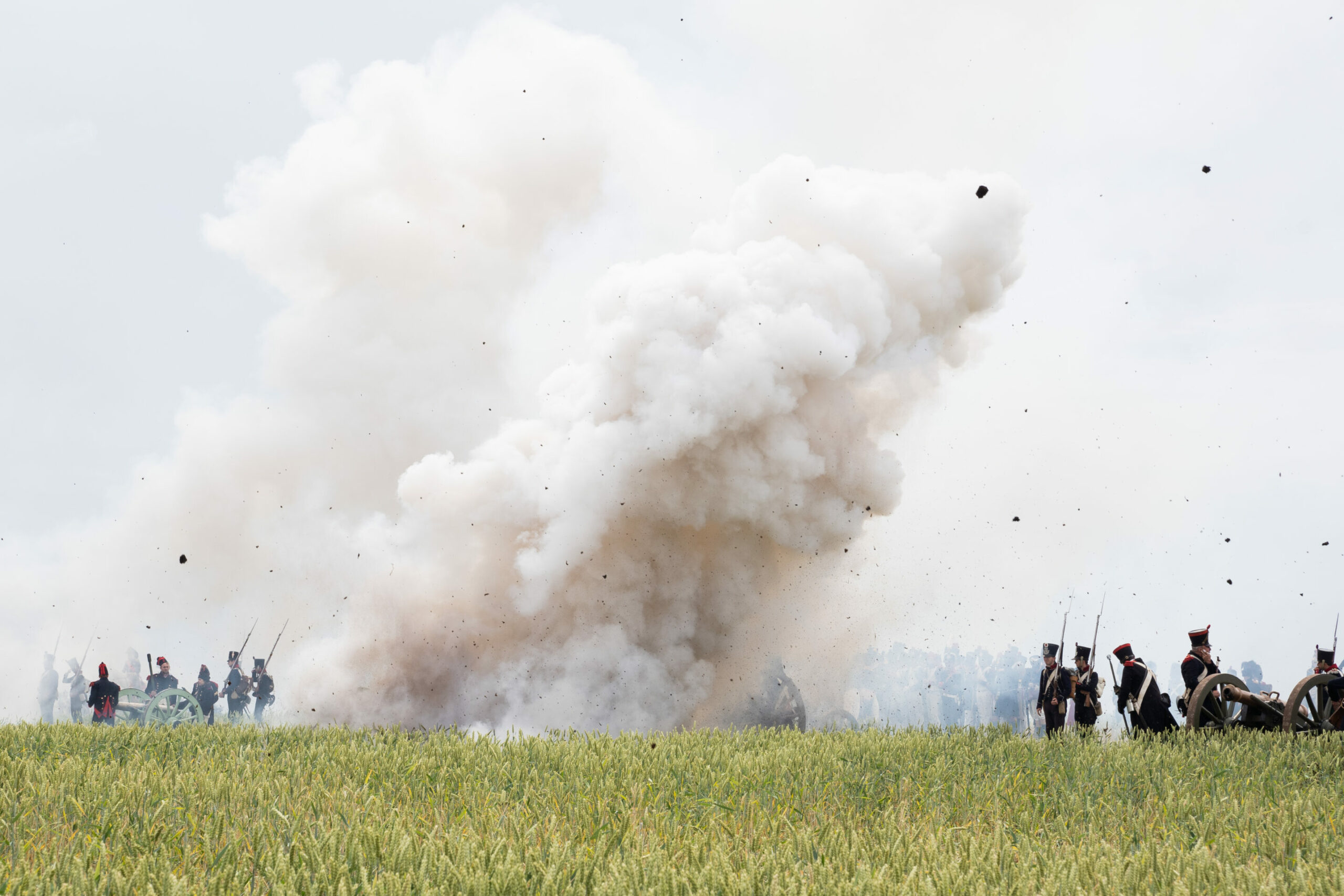
The explosions spectators see at the dramatic reenactment are all real. The enthusiasts blast real gunpowder through their muskets. Cannons pound loud and bright charges through their barrels, and explosions rip up from underneath the grass as planted charges replicate the impact of cannonballs. “The only thing we don’t do is put the ball down the barrel of the musket,” she explained. “Everything else is absolutely real.”
Overheating, not gunfire, is often the greater danger. “The uniforms are exceptionally hot,” Stanhope said. “People drop ‘dead’ because they run out of water or have run out of ammunition.” Suncream, paracetamol and glucose tablets are as crucial as gunpowder.
While the giant battle is a spectacle that draws large crowds, the organisers and Stanhope’s Napoleonic society are eager to show that the spirit of commemoration remains central. “There’s a wreath-laying ceremony on Saturday, and it's no different from Poppy Day, just older,” she said. “The Belgians have looked after the memorials brilliantly. This isn’t just a show. It’s a memorial, a way to honour that sacrifice.”
