
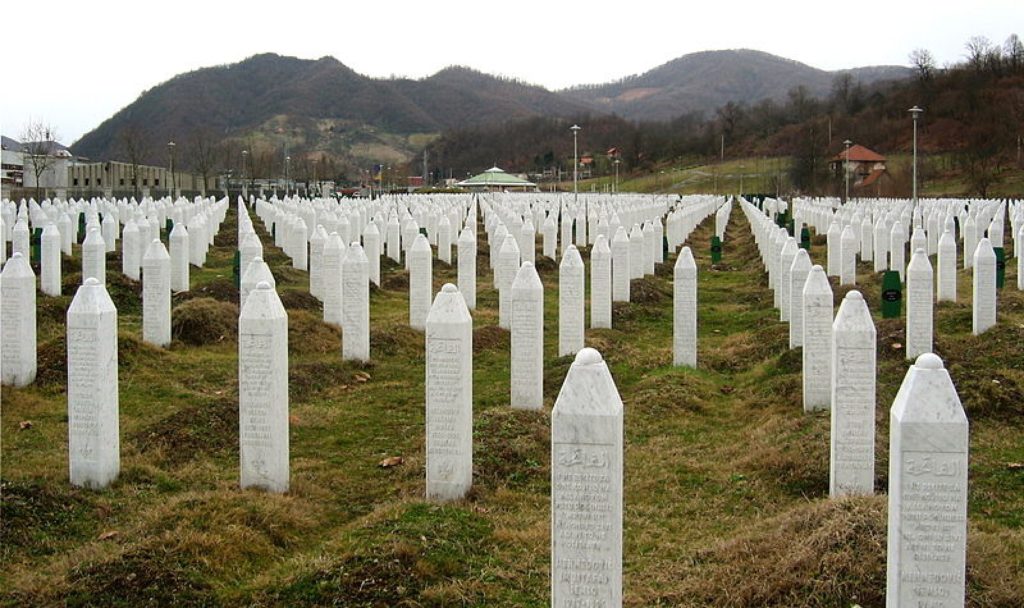
This week marks 30 years since the start of the genocide in Srebrenica. On 11th July 1995, Bosnian-Serb forces, led by General Ratko Mladić, launched an assault on the former mining town in eastern Bosnia.Over the following days, the town’s male population was virtually wiped out.
Between 13th and 16th July 1995, more than 8,000 Bosnian-Muslim men and boys were murdered in mass executions – the likes of which had not been seen in Europe since the second world war. During the round-ups, thousands of women and girls were deported, and many were raped.
The genocide took place during the Bosnian civil war, which started in 1992 and ended in 1995, one of several conflicts in the region triggered by the collapse of Yugoslavia.
The Bosnian Orthodox Serbs rejected the declaration of independence of Bosnia and Herzegovina, leading to a war with the Croat Catholics and the Bosnian Muslims – also known as Bosniaks. During the Bosnian Civil War, approximately 100,000 people died.
At the time of the genocide, Srebrenica was part of a UN enclave, having been declared a safe zone in April 1995. Many of the people seeking shelter in the safe zone were survivors of previous mass killings in north-eastern Bosnia. Around 40,000 Bosniaks were in Srebrenica at the time of the genocide.
The enclave was under the protection of 370 Dutch peacekeepers. However, the soldiers, who were lightly armed, gave up their outposts during the Serbian offensive.
'People were like us, they dressed like us, they listened to the same music as us'
RTBF journalist Françoise Wallemacq was in Bosnia-Herzegovina in July 1995, staying in the town of Tuzla, some 100 km from the enclave. In a recent interview with Belga, Wallemacq said: "We hadn't imagined it, and when we heard it, we didn't really believe it.”
"When we heard that an assault was being prepared in the enclave of Srebrenica, that it was really in danger, we said to ourselves that we had to leave. But there was no way of getting close by."
“A few days after the fall of the enclave, we began to see people arriving from there, on foot. They had been walking for days and days. Women, children and the elderly were arriving by the busload. In fact, it was practically all women and children. We wondered where the men were. It was very strange," she recalled.
For Wallemacq, the Bosnian war was special because of its proximity to Belgium. "It happened in Europe, 2,000 km from home, and you could drive there. People were like us, they dressed like us, they listened to the same music as us."
The war, and the Srebrenica massacre in particular, “were a lesson for Europe”, she believes. “It was judged, there was a trial, which took a long time, and a declaration of genocide.”
The International Criminal Tribunal for the former Yugoslavia and the International Court of Justice have declared the crimes carried out at Srebrenica to be acts of genocide.
In May 2024, the United Nations General Assembly designated July 11 as the International Day of Reflection and Commemoration of the genocide committed at Srebrenica in 1995.
In his message published ahead of the 30th anniversary of the Srebrenica Genocide, the Council of Europe Commissioner for Human Rights, Michael O’Flaherty, stressed the importance of honouring the victims to prevent human rights violations in the future.
“I was in Bosnia and Herzegovina 30 years ago. I vividly recall the fall of each of the safe areas, with horrific consequences for those who lived there. We remember the genocide at Srebrenica on this 30th anniversary,” he said.
“We recall and we honour the over 8,000 men and boys who were massacred at Srebrenica. We honour them through memorialisation. We determine never again to see such an atrocity perpetrated on the soil of our continent.”
