
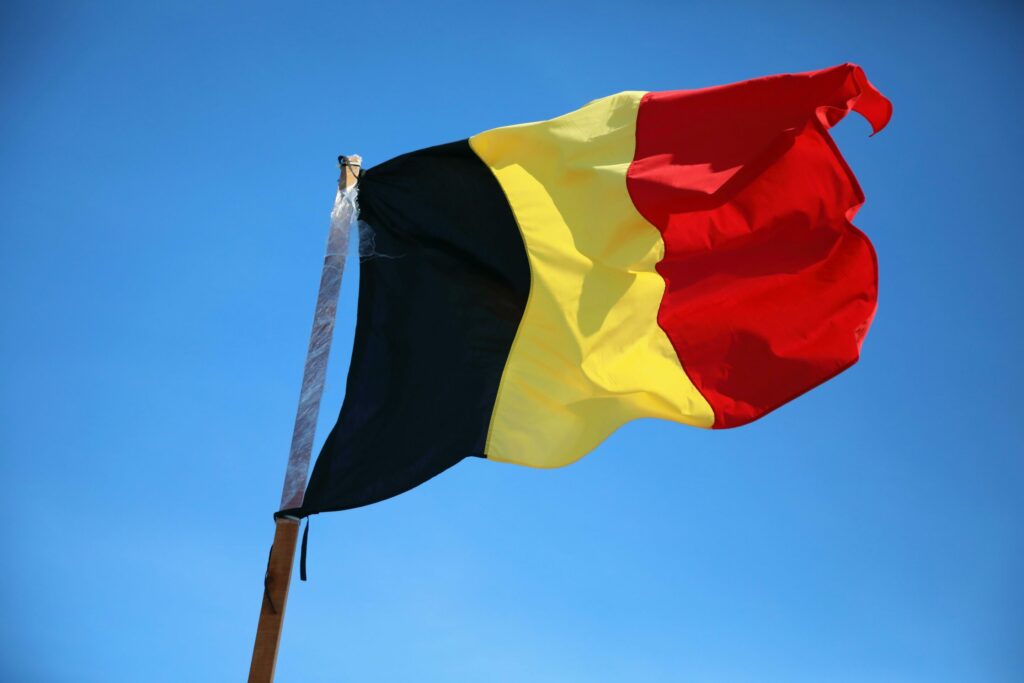
Back in the day, schoolchildren in Flanders used to be taught a little ditty to remember the colours of the Belgian national flag:
Rood, geel en zwart zijn de Belgische kleuren/rood, geel en zwart is de Belgische vlag (red, yellow and black are the Belgian colours/red, yellow and black is the Belgian flag).
Today, the tricolour is so ubiquitous in Belgium that children probably don’t need to be reminded of the colours. Anytime the Red Devils play in a tournament, Brussels is awash with Belgian flags, and children proudly line up to have their faces painted black, yellow and red.
But where do the colours come from, and how did the flag we know and love come to exist?
A revolutionary symbol
The story begins in the late 18th century, before the existence of the Belgian state.
A tricolour flag bearing the colours red, black and yellow first appeared during the Brabant Revolution of 1789 to 1790.
The revolution led to the brief overthrow of Habsburg rule in what was then known as the Austrian Netherlands, leading to the proclamation of the United Belgian States.
A flag was created for the short-lived polity, its colours inspired by the coat of arms of the Duchy of Brabant, which showed a golden (yellow) lion with gules (red) claws and tongue, set against a sable (black) background. The colours of the flag were arranged horizontally, with a red stripe at the top, a yellow stripe at the bottom and black in the middle.
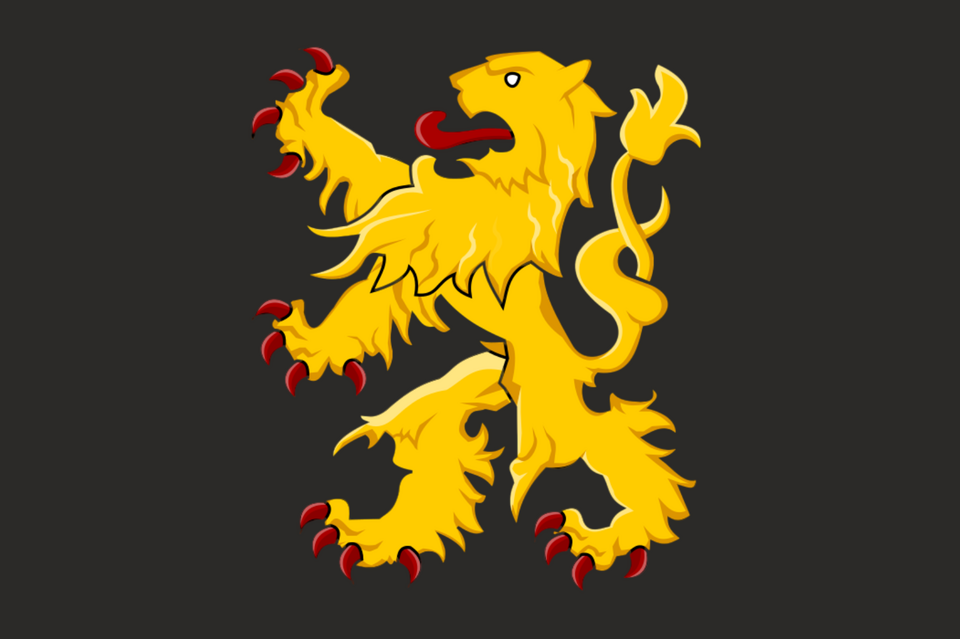
Flag of the Duchy of Brabant (1183 – 1795). Credit: Wikicommons.
During the revolution of August 1830, which led to the creation of an independent Belgium, the red, white and blue French tricolour was initially flown. But the day after the revolution, journalist Édouard Ducpétiaux decided Belgians needed their own unique flag to rally behind.
He knew of a shop near the Grand Place where a seamstress named Marie Abts-Ermens plied her trade. Ducpétiaux went to the shop and asked Abt-Ermans to make a flag in three colours – red, yellow and black – arranged horizontally, like the flag of the United Belgian States.
At the corner of Marché aux Herbes and Rue de la Colline you can find a plaque commemorating this important moment in Belgian history.
On 30 September 1830, the provisional government officially adopted the national flag, maintaining the horizontal arrangement of colours.
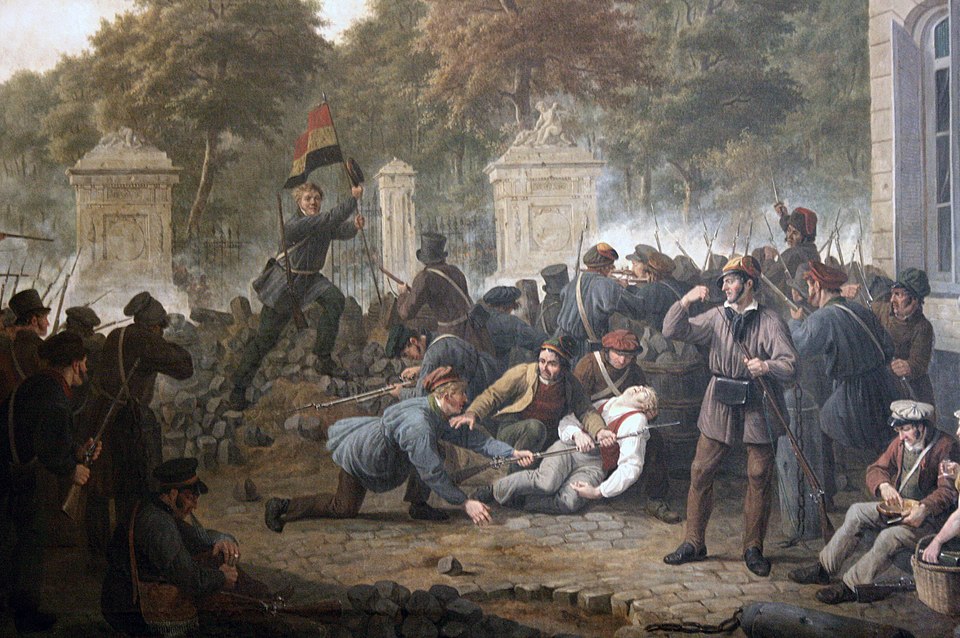
'Attaque du parc de Bruxelles' by Constantinus Fidelio Coene showing fighting between Belgian rebels and Dutch forces in 1830. A horizontal Belgian tricolour is visible in the background. Credit: Wikicommons.
The colours of the flag were subsequently written into the Belgian constitution. Article 193 of the constitution sets out the colours of the national flag, as well as Belgium's coat of arms and its national motto: "The Belgian nation adopts red, yellow and black colours, and as arms of the kingdom the Lion of Belgium with the motto: Union is Strength."
In January 1831, a new design was introduced, and the flag’s stripes became vertical. Some say this was to ensure the flag didn’t look too much like the flag of the Netherlands. In October that year, the black was moved to the hoist side of the flag, and the flag attained its modern form.
That the country’s flag as we know it today does not respect the order of colours set out in the constitution is one of Belgium’s many quirks – and perhaps an early example of 'Belgitude' coming to the fore.
